ART WIKI32.963 en sala
MapaColecciónArtistasMuseosExposicionesRevista
Acceder

ART WIKI

Dónde cuelga la obra maestra y cuándo le dejan pasar.

Colecciones: Galería Nacional de Arte, Galería Nacional de Dinamarca, Galería Nacional de Retratos, Galería Tretiakov, Harvard Art Museums, Instituto de Arte de Chicago, Instituto de Artes de Mineápolis, MoMA, Museo de Arte de Cleveland, Museo de Victoria y Alberto, Museo del Hermitage, Museo del Louvre, Museo Estatal Ruso, Museo Hirshhorn y Jardín de Esculturas, Museo J. Paul Getty, Museo Metropolitano de Arte, Museo Pushkin, Museo Smithsoniano de Arte Americano, Museo Whitney de Arte Estadounidense, National Museum of Asian Art, Rijksmuseum, Villa Getty, Catálogo Estatal del Fondo Museístico de Rusia (274 museos), Europeana (19 museos), Wikidata (6 museos), Paris Musées (12 museos) y Joconde, la base de museos del Ministerio de Cultura de Francia (495 museos). Las imágenes pertenecen a sus titulares de derechos.

Secciones

  • Mapa
  • Búsqueda
  • Colección
  • Obras maestras
  • Expuestas ahora
  • Artistas

Más

  • Museos y galerías
  • Exposiciones
  • Revista
  • De dónde salen los datos
  • Privacidad y cookies
InicioMapaCatálogo
  1. Colección/
  2. Rijksmuseum/
  3. Nemesis
Nemesis, Albrecht Dürer, 1499 - 1503
Albrecht Dürer, retratoAlbrecht DürerAlemania, 1471–1528

Nemesis

1499 - 1503 · Print

¿Se puede contemplar?

Se desconoce

Rijksmuseum

Amsterdam, Países Bajos

Se conoce el propietario; no se sabe si hoy está expuesta.

Fuente
El museo
En el mapaPágina del museo

Sobre la obra

En palabras del museo — en neerlandés

Een gevleugelde vrouw met een beker in de ene hand en een breidel in de andere hand, staande op een bol, zwevend boven een rivierdal met een dorp.

Rijksmuseum

Ficha

1499 - 1503
14711528
Número de inventario
RP-P-OB-1240

Lo que muestra

Nemesis (Adrastea)Luck, Fortune, LotFato', 'Fortuna', 'Fortuna aurea', 'Fortuna buona', 'Fortuna pacifica overo clemente', 'Sorte' (Ripa)

En el catálogo

EstampasRenacimientoSiglo XV

Fuentes

  • Rijksmuseum
  • Imagen: Rijksmuseum — public domain

Mientras tanto, en la vida de Albrecht Dürer

La vida entera
  1. 1500

    Jacopo de' Barbari and the secret of proportion

    The Venetian Jacopo de' Barbari, whom Dürer had met in Venice, came to Nuremberg, and Dürer said he learned much from him about perspective, anatomy and proportion. Feeling that de' Barbari would not explain everything he knew, Dürer began studies of his own that became a lifelong preoccupation.

  2. 1501–1502

    In the circle of Nuremberg's humanists

    Through his lifelong friend Willibald Pirckheimer, Dürer entered the circle of Nuremberg's humanists. He engraved illustrations for Conrad Celtis's editions of Hrotsvitha (1501) and of his Four Books of Love (1502), and decorated 14 books in Pirckheimer's library with drawings.

  3. 1502

    Death of his father

    Albrecht Dürer the Elder died, and his son took on the care of his mother and his two younger brothers, Endres and Hans.

  4. 1504 · Lugar de trabajo

    Lutherstadt Wittenberg

  5. 1505

    Second journey to Italy

    Dürer set off for Italy again — perhaps not only to earn money but also to stop Marcantonio Raimondi from copying his prints. His stay in Venice is known from ten surviving letters to Pirckheimer.

  6. 1505–1507

    To Bologna for the secrets of perspective

    Dürer travelled to the university city of Bologna, hoping to learn the secrets of geometric perspective from its scholars. He then meant to visit Mantegna in Padua but received news of his death, which he greatly regretted afterwards.
Más obras de Albrecht Dürer

Todas las obras
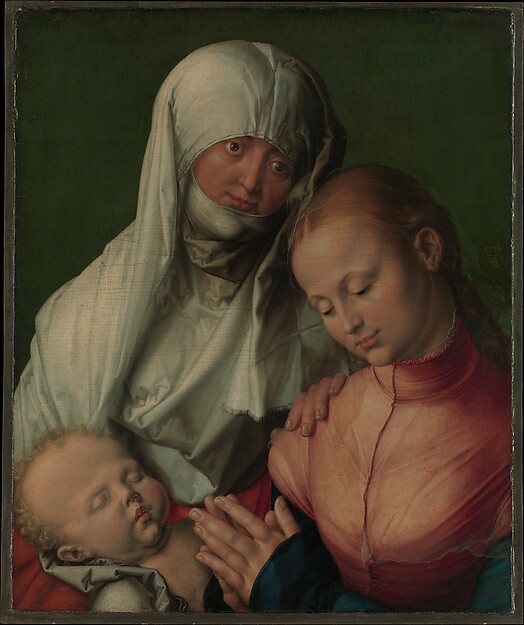
Virgin and Child with Saint Anne, Albrecht Dürer, probably 1519

Virgin and Child with Saint Anne

probably 1519 · Museo Metropolitano de Arte

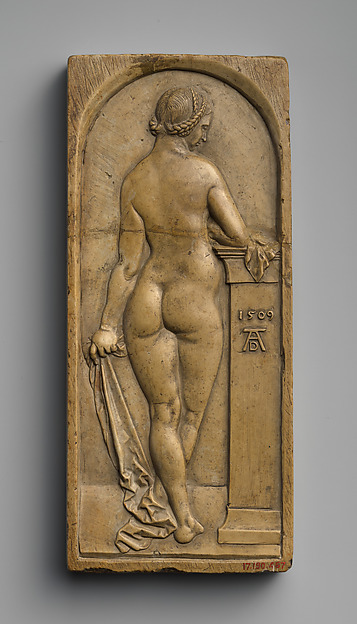
Female Nude Seen from Behind, Albrecht Dürer, early 17th century

Female Nude Seen from Behind

early 17th century · Museo Metropolitano de Arte

Madonna and Child [obverse], Albrecht Dürer, c. 1496/1499

La Virgen con el Niño.

c. 1496/1499 · Galería Nacional de Arte

Lot and His Daughters [reverse], Albrecht Dürer, c. 1496/1499

Lot and His Daughters [reverse]

c. 1496/1499 · Galería Nacional de Arte

The Martyrdom of Saint Catherine, Albrecht Dürer, ca. 1498

The Martyrdom of Saint Catherine

ca. 1498 · Museo Metropolitano de Arte

Nemesis (The Great Fortune), Albrecht Dürer, c. 1501/1502

Nemesis (The Great Fortune)

c. 1501/1502 · Museo de Arte de Cleveland

Large Horse, Albrecht Dürer, 1505

Large Horse

1505 · Museo de Arte de Cleveland

The Lamentation, Albrecht Dürer, 1507

The Lamentation

1507 · Museo de Arte de Cleveland

Bajo el mismo techo: Rijksmuseum

Página del museo
Self-portrait, Vincent van Gogh, 1887

Vincent van Gogh

Self-portrait, 1887

La Corniche near Monaco, Claude Monet, 1884

Claude Monet

La Corniche bij Monaco, 1884

De Nachtwacht, Rembrandt van Rijn, 1642

Rembrandt van Rijn

La ronda de noche, 1642

Portrait of a Woman, Probably Maria Trip (1619-1683), Rembrandt van Rijn, 1639

Rembrandt van Rijn

Retrato de Maria Trip, 1639

Still Life with Peacocks, Rembrandt van Rijn, c. 1639

Rembrandt van Rijn

Still Life with Peacocks, c. 1639

Landscape with a Stone Bridge, Rembrandt van Rijn, c. 1638

Rembrandt van Rijn

El puente de piedra, c. 1638

Man in Oriental Dress, Rembrandt van Rijn, 1635

Rembrandt van Rijn

Man in Oriental Dress, 1635

Portrait of Haesje Jacobsdr van Cleyburg, Rembrandt van Rijn, 1634

Rembrandt van Rijn

Portrait of Haesje Jacobsdr van Cleyburg, 1634