Gustave CourbetFrancia, 1819–1877
Mère Grégoire
¿Se puede contemplar?
Sí, recibe visitas

Instituto de Arte de Chicago
Sala222Chicago, Estados Unidos
Expuesta al público. Quién lo avala figura más abajo.
- Comprobado
- En este estado desde
- Fuente
- El museo
Sobre el cuadro
As the undisputed leader of the Realist movement, Gustave Courbet played a crucial role in the development of modern French painting. But critics and the public did not easily accept his large, naturalistic, and unsentimental depictions of commonplace, often rural subjects; they called him the “apostle of ugliness.”
The ample, demurely dressed subject of Mère Grégoire was inspired by the heroine of a popular song written in the 1820s by French lyricist Pierre-Jean Béranger. Béranger often penned ribald lyrics; his “Madame Grégoire” was the proprietor of a house of prostitution. Courbet depicted the woman here in the midst of a transaction, with coins scattered on a marble-topped counter and a ledger beneath her right hand. Under her other hand is the small bell she uses to summon one of her female employees. She presumably offers an unseen customer a flower, a symbol of love.
Seguir leyendo
The painting may also have had a political subtext. Béranger and Courbet were fierce opponents of the monarchy and the Second Empire, respectively. In the mid-1850s, when Courbet began his portrait of Mère Grégoire, the government harshly attacked the songs of the popular writer as part of an effort to restrict free expression. Courbet’s decision to portray Béranger’s Madame Grégoire, whose flower exhibits the blue, white, and red of the French flag, may represent a protest not only against government censorship but also against the Second Empire itself, making the subject of this painting into a heroine embodying the rights to freedom in life and love that were forbidden under a repressive regime.
Instituto de Arte de ChicagoCC BY 4.0
Ficha
- Número de inventario
- 1930.78
Lo que muestra
En el catálogo
Fuentes
- Instituto de Arte de Chicago
- Imagen: Instituto de Arte de Chicago — CC0
Mientras tanto, en la vida de Gustave Courbet
La vida entera1855
Stages the “Pavilion of Realism”
Refusing to accept the jury's decision, Courbet asked museums and private owners to lend his paintings, had a separate building erected and showed about forty canvases there, without state permission, under the Second Empire. The public was baffled and laughed at the “crude art”, and the critics mocked him; the paintings were appreciated by Delacroix and Baudelaire.
1855
The “Realist Manifesto” in the exhibition catalogue
The catalogue of the Pavilion of Realism opened with a manifesto in which Courbet claimed the right to artistic freedom and the right to show his works to the public on his own. He defined his aim as conveying the customs, ideas and appearance of his time, to be not only a painter but a man as well: to “create living art”.
1855
The Exposition Universelle jury turns down three paintings
Courbet submitted fourteen paintings to the Salon of 1855, part of the Exposition Universelle; three were rejected “for lack of space”, among them the monumental “A Burial at Ornans” and “The Artist's Studio”.
1855
Empress Eugénie before “The Bathers”
According to Proudhon's recollection, Empress Eugénie, visiting the Pavilion of Realism, stopped before Courbet's “Bathers”, with its robustly peasant-like nude body shown without the usual idealization, and exclaimed, “Is this a Percheron too?” She had just been looking at Rosa Bonheur's “Horse Fair”.
1857
Salon of 1857: “Young Ladies on the Banks of the Seine”
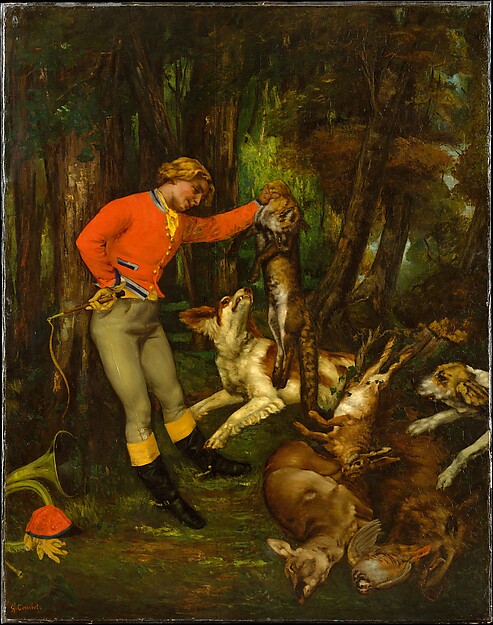
At the Salon of 1857 Courbet showed six paintings, among them “Young Ladies on the Banks of the Seine (Summer)”, painted the year before, and the first of his many hunting scenes. Modern women casually displaying their undergarments caused a scandal; pairing sensational works with hunting scenes secured Courbet both notoriety and sales.