RaphaelItalia, 1483–1520
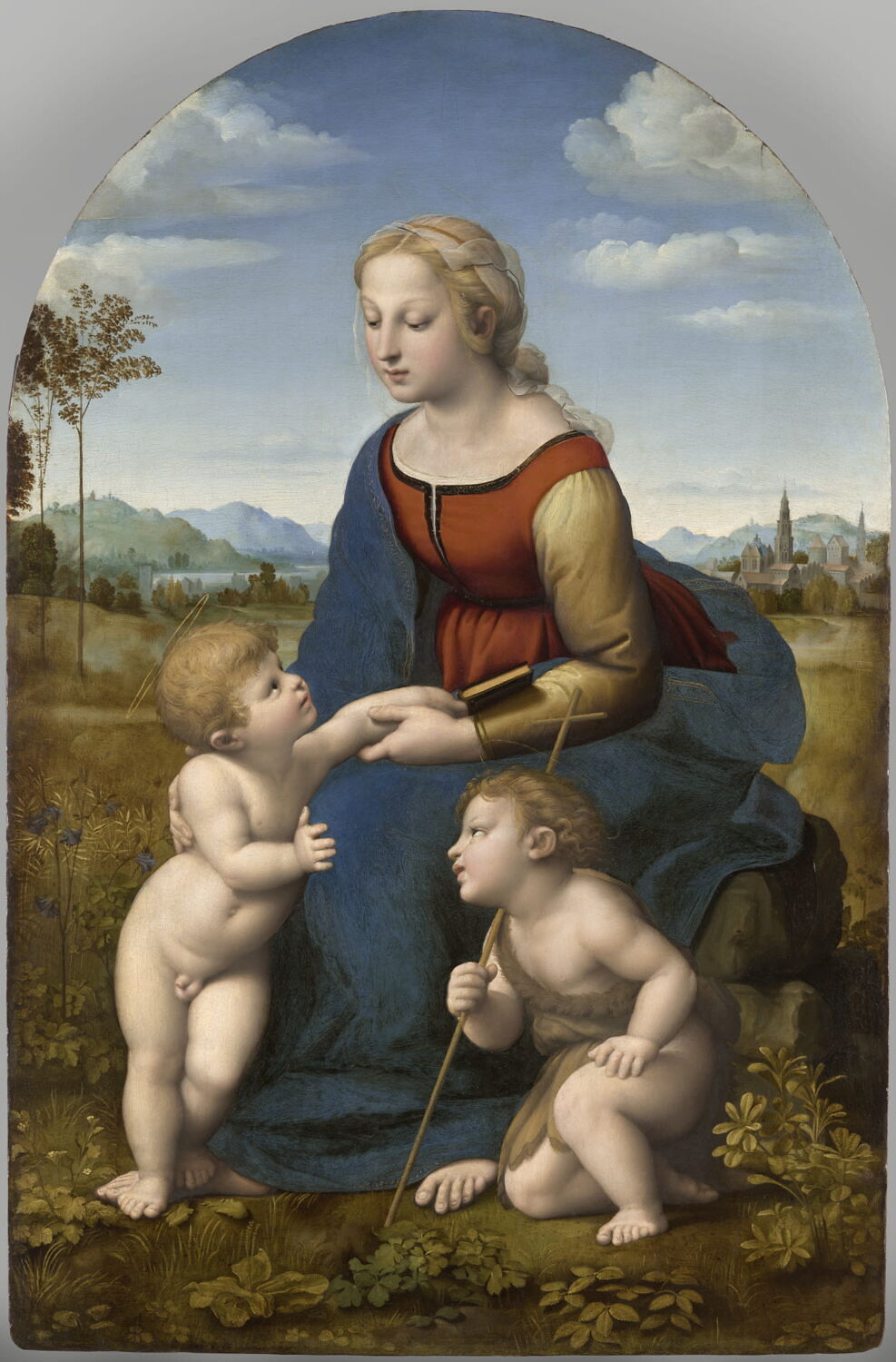
Virgen de los claveles
Madonna of the Pinks
¿Puedo verla?
Se desconoce
¿Dónde está «Virgen de los claveles» hoy? Colección: National Gallery, Londres. Se desconoce.

Londres, Reino Unido
Se conoce el propietario; no se sabe si hoy está expuesta.
- En este estado desde
- Fuente
- El museo
Sobre el cuadro
La Virgen de los claveles (en italiano La Madonna dei garofani) es una pintura atribuida al artista renacentista italiano Rafael Sanzio, que data de 1506-1507. Es una pintura al óleo sobre madera de frutal con unas dimensiones de 28,8 centímetros de alto y 22,8 cm de ancho. Se conserva en la National Gallery de Londres, Reino Unido, donde se exhibe con el título de Madonna of the Pinks.
Ficha
- Número de inventario
- NG6596
En el catálogo
Fuentes
- Wikidata
- Imagen: National Gallery — Raphael · Public domain · Wikimedia Commons
En la vida de Raphael
La vida entera1500
Called a master at seventeen
In December 1500 Raphael is first described as a “master”, that is, fully trained. His first documented work was the Baronci Altarpiece for the church of Saint Nicholas of Tolentino in Città di Castello, commissioned in 1500 and finished in 1501; only fragments survive.
1501
In Perugino's workshop
From 1501 Raphael studied and worked in Pietro Perugino's workshop in Perugia; according to Vasari, his early works cannot be told apart from his master's. He often travelled home to Urbino, to Città di Castello and, with Pinturicchio, to Siena.
late 1504
Meets Leonardo and Michelangelo
Having moved to Florence, Raphael met Leonardo da Vinci, Michelangelo and Bartolomeo della Porta and closely studied Leonardo's sfumato. His first Florentine commission, portraits of Agnolo Doni and his wife, was painted under the clear impression of the “Mona Lisa”.
1504
Friendship with Baldassare Castiglione
In Urbino Raphael met the philosopher, writer and patron Count Baldassare Castiglione; they formed a firm friendship and correspondence, including the famous letters about the fresco “The Triumph of Galatea”.
1504
To Florence, to study
The mother of the next Duke of Urbino gave Raphael a letter of recommendation to the Gonfaloniere of Florence: “The bearer of this will be found to be Raphael, painter of Urbino, who, being greatly gifted in his profession has determined to spend some time in Florence to study.” She called him “a sensible and well-mannered young man”.
1508
Moves to Rome at the invitation of Julius II
The new pope, Julius II, invited Raphael to Rome, perhaps at the suggestion of his architect Bramante, a distant relative of the artist. Unlike Michelangelo, kept waiting for months after his summons, Raphael was immediately commissioned to fresco what was to become the pope's private library, a far larger commission than any he had had before.