ART WIKI32.979 en sala
MapaColecciónArtistasMuseosExposicionesRevista
Acceder

ART WIKI

Dónde cuelga la obra maestra y cuándo le dejan pasar.

Colecciones: Galería Nacional de Arte, Galería Nacional de Dinamarca, Galería Nacional de Retratos, Galería Tretiakov, Harvard Art Museums, Instituto de Arte de Chicago, Instituto de Artes de Mineápolis, MoMA, Museo de Arte de Cleveland, Museo de Victoria y Alberto, Museo del Hermitage, Museo del Louvre, Museo Estatal Ruso, Museo Hirshhorn y Jardín de Esculturas, Museo J. Paul Getty, Museo Metropolitano de Arte, Museo Pushkin, Museo Smithsoniano de Arte Americano, Museo Whitney de Arte Estadounidense, National Museum of Asian Art, Rijksmuseum, Villa Getty, Catálogo Estatal del Fondo Museístico de Rusia (274 museos), Europeana (19 museos), Wikidata (6 museos), Paris Musées (12 museos) y Joconde, la base de museos del Ministerio de Cultura de Francia (495 museos). Las imágenes pertenecen a sus titulares de derechos.

Secciones

  • Mapa
  • Búsqueda
  • Colección
  • Obras maestras
  • Expuestas ahora
  • Artistas

Más

  • Museos y galerías
  • Exposiciones
  • Revista
  • De dónde salen los datos
  • Privacidad y cookies
InicioMapaCatálogo
  1. Colección/
  2. Instituto de Arte de Chicago/
  3. Golden Bird
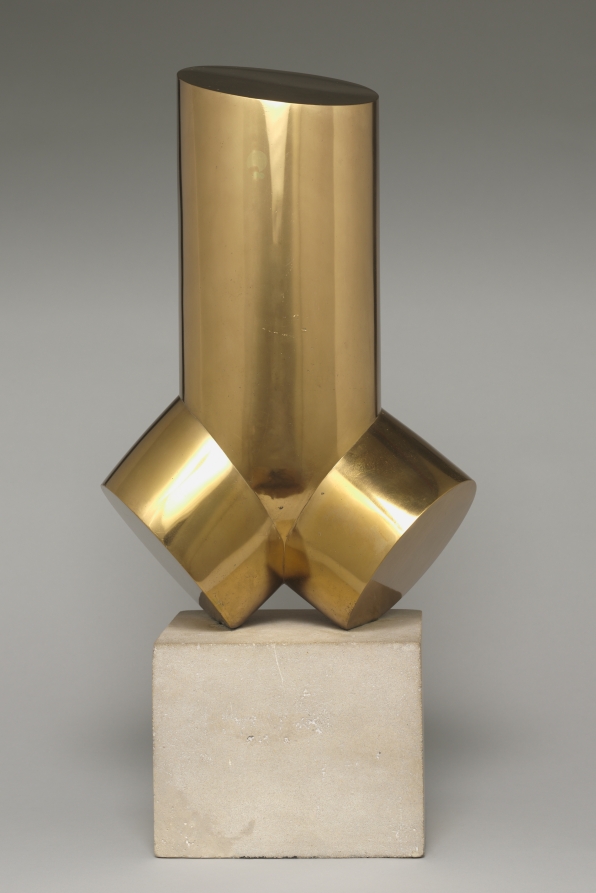
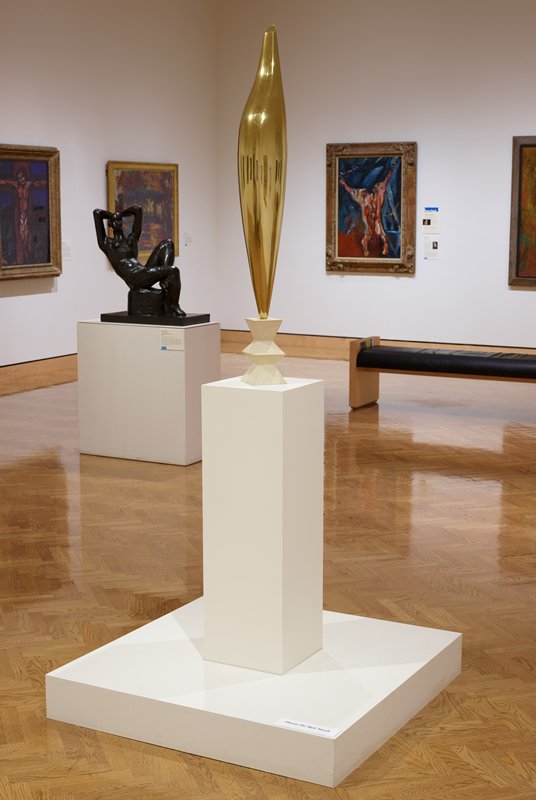
Golden Bird, Constantin Brancusi, 1919/20 (base c. 1922)
Constantin Brancusi, retratoConstantin BrancusiRumania, 1876–1957

Golden Bird

1919/20 (base c. 1922) · Sculpture

Sobre la escultura

Trained in both folk and academic traditions, Constantin Brancusi sought his own path for sculpture around 1907. Breaking with the currents of the time, he adopted direct carving, combined different materials for single works, and simplified form in his search for his subjects’ essential characters. His works have profoundly influenced the development of twentieth-century abstraction.

Seguir leyendo

More than any other theme, Brancusi’s series Bird summarizes his quest for a self-sufficient form. “All my life, I have sought to render the essence of flight,” the artist once said. He began the first of twenty-seven Bird sculptures around 1910 and completed the last in the 1940s. He called the earliest variations Maiastra, referring to a bird in Romanian folklore that leads a prince to his princess. In the Art Institute’s Golden Bird, details such as feet, a tail, and an upturned crowing beak are only suggested in an elegant, streamlined silhouette. Brâncusi perched this refined shape on a rough-hewn, geometric base, contrasting the disembodied, light-reflective surface with an earthbound mass. The central polyhedron was cut from the middle of a tree trunk, and its circles (indicating the tree’s age) rotate like a sun, as if radiating light over the bird.

Instituto de Arte de Chicago · CC BY 4.0

Ficha

1919/20 (base c. 1922)
18761957
Número de inventario
1990.88

Mientras tanto, en la vida de Constantin Brancusi

La vida entera
  1. 1910s

    “Mobile groups”: rearranging the sculptures

    During the 1910s Brâncuși arranges sculptures and pedestals in changing compositions that he calls “mobile groups”: he moves the works and watches how each change alters the space around them. When he sells a sculpture he often puts a plaster version in the same position, and by the 1920s the studio is also an exhibition space whose arrangement forms part of the work.

  2. 1915–1917

    The First World War: a refusal to serve

    Brâncuși stays in Paris after the outbreak of World War I; in 1915 he donates works to an exhibition at Bernheim-Jeune that raises money for Polish artists affected by the war. As a Romanian citizen he remains liable for military service, but he refuses to serve in 1916 and receives a permanent exemption on 8 November 1917.

  3. November 1919

    Meeting Erik Satie

    The writer Henri-Pierre Roché brings the composer Erik Satie, exactly ten years older than Brâncuși, to his studio together with Marcel Duchamp, beginning a friendship that lasts from 1919 to 1925. After dinner Brâncuși plays the violin for his guest, and Satie, in Roché’s words, teaches him verbal fencing, self-belief and clarity of thought.

  4. January 1920

    “Princess X” excluded from the Salon des Indépendants

    In January 1920 the organizers of the Salon des Indépendants exclude “Princess X” (1915–1916) because they regard its shape as phallic. Fernand Léger and other friends of Brâncuși protest, the sculpture is returned to the exhibition, and the dispute leads to the manifesto “Pour l’indépendance de l’art”, signed by more than seventy artists and writers; Erik Satie signed the protest petition on 25 February 1920.

Más obras de Constantin Brancusi

Todas las obras

En la misma sala · Gallery 395, Instituto de Arte de Chicago

Página del museo

Sobre el mismo tema · Biomorphic

Todas las obras sobre el tema
  • 1921

    Man Ray and the darkroom

    Brâncuși, who has photographed his work since the 1910s, meets Man Ray in 1921, who helps him buy equipment, set up a darkroom and improve his developing methods. He photographs the sculptures under changing light, alters his framing and documents the relationships between the works and the surrounding space; he also films his studio and sculptures mounted on rotating bases.

  • September 1921

    A Brâncuși issue of “The Little Review”

    In September 1921 the American magazine “The Little Review” publishes an issue devoted to Brâncuși, with an essay by Ezra Pound and 24 photographic plates showing sculptures and views of the studio.

  • ¿Se puede contemplar?

    Sí, recibe visitas

    Instituto de Arte de Chicago

    Chicago, Estados Unidos

    Sala395

    Expuesta al público. Quién lo avala figura más abajo.

    Comprobado
    hace 3 días
    En este estado desde
    19 ago 2026
    Fuente
    El museo
    En el mapaPágina del museo

    Lo que muestra

    BiomorphicBronze (color)Fluid shapesGeometric

    En el catálogo

    EsculturaBronceModernismoSiglo XXFrancia

    Fuentes

    • Instituto de Arte de Chicago
    • Imagen: Instituto de Arte de Chicago — © the artist or rights holder
    Maiastra, Constantin Brâncuși, c. 1911

    Maiastra

    c. 1911 · Galería Nacional de Arte

    Bird in Space, Constantin Brâncuși, 1925

    Bird in Space

    1925 · Galería Nacional de Arte

    Bird in Space, Constantin Brâncuși, 1927

    Bird in Space

    1927 · Galería Nacional de Arte

    Agnes E. Meyer, Constantin Brâncuși, 1929

    Agnes E. Meyer

    1929 · Galería Nacional de Arte

    Male Torso, Constantin Brancusi, 1917

    Male Torso

    1917 · Museo de Arte de Cleveland

    Golden Bird, Constantin Brancusi, c. 1919

    Golden Bird

    c. 1919 · Instituto de Artes de Mineápolis

    Wisdom, Constantin Brancusi, c. 1908

    Wisdom

    c. 1908 · Instituto de Arte de Chicago

    Leda, Constantin Brancusi, 1920

    Leda

    1920 · Instituto de Arte de Chicago

    The Plough and the Song, Arshile Gorky, 1946–47

    Arshile Gorky

    The Plough and the Song, 1946–47

    Untitled, Yves Tanguy, 1928

    Yves Tanguy

    Untitled, 1928

    Spoon Woman, Alberto Giacometti, 1926–27 (cast 1954)

    Alberto Giacometti

    Spoon Woman, 1926–27 (cast 1954)

    Averno, Richard Rezac, 2020

    Richard Rezac

    Averno, 2020

    Veil, Richard Rezac, 1987

    Richard Rezac

    Veil, 1987

    Vigil, Richard Rezac, 1986

    Richard Rezac

    Vigil, 1986

    All Alone, Jean Fautrier, 1957

    Jean Fautrier

    All Alone, 1957

    Cyclops, William Baziotes, 1947

    William Baziotes

    Cyclops, 1947

    Hero Construction, Richard Hunt, 1958

    Richard Hunt

    Hero Construction, 1958

    Instituto de Arte de Chicago

    Spoon Woman, Alberto Giacometti, 1926–27 (cast 1954)

    Alberto Giacometti

    Spoon Woman, 1926–27 (cast 1954)

    Instituto de Arte de Chicago

    Oonagh MacCumhail: The Case of the Entered Novitiate, Matthew Barney, 2002

    Matthew Barney

    Oonagh MacCumhail: The Case of the Entered Novitiate, 2002

    No expuesta · Instituto de Arte de Chicago

    Tanktotem I, David Smith, 1952

    David Smith

    Tanktotem I, 1952

    No expuesta · Instituto de Arte de Chicago

    Untitled, Yves Tanguy, 1928

    Yves Tanguy

    Untitled, 1928

    Instituto de Arte de Chicago

    Horse, Raymond Duchamp-Villon, 1914

    Raymond Duchamp-Villon

    Horse, 1914

    No expuesta · Instituto de Arte de Chicago

    Clio, Kurt Seligmann, 1950

    Kurt Seligmann

    Clio, 1950

    No expuesta · Instituto de Arte de Chicago

    Working Model for UNESCO Reclining Figure, Henry Moore, 1957

    Henry Moore

    Working Model for UNESCO Reclining Figure, 1957

    Instituto de Arte de Chicago