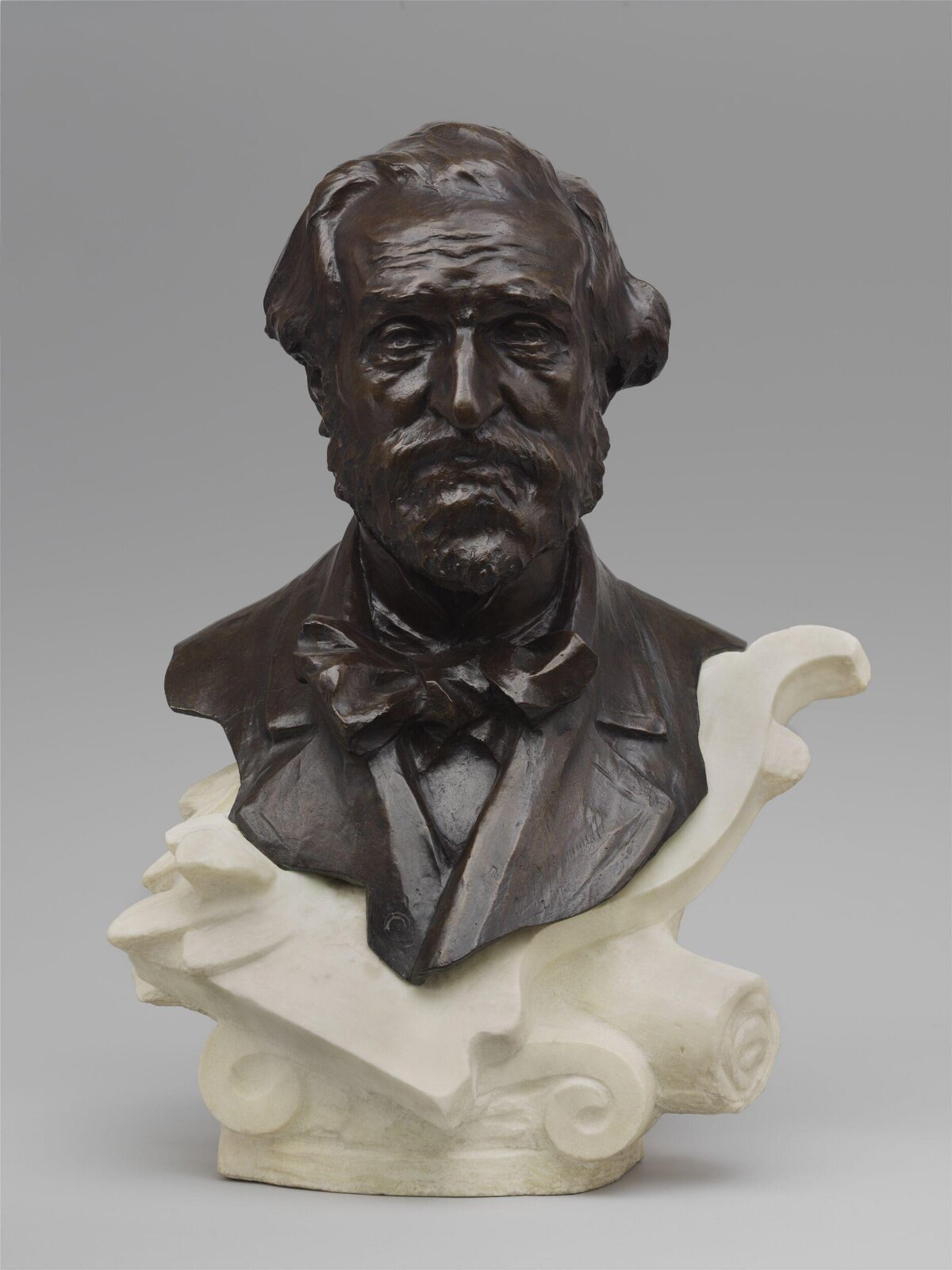
Giuseppe Verdi
¿Se puede contemplar?
Por ahora no recibe

Londres, Reino Unido
Pertenece a la colección, pero ahora mismo no está expuesta.
- Comprobado
- En este estado desde
- Fuente
- El museo
Sobre la escultura
Giuseppe Verdi (1815-1901) was the most influential Italian opera composer of the 19th century whose best-known works include Rigoletto, 1851; Il Trovatore, and La Traviata, 1853; Macbeth, 1865; Don Carlos, 1867; Aida, 1871, and Otello, 1887.
Raffaello Romanelli (1856-1928) was the second generation of a dynasty of Florentine sculptors active from the mid 19th century. The son of Pasquale Romanelli (1812-1887), he is considered one of the foremost Italian monumental sculptors of his generation. He studied under his father, a pupil in turn of Lorenzo Bartolini (1777-1850) at the Accademia di Belle Arti in Florence. The Romanelli Sculpture Gallery was founded in Florence when Pasquale took over Bartolino’s studio.
Leer más
After studying in Rome, Raffaello returned to Florence in the mid-1880s where he established himself in his father's studio, as a sculptor of busts, medallions and bas relief. During the 1890s, Raffaello was commissioned for numerous funerary and public monuments in Florence and elsewhere in Italy. He also secured by high profile international commissions such as the Demidoff monument in Kyiv (Kiev) and the General Martin monument in Caracas, as well as exhibiting at the many international exhibitions of the period. In the early 1900s he moved away from Classic Realism, gravitating towards the style of the Liberty or Art Nouveau style which afforded him a greater sense of freedom in his work in subject and treatment.
By the first decade of the 20th century Raffaello had achieved a wide reputation with The Anglo-American Gazette calling him ‘Italy’s greatest living sculptor’ in 1908, and the San Francisco Examiner contending that he was ‘to Italy what Rodin is to France’ in 1915. He was eventually appointed Professor of the Accademia, and was followed by his son Romano (1882-1968), also a successful sculptor.
Museo de Victoria y Alberto
Ficha
- Número de inventario
- S.1694-2014
Lo que muestra
En el catálogo
Fuentes
- Museo de Victoria y Alberto
- Imagen: Museo de Victoria y Alberto — © Victoria and Albert Museum, London







