 Albrecht DürerAlemania, 1471–1528
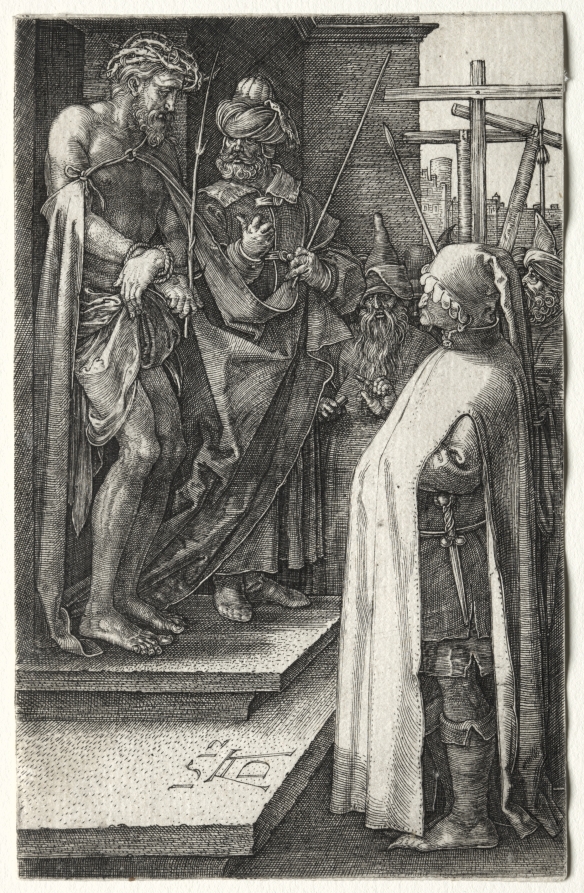
Ecce Homo
¿Se puede contemplar?
Por ahora no recibe

Museo de Arte de Cleveland
Cleveland, Estados Unidos
Pertenece a la colección, pero ahora mismo no está expuesta.
- Comprobado
- En este estado desde
- Fuente
- Los datos de colección del propio museo
Sobre la obra
This scene of the presentation of Christ to the people, or ecce homo (“behold the man”) from the Engraved Passion series exemplifies Albrecht Dürer’s instinct for the graphic possibilities of the engraved line. Working with a burin on a copperplate, he crossed lines at different angles and varied the thickness of the lines to create dramatic tonal areas and highly descriptive textures. In this closely cropped composition, the focus on Christ’s clenched and pained body as he stands in judgment before a crowd contrasts with the disinterest emanating from the man standing calmly before him.
Museo de Arte de Cleveland
Ficha
- Número de inventario
- 1921.1168
What it shows
En el catálogo
Idas y venidas
Ahora no está expuesta
Museo de Arte de Cleveland · 29 sept 2026 — hoy · Verificado
Ahora no está expuesta
Galería Nacional de Arte · 29 sept 2026 — 29 sept 2026 · Verificado
Ahora no está expuesta
Museo de Arte de Cleveland · 28 sept 2026 — 29 sept 2026 · Verificado
Ahora no está expuesta
Galería Nacional de Arte · 28 sept 2026 — 28 sept 2026 · Verificado
Ahora no está expuesta
Museo de Arte de Cleveland · 27 sept 2026 — 28 sept 2026 · Verificado
Ahora no está expuesta
Galería Nacional de Arte · 26 sept 2026 — 27 sept 2026 · Verificado
Ahora no está expuesta
Museo de Arte de Cleveland · 26 sept 2026 — 26 sept 2026 · Verificado
Ahora no está expuesta
Galería Nacional de Arte · 25 sept 2026 — 26 sept 2026 · Verificado
Ahora no está expuesta
Museo de Arte de Cleveland · 19 ago 2026 — 25 sept 2026 · Verificado
Fuentes
- Museo de Arte de Cleveland: the museum's own open data · obtenido hace 7 días
- Imagen: Museo de Arte de Cleveland — Museum open access
Mientras tanto, en la vida de Albrecht Dürer
La vida entera1507–1528 · Lugar de trabajo
Nuremberg
1513–1516
Three years without painting
Complaining that painting did not pay enough to justify the time compared with his prints, Dürer produced no paintings from 1513 to 1516.
1514
Death of his mother
In the year of Melencolia I and St Jerome in His Study, the artist's mother, Barbara Holper, died.
1515
A life pension from the emperor
The perpetually cash-strapped Maximilian could not pay on time and offered to exempt the artist from city taxes, which the Nuremberg Council opposed. At Dürer's request the emperor granted him a life pension of 100 guilders a year from the sums Nuremberg paid into the imperial treasury.
1517
Joins Nuremberg's circle of reformers
Dürer joined the circle of Nuremberg reformers led by the Augustinian vicar Johann Staupitz and Wenceslaus Linck. Around 1518 he came to know the writings of Martin Luther, which, he said, had “greatly helped” him.
![Madonna and Child [obverse], Albrecht Dürer, c. 1496/1499](https://api.nga.gov/iiif/878db7e6-10ae-4cae-ba5d-6d6f5c413ae8/full/!2400,2400/0/default.jpg)
![Lot and His Daughters [reverse], Albrecht Dürer, c. 1496/1499](https://api.nga.gov/iiif/7565a449-f82a-414b-9bda-c93f55a51b4d/full/!2400,2400/0/default.jpg)