 Roy LichtensteinEstados Unidos, 1923–1997
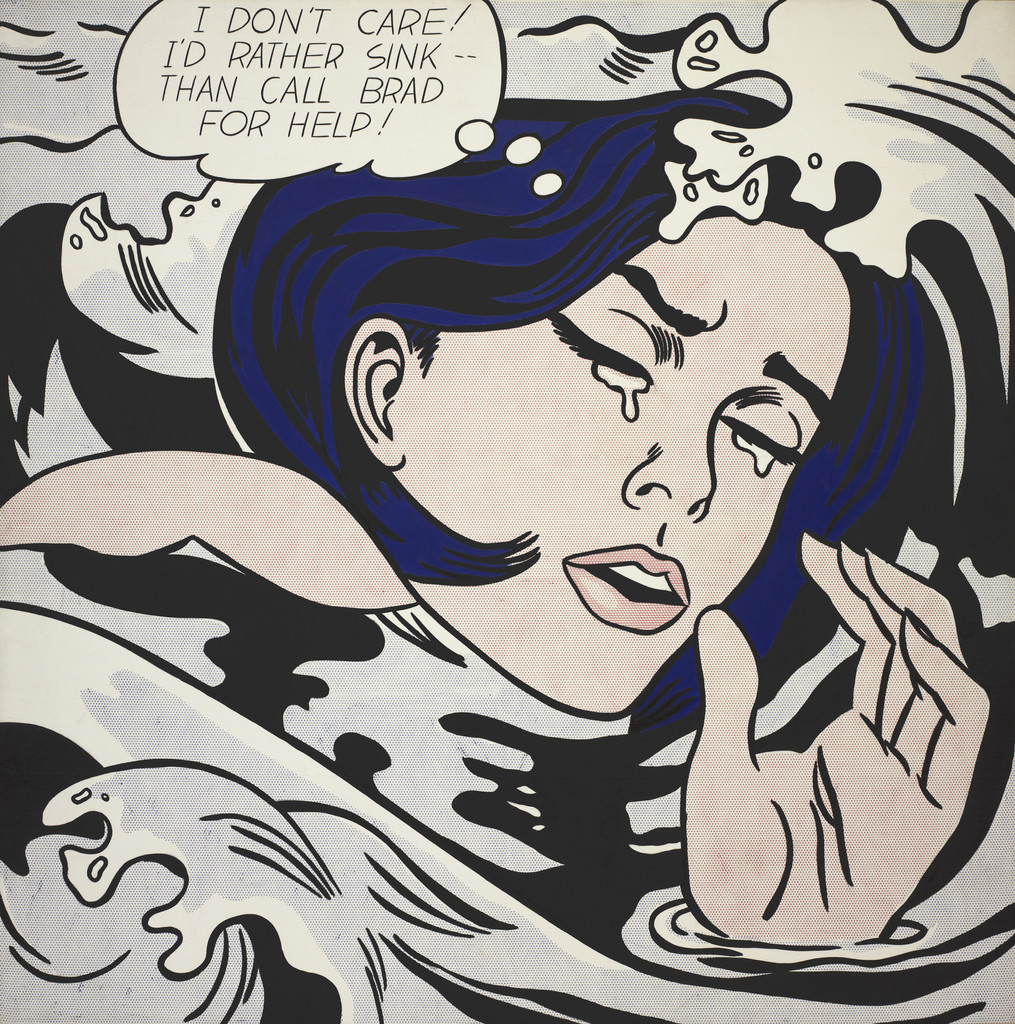
Drowning Girl
¿Se puede contemplar?
Por ahora no recibe

MoMA
Nueva York, Estados Unidos
Pertenece a la colección, pero ahora mismo no está expuesta.
- Comprobado
- Fuente
- El museo
Sobre el cuadro
Drowning Girl —en español Chica ahogada —también conocida como Secret Hearts o I Don't Care! I'd Rather Sink, es una pintura estadounidense de 1963 en óleo y pintura de polímero sintético sobre lienzo de Roy Lichtenstein, basada en el arte original de Tony Abruzzo. La pintura se considera una de las obras más significativas de Lichtenstein, quizás a la par de su aclamado díptico de 1963 ¡Whaam!. Una de las pinturas más representativas del movimiento pop art, Drowning Girl fue adquirida por el Museo de Arte Moderno en 1971.
Seguir leyendo
La pintura ha sido descrita como una "obra maestra del melodrama" y es una de las primeras imágenes del artista que representa a mujeres en situaciones trágicas, un tema al que volvió a menudo a mediados de la década de 1960. Muestra a una mujer con ojos llorosos en un mar turbulento. Está emocionalmente angustiada, aparentemente por un romance. Usando las convenciones del arte de los cómics, un globo de pensamiento dice: "¡No me importa! ¡Prefiero hundirme que llamar a Brad para pedir ayuda!". Este elemento narrativo resalta el melodrama cliché, mientras que sus gráficos, incluidos los puntos de Ben-Day que hacen eco del efecto del proceso de impresión, reiteran el tema de Lichtenstein del trabajo pictórico que imita la reproducción mecanizada.
El trabajo se deriva de una viñeta de DC Comics de 1962; tanto los elementos gráficos como los narrativos de la obra se recortan de la imagen de origen. También toma prestado de La gran ola de Kanagawa de Hokusai y de elementos de los artistas modernistas Jean Arp y Joan Miró. Es una de varias obras de Lichtenstein que mencionan a un personaje llamado Brad que está ausente de la imagen.
Ficha
- Número de inventario
- 685.1971
En el catálogo
Fuentes
- MoMA
- Imagen: MoMA — © the artist or rights holder
Mientras tanto, en la vida de Roy Lichtenstein
La vida entera1961
The turn to Pop Art: a challenge from his son
In 1961 Lichtenstein began his first Pop paintings, using cartoon images and techniques derived from commercial printing; the first work to use hard-edged figures and Ben-Day dots on a large scale was “Look Mickey”. The push came from his son, who, as the artist told it, pointed to a Mickey Mouse comic book and doubted that his father could paint as well.
1961
Leo Castelli begins showing his work
In 1961 Leo Castelli began displaying Lichtenstein’s work at his gallery in New York.
1962
The Castelli show sells out before it opens
Lichtenstein’s first one-man show at the Castelli gallery took place in 1962: the entire collection was bought by influential collectors before it even opened. The Leo Castelli Gallery has represented him exclusively since then.
1963–1964
Leaves Rutgers and returns to New York
In September 1963 Lichtenstein took a leave of absence from Douglass College at Rutgers; in 1964 he moved back to New York to be at the centre of the art scene and resigned from Rutgers to concentrate on his painting.
1964
The first American to exhibit at the Tate Gallery
Lichtenstein became the first American to exhibit at the Tate Gallery in London, in the show “’54–’64: Painting and Sculpture of a Decade”.
1964
Life magazine asks: “Is He the Worst Artist in the U.S.?”
When Lichtenstein’s work was first exhibited, many critics challenged its originality and called it vulgar and empty; a Life magazine article of 1964 was headed “Is He the Worst Artist in the U.S.?”. The artist replied that the closer his work is to the original, the more threatening and critical its content.


![Untitled [pyramid], Roy Lichtenstein, c. 1970](https://whitneymedia.org/assets/artwork/61776/2019_234_14_cropped.jpg)
![Untitled [pyramid], Roy Lichtenstein, c. 1970](https://whitneymedia.org/assets/artwork/61778/2019_234_16_cropped.jpg)
![Untitled [pyramid], Roy Lichtenstein, c. 1970](https://whitneymedia.org/assets/artwork/61777/2019_234_15_cropped.jpg)
![Untitled [pyramid], Roy Lichtenstein, c. 1970](https://whitneymedia.org/assets/artwork/61763/2019_234_1_cropped.jpg)