ART WIKI32.963 en sala
MapaColecciónArtistasMuseosExposicionesRevista
Acceder

ART WIKI

Dónde cuelga la obra maestra y cuándo le dejan pasar.

Colecciones: Galería Nacional de Arte, Galería Nacional de Dinamarca, Galería Nacional de Retratos, Galería Tretiakov, Harvard Art Museums, Instituto de Arte de Chicago, Instituto de Artes de Mineápolis, MoMA, Museo de Arte de Cleveland, Museo de Victoria y Alberto, Museo del Hermitage, Museo del Louvre, Museo Estatal Ruso, Museo Hirshhorn y Jardín de Esculturas, Museo J. Paul Getty, Museo Metropolitano de Arte, Museo Pushkin, Museo Smithsoniano de Arte Americano, Museo Whitney de Arte Estadounidense, National Museum of Asian Art, Rijksmuseum, Villa Getty, Catálogo Estatal del Fondo Museístico de Rusia (274 museos), Europeana (19 museos), Wikidata (6 museos), Paris Musées (12 museos) y Joconde, la base de museos del Ministerio de Cultura de Francia (495 museos). Las imágenes pertenecen a sus titulares de derechos.

Secciones

  • Mapa
  • Búsqueda
  • Colección
  • Obras maestras
  • Expuestas ahora
  • Artistas

Más

  • Museos y galerías
  • Exposiciones
  • Revista
  • De dónde salen los datos
  • Privacidad y cookies
InicioMapaCatálogo
  1. Colección/
  2. Instituto de Arte de Chicago/
  3. Commerce Counselor Ebenstein
Commerce Counselor Ebenstein, Oskar Kokoschka, 1908
Oskar Kokoschka, retratoOskar KokoschkaAustria, 1886–1980

Commerce Counselor Ebenstein

1908 · Painting

¿Se puede contemplar?

Por ahora no recibe

Instituto de Arte de Chicago

Chicago, Estados Unidos

Pertenece a la colección, pero ahora mismo no está expuesta.

Comprobado
hace 3 días
En este estado desde
19 ago 2026
Fuente
El museo
En el mapaPágina del museo

Sobre el cuadro

The sitter for this portrait, Ernest Ebenstein, was a distinguished tailor to the Austrian aristocracy. Ebenstein took an interest in the young Oskar Kokoschka and offered not only to make the artist’s clothes but also to instruct him in anatomy. In exchange for a fine suit, the tailor commissioned this portrait, which was one of the first mature works Kokoschka ever completed. Shortly after the Art Institute acquired the work in the mid-1950s, the artist visited the museum and recalled Ebenstein as a charming and kind man who taught him more about anatomy than anyone else.

Instituto de Arte de Chicago · CC BY 4.0

Ficha

1908 · a los 22 años
18861980
Número de inventario
1956.364

Lo que muestra

VarónSuitsFashionRetratoJoseph Winterbotham Collection

En el catálogo

PinturaÓleoPintura británicaPintura austriacaModernismoSiglo XXInglaterra

Fuentes

  • Instituto de Arte de Chicago
  • Imagen: Instituto de Arte de Chicago — © the artist or rights holder

Mientras tanto, en la vida de Oskar Kokoschka

La vida entera
  1. 1908

    A scandalous debut at the Vienna Kunstschau

    In 1908 Kokoschka was invited to submit works to the first Vienna Kunstschau. Instead of the colour pictures for a children’s book commissioned by Fritz Wärndorfer, director of the Wiener Werkstätte, he showed illustrations to his own poem “Die träumenden Knaben” and a tapestry, “The Dream Bearers” (now lost); the frank adolescent fantasies provoked a backlash from conservative officials and he was expelled from the school, but found his place in the Viennese avant-garde.

  2. 1908

    The book “Die träumenden Knaben” with lithographs

    Kokoschka published the poem, written a year earlier, with the Wiener Werkstätte, with two small black-and-white and eight larger colour lithographs, and dedicated it to Gustav Klimt. Of the five hundred copies only a small proportion were bound and sold; the poem is an autobiographical adolescent fantasy about his love for a Swedish classmate, Lilith.

  3. 1909

    The scandalous staging of “Murderer, the Hope of Women”

    Kokoschka’s play “Murderer, the Hope of Women” was first staged in 1909, and the production on a Viennese stage caused a scandal. The play is often called the first Expressionist drama; Paul Hindemith made an opera of it in 1921.

  4. 1909–1914

    Adolf Loos: patron and commissioner of portraits

    The architect Adolf Loos befriended Kokoschka, introduced him to the Viennese avant-garde and ordered portraits of his clients and friends, agreeing to buy the work if the sitter declined. This left Kokoschka complete artistic freedom; he painted the bulk of his portraiture between 1909 and 1914.

  5. 1910

    Berlin: Cassirer and Walden

    In 1910 Kokoschka moved to Berlin. The art dealer Paul Cassirer saw promise in his work and launched him into the international circle, and the publisher and critic Herwarth Walden, introduced to him by Loos, employed him as an illustrator for his magazine “Der Sturm”; over the next four years Kokoschka travelled back and forth between Vienna and Berlin.

  6. 1910

    Drawings and a cover for the magazine “Der Sturm”

    Twenty-eight drawings by Kokoschka were published in “Der Sturm” during its first year; the first was a drawing from the series “Menschenköpfe” dedicated to Karl Kraus, and the twentieth issue carried his first cover illustration, for “Murderer, the Hope of Women”, and his first literary contribution.
Más obras de Oskar Kokoschka

Todas las obras
Sleeping Woman (Schlafende Frau)(title page) from Die träumenden Knaben (The Dreaming Boys), Oskar Kokoschka, 1917 (executed 1907-08)

Sleeping Woman (Schlafende Frau)(title page) from Die träumenden Knaben (The Dreaming Boys)

1917 (executed 1907-08) · No expuesta · MoMA

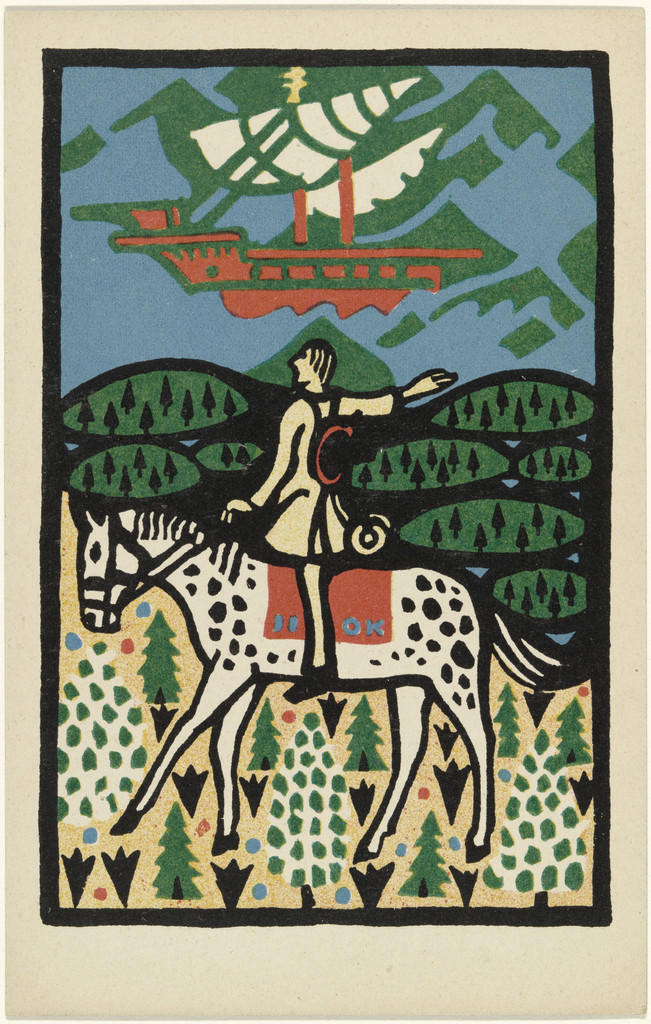
Rider and Sailboat (Reiter und Segelschiff) (postcard), Oskar Kokoschka, 1907

Rider and Sailboat (Reiter und Segelschiff) (postcard)

1907 · No expuesta · MoMA

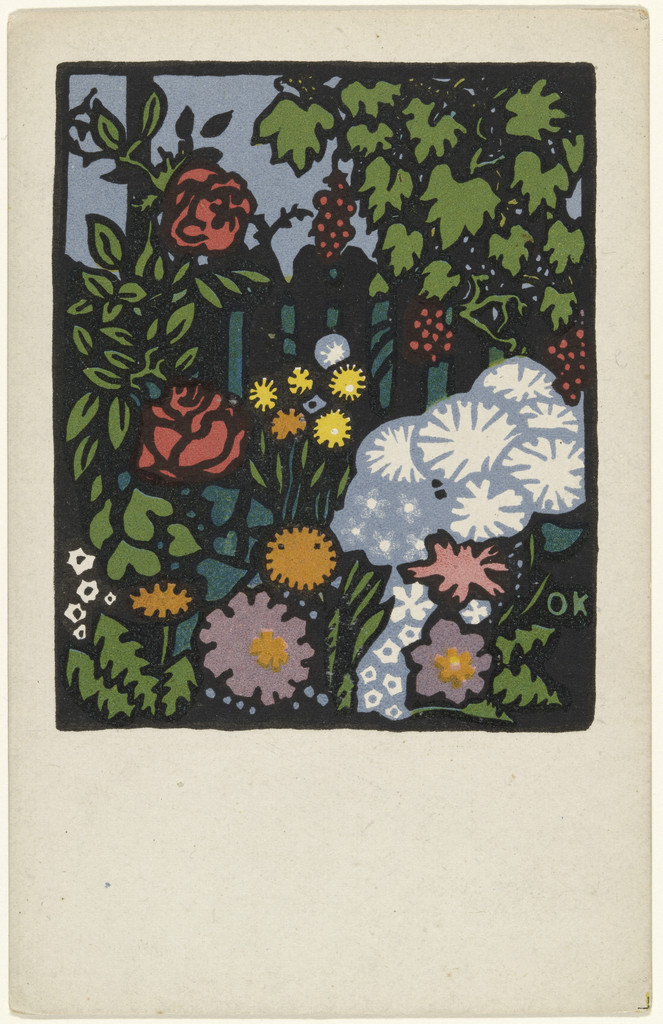
Flower Garden (Blumengarten), Oskar Kokoschka, 1907

Flower Garden (Blumengarten)

1907 · No expuesta · MoMA

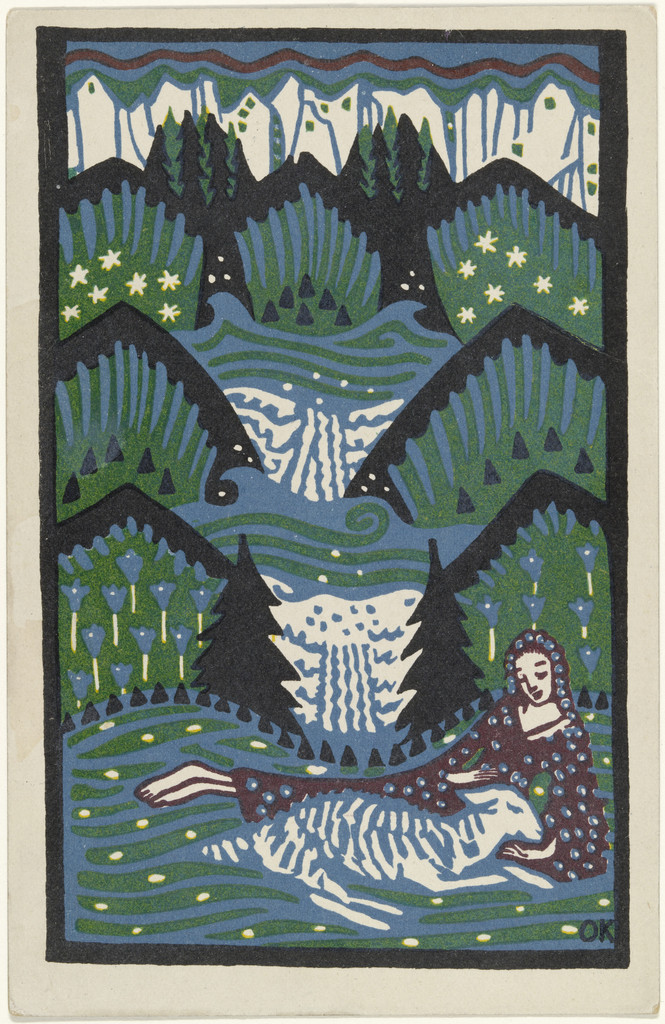
Girl with a Sheep in the Mountain Meadow (Mädchen mit Schaf auf Bergwiese) (postcard), Oskar Kokoschka, 1907

Girl with a Sheep in the Mountain Meadow (Mädchen mit Schaf auf Bergwiese) (postcard)

1907 · No expuesta · MoMA

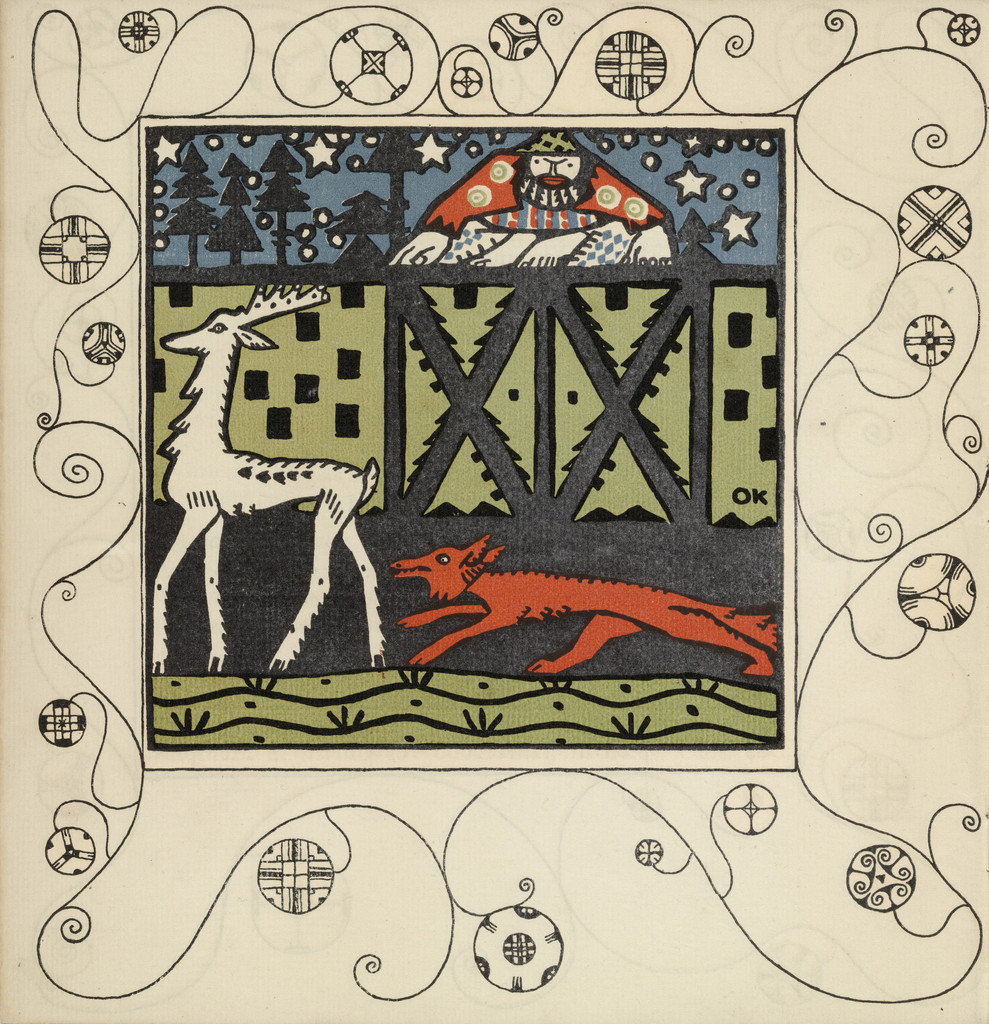
Shepherd, Stag and Fox (Hirt, Hirsch und Fuchs). Illustration for the shadow play The Speckled Egg (Das getupfte Ei) (plate 1) from the First Theater Program of Kabarett Fledermaus (Cabaret Fledermaus), Oskar Kokoschka, 1907

Shepherd, Stag and Fox (Hirt, Hirsch und Fuchs). Illustration for the shadow play The Speckled Egg (Das getupfte Ei) (plate 1) from the First Theater Program of Kabarett Fledermaus (Cabaret Fledermaus)

1907 · No expuesta · MoMA

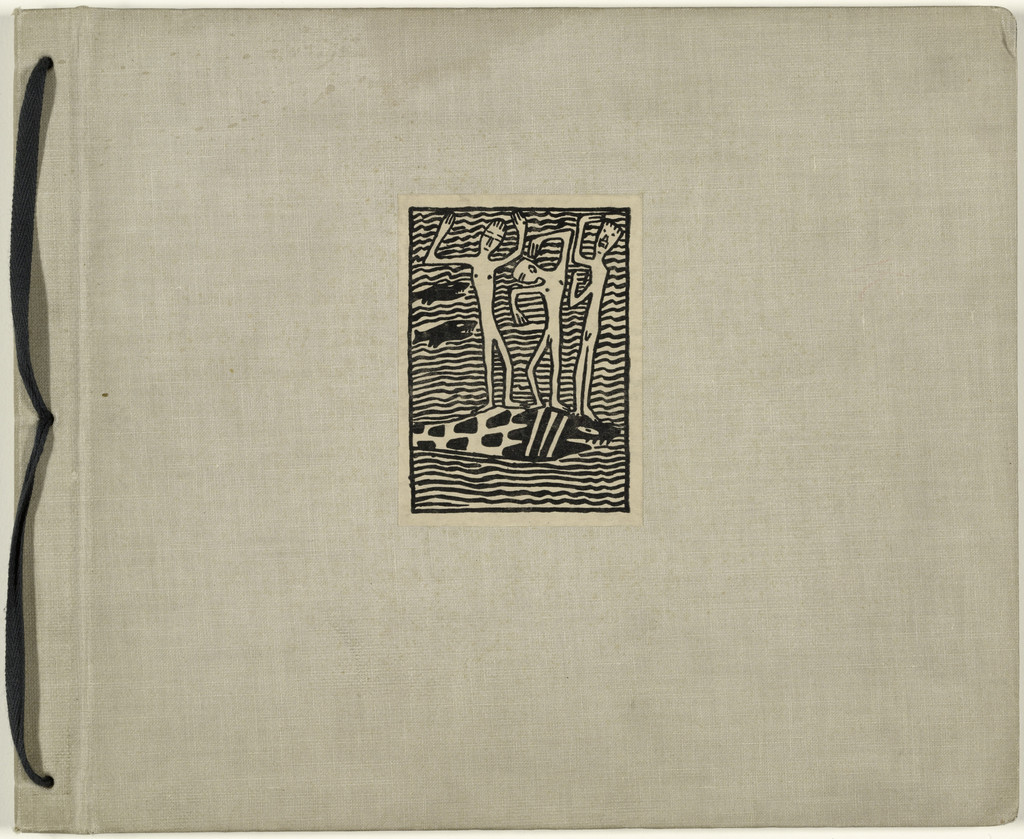
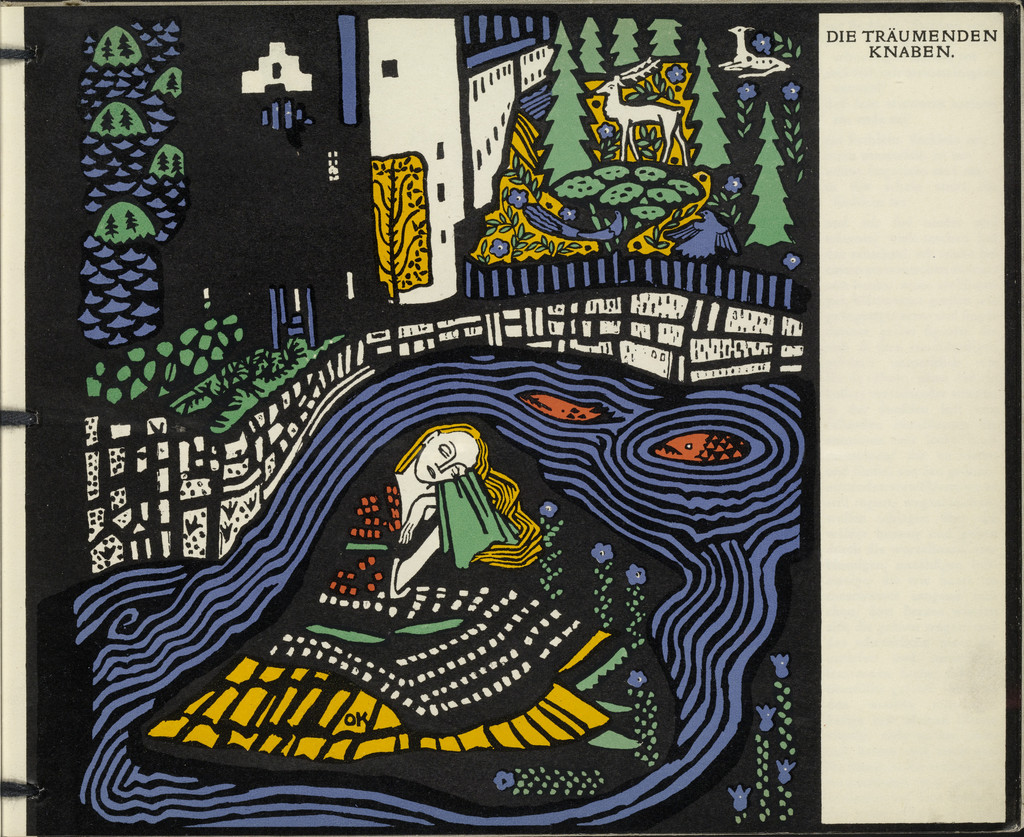
Die träumenden Knaben (The Dreaming Boys), Oskar Kokoschka, 1907–08, published 1917

Die träumenden Knaben (The Dreaming Boys)

1907–08, published 1917 · No expuesta · MoMA

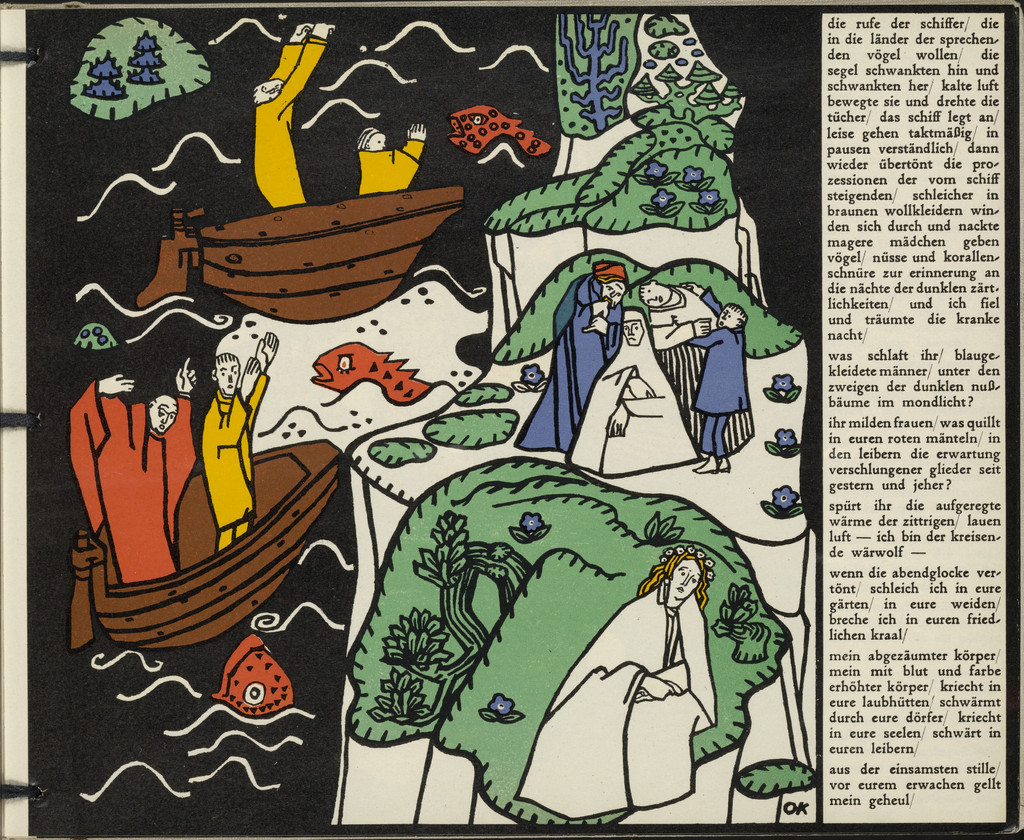
The Sailors Are Calling (Die Schiffer rufen)(in-text plate, folio 5) from Die träumenden Knaben (The Dreaming Boys), Oskar Kokoschka, 1917 (executed 1907-08)

The Sailors Are Calling (Die Schiffer rufen)(in-text plate, folio 5) from Die träumenden Knaben (The Dreaming Boys)

1917 (executed 1907-08) · No expuesta · MoMA

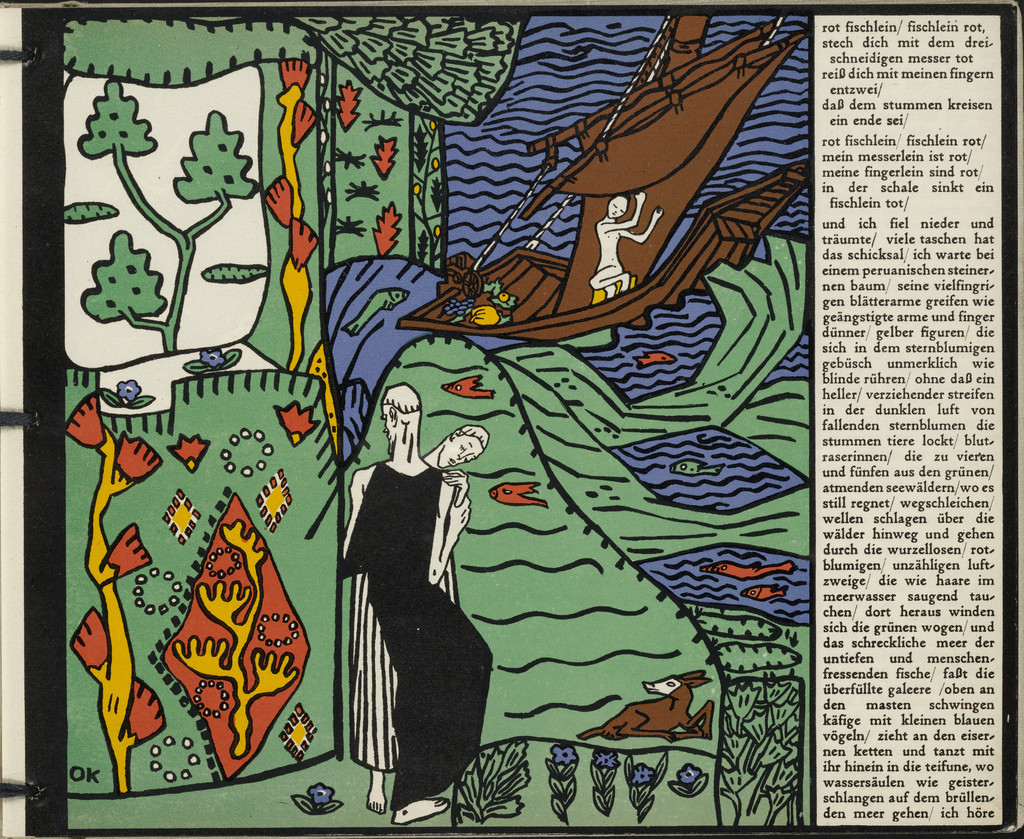
The Sailboat (Das Segelschiff)(in-text plate, folio 4) from Die träumenden Knaben (The Dreaming Boys), Oskar Kokoschka, 1917 (executed 1907-08)

The Sailboat (Das Segelschiff)(in-text plate, folio 4) from Die träumenden Knaben (The Dreaming Boys)

1917 (executed 1907-08) · No expuesta · MoMA

Bajo el mismo techo: Instituto de Arte de Chicago

Página del museo
The Bedroom, Vincent van Gogh, 1889

Vincent van Gogh

The Bedroom, 1889

A Sunday on La Grande Jatte — 1884, Georges Seurat, 1884–86, border added 1888–89

Georges Seurat

Tarde de domingo en la isla de la Grande Jatte, 1884–86, border added 1888–89

Paris Street; Rainy Day, Gustave Caillebotte, 1877

Gustave Caillebotte

Calle de Paris, dia de lluvia, 1877

Two Sisters (On the Terrace), Pierre-Auguste Renoir, 1881

Pierre-Auguste Renoir

En la terraza, 1881

The Basket of Apples, Paul Cézanne, c. 1893

Paul Cézanne

Cesto de manzanas, c. 1893

Stacks of Wheat (End of Summer), Claude Monet, 1890–91

Claude Monet

Stacks of Wheat (End of Summer), 1890–91

American Gothic, Grant Wood, 1930

Grant Wood

American Gothic, 1930

Nighthawks, Edward Hopper, 1942

Edward Hopper

Noctámbulos, 1942

Sobre el mismo tema · Varón

Todas las obras sobre el tema
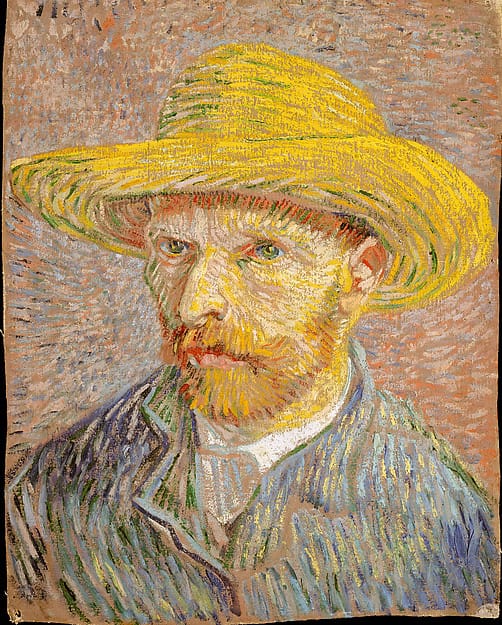
Self-Portrait with a Straw Hat (obverse: The Potato Peeler), Vincent van Gogh, 1887

Vincent van Gogh

Self-Portrait with a Straw Hat (obverse: The Potato Peeler), 1887

Museo Metropolitano de Arte

Garden at Sainte-Adresse, Claude Monet, 1867

Claude Monet

La terraza de Sainte-Adresse, 1867

Museo Metropolitano de Arte

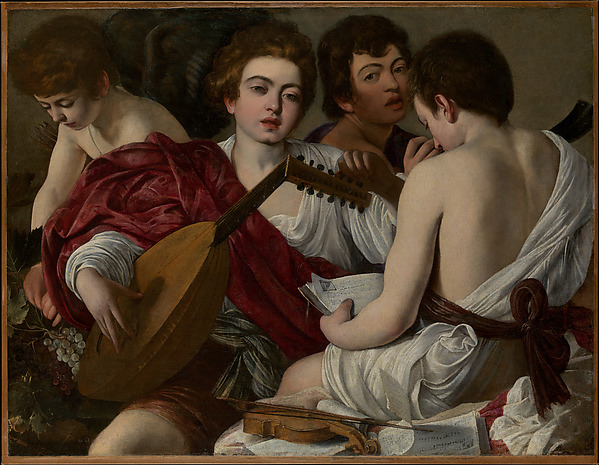
The Musicians, Caravaggio, 1597

Caravaggio

Los músicos, 1597

Museo Metropolitano de Arte

Self-Portrait, Rembrandt van Rijn, 1660

Rembrandt van Rijn

Self-Portrait, 1660

Museo Metropolitano de Arte

Portrait of Gerard de Lairesse, Rembrandt van Rijn, 1665–67

Rembrandt van Rijn

Portrait of Gerard de Lairesse, 1665–67

Museo Metropolitano de Arte

Aristotle with a Bust of Homer, Rembrandt, 1653

Rembrandt van Rijn

Aristóteles contemplando el busto de Homero, 1653

Museo Metropolitano de Arte

Young Sailor II, Henri Matisse, 1906

Henri Matisse

Young Sailor II, 1906

Museo Metropolitano de Arte

Rubens, Helena Fourment (1614–1673), and Their Son Frans (1633–1678), Peter Paul Rubens, ca. 1635

Peter Paul Rubens

Rubens, Helena Fourment (1614–1673), and Their Son Frans (1633–1678), ca. 1635

Museo Metropolitano de Arte