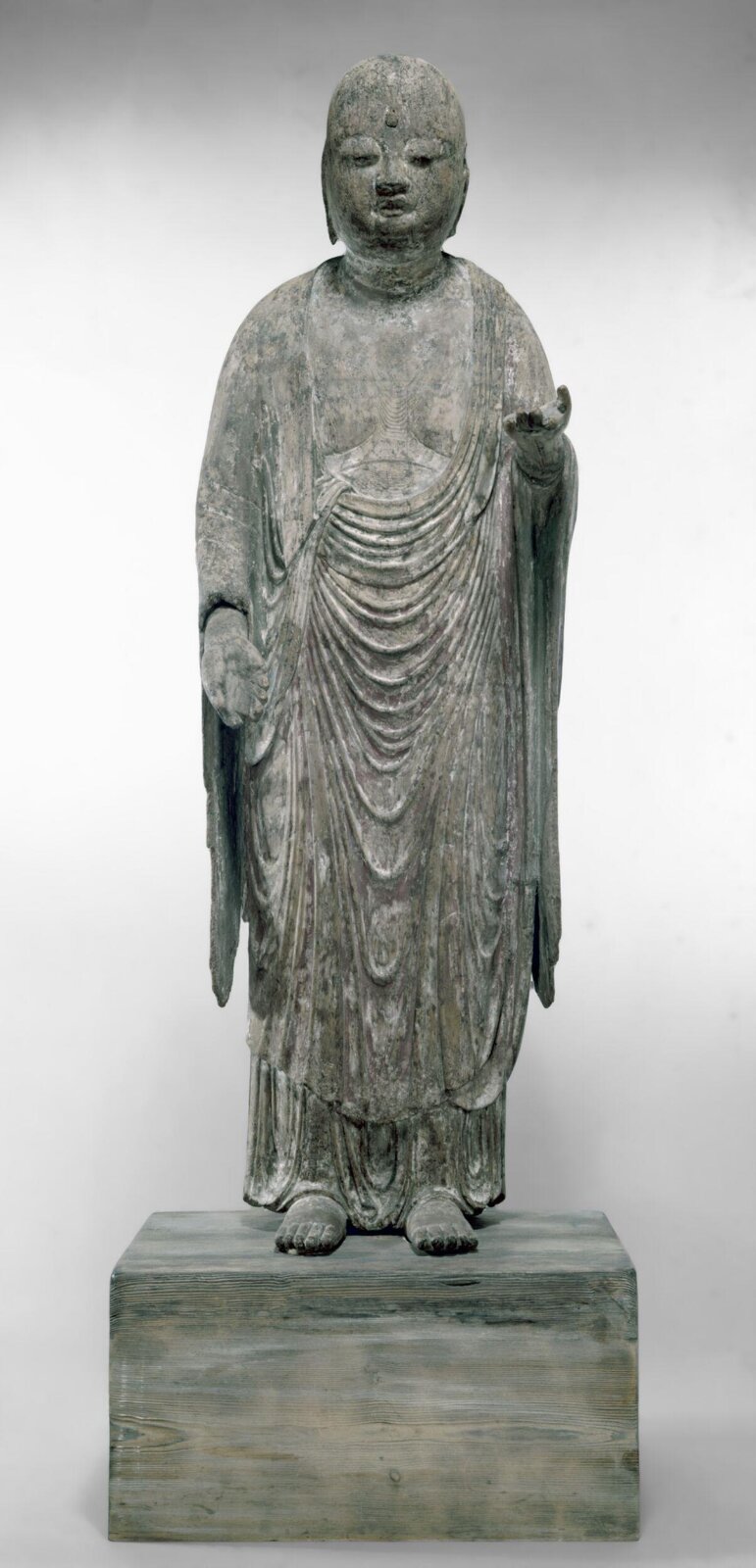
Bodhisattva Jizō
¿Se puede contemplar?
Sí, recibe visitas

Museo de Victoria y Alberto
SalaJapan, Room 45, The Toshiba GalleryLondres, Reino Unido
Expuesta al público. Quién lo avala figura más abajo.
- Comprobado
- hace 9 días
- En este estado desde
- 25 sept 2026
- Fuente
- Los datos de colección del propio museo
About the sculpture
A bodhisattva is viewed as a divine being with boundless compassion who intercedes on behalf of living creatures in distress. While awaiting the arrival of the Buddha of the Future, a bodhisattva postpones his own entry into Nirvana in order to help others achieve enlightenment.
Jizo is one of Japan’s most popular bodhisattvas and appears in the guise of a monk carrying a staff in his right hand and the Buddhist wish-fulfilling jewel in his left: both are missing from this sculpture. In early examples he holds a wish-fulfilling gem in his left hand while his right hand indicates the wish-granting mudra.
Read on
The head of this sculpture dates to the late Heian period (12th century). Inscriptions found inside the sculpture indicate that the body may have been restored (or carved to match the head) in 1682 (Tenna 2) by Iori Sadakiyo; at this time the sculpture was housed in Byodoji, a temple in Imayama Village. An inscription on the bottom of the pedestal indicates that this was made later than the restoration in 1755 (Horeki 5).
Images of Jizo are very common in Japan, reflecting the continuing popularity of his worship among the general populace. Because of his mission to save all sentient beings, there evolved the idea of 'six Jizo' - one responsible for each of the six realms of transmigratory existence. The six realms constitute the life cycle of unenlightened mortals: they are Hell, Hunger, Animality, Anger, Humanity and Heaven.
The denizens of hell were considered especially deserving of Jizo’s help, and he has come to be particularly revered as their saviour. Jizo is also regarded as the protector of children and travellers, hence the number of stone figures of Jizo that can be seen along the roadside in Japan.
Museo de Victoria y Alberto
Ficha
- Número de inventario
- FE.14-1972
En el catálogo
Fuentes
- Museo de Victoria y Alberto: the museum's own open data · obtenido hace 9 días
- Imagen: Museo de Victoria y Alberto — © Victoria and Albert Museum, London