Thomas Cowperthwaite Eakins (Filadelfia, 25 de julio de 1844-Filadelfia, 25 de junio de 1916) fue un pintor estadounidense.

Estados Unidos · 1844–1916
Thomas Eakins
Thomas Cowperthwaite Eakins fue un pintor estadounidense.
Estados Unidos · 1844–1916
Thomas Cowperthwaite Eakins fue un pintor estadounidense.
Thomas Cowperthwaite Eakins (Filadelfia, 25 de julio de 1844-Filadelfia, 25 de junio de 1916) fue un pintor estadounidense.
Nacimiento · 25 de julio de 1844
Philadelphia
Evento · c. 1856 · Philadelphia
By twelve, masters precise drawing
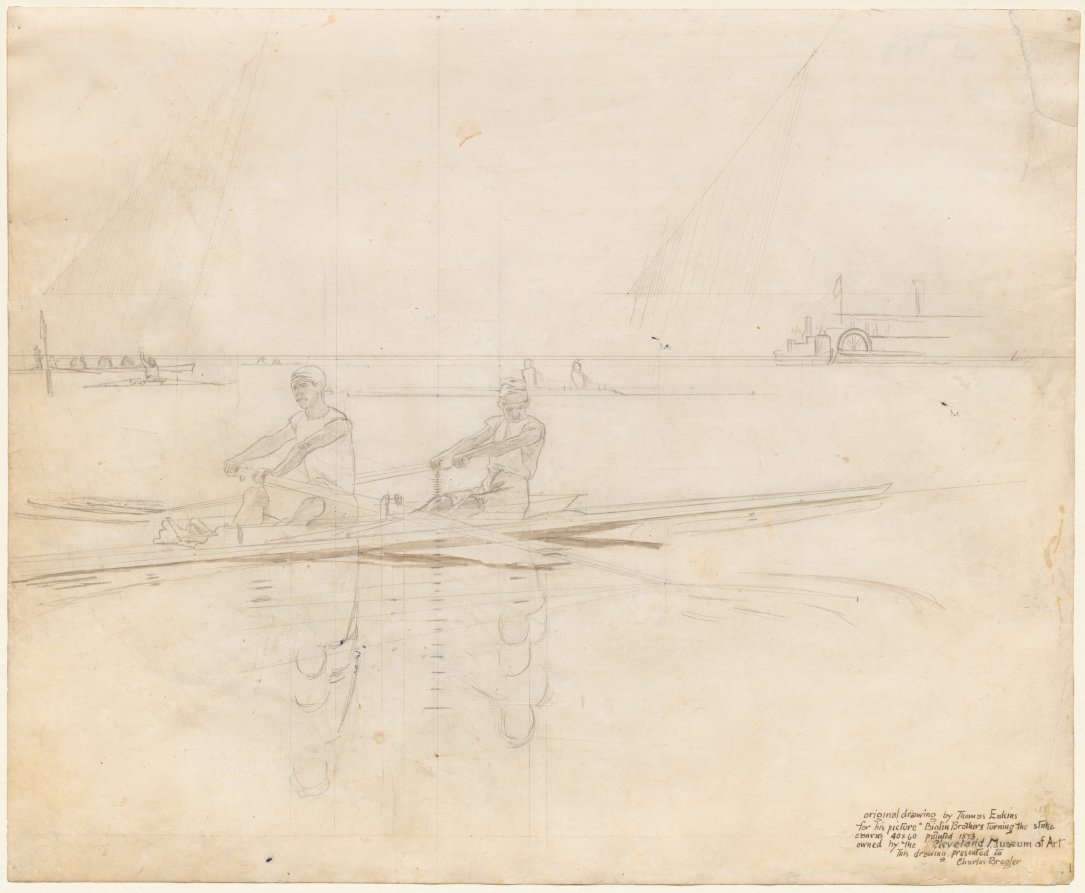
The son of the writing master and calligraphy teacher Benjamin Eakins, he watched his father at work and by the age of twelve showed skill in precise line drawing, perspective and laying out a design on a grid — skills he later applied to his art. An athletic boy, he loved rowing, skating, swimming, wrestling, sailing and gymnastics, the future subjects of his paintings.
Carrera · Philadelphia
Enrols at the Pennsylvania Academy of the Fine Arts
At the Academy Eakins was reunited with Charles Lewis Fussell, a fellow artist and lifelong friend from Philadelphia's Central High School, where Eakins had excelled in mechanical drawing. There too he met Emily Sartain, daughter of John Sartain.
Lugar de trabajo · 1862–1866
Philadelphia
Carrera · 1864–1865 · Philadelphia
Anatomy and dissection at Jefferson Medical College
While at the Academy, Eakins took courses in anatomy and dissection at Jefferson Medical College; his scientific interest in the human body led him to consider becoming a surgeon. For a while he also followed his father's profession and was listed in city directories as a writing teacher.
Lugar de trabajo · 1870–1916
Philadelphia
Evento
Acquires a camera
From 1880 Eakins had his own camera: paintings such as “Mending the Net” (1881) and “Arcadia” (1883) derive in part from his photographs. He is credited with having “introduced the camera to the American art studio”; some eight hundred photographs are attributed to him and his circle.
Carrera · Philadelphia
Becomes director of the Pennsylvania Academy
Eakins became the Academy's director. His methods were controversial — no drawing from antique casts and no prize competitions, a quick move from charcoal to paint, anatomy through dissection and photography — yet by the early 1880s the course was called the most “liberal and advanced in the world”.
Familia
Death of his sister Margaret
Eakins's sister Margaret, who had acted as his secretary and personal servant, died of typhoid; it has been suggested that his marriage two years later was meant to replace her.
Carrera
Equestrian reliefs for an arch in Brooklyn
Acknowledging Eakins's expertise in equine anatomy, his friend the sculptor William Rudolf O'Donovan asked him to collaborate on the commission for bronze equestrian reliefs of Abraham Lincoln and Ulysses S. Grant for the Soldiers' and Sailors' Arch in Grand Army Plaza, Brooklyn.
Carrera · March 1895 · Philadelphia
Dismissed by the Drexel Institute
The Drexel Institute dismissed Eakins for again using a fully nude male model. By 1898 he had gradually withdrawn from teaching, which he had also done at the Art Students League of New York, the National Academy of Design, Cooper Union and the Art Students' Guild in Washington.
Obra
Paints Cardinal Sebastiano Martinelli
It belongs to a late series of portraits of the Catholic clergy — from a cardinal to monsignors, among them Archbishop William Henry Elder (1903). As usual, Eakins asked the sitters to pose and gave them the finished portraits, and the brilliant vestments animated the compositions.
Obra
Returns to “William Rush and His Model”
Many years later the subject became personal: the chaperon and detailed interior are gone, and so is the distance between sculptor and model; in one version the nude, seen from the front, is helped down from the stand by an artist who strongly resembles Eakins.
Fallecimiento · 25 de junio de 1916
Philadelphia
Sepultura
The Woodlands
Took part · 30 de julio de 1932 – 14 de agosto de 1932
1932 Summer Olympics
Viaje
Leaves to study in Paris under Gérôme
Eakins left to study in Europe, chiefly in Paris under Jean-Léon Gérôme — he was only the second American pupil of the master — and also attended Léon Bonnat's atelier, while taking scant interest in Impressionism. His romance with Emily Sartain floundered after he left, and she accused him of immorality.
Lugar de trabajo · 1866–1869
Paris
Viaje
Switzerland
Viaje
Germany
Evento · Paris
Letter to his father: “I hate affectation”
In a letter to his father, the 24-year-old Eakins set out his creed: the female nude is the most beautiful thing in the world except a naked man, yet he had never seen a study of one exhibited — and he mocked the salons' “smiling smirking goddesses of waxy complexion”. “I hate affectation,” he concluded.
Viaje · 1869–1870
Spain
Obra
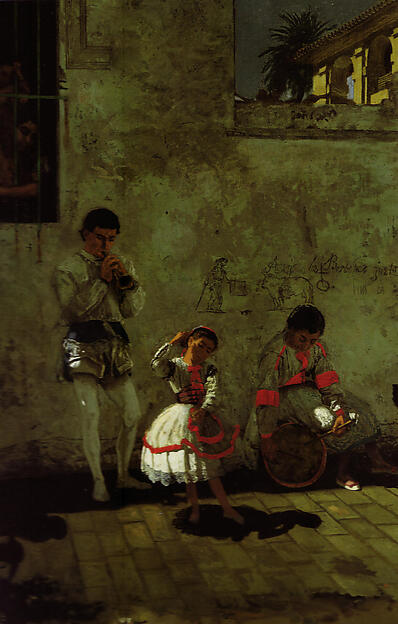
Paints “A Street Scene in Seville”
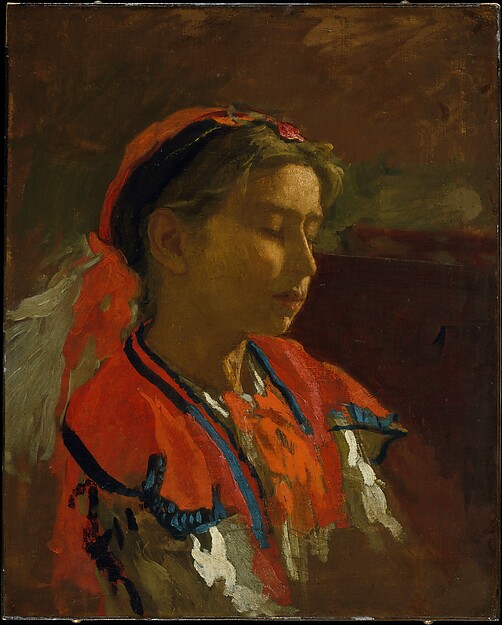
On a six-month trip to Spain that confirmed his admiration for the realism of Velázquez and Ribera, Eakins attempted his first large oil painting — his first scene observed outside the studio. The same year in Seville he painted “Carmelita Requeña”, a portrait of a seven-year-old Romani dancer, more freely and colourfully than his Paris studies.
Obra
“The Gross Clinic”
Encuentro
Meets Susan Macdowell
At the Hazeltine Gallery, where “The Gross Clinic” was on show, Eakins met the 25-year-old Susan Macdowell, daughter of a Philadelphia engraver. Unlike many, she was impressed by the painting and went to study with him at the Academy for six years, winning the Mary Smith Prize for the best painting by a woman student.
Obra
“The Chess Players”
Exposición
Centennial Exhibition: “The Gross Clinic” rejected
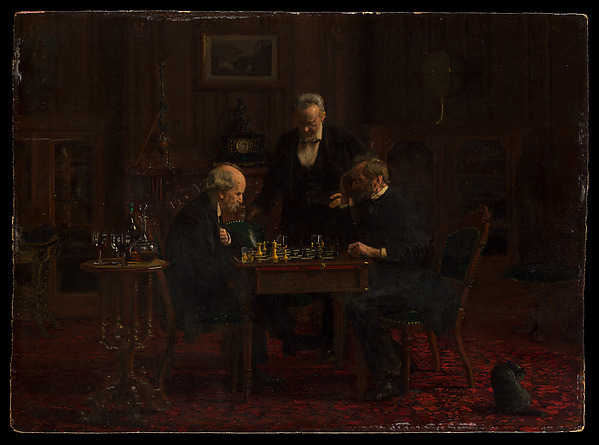
The committee of the Centennial Exhibition rejected “The Gross Clinic” for the Art Gallery — it was shown in an exhibit of a U.S. Army Post Hospital — while “The Chess Players” was accepted, much admired and praised by critics. One reviewer knew of nothing greater ever executed in America, but the blood on the canvas troubled the public, and the college finally bought the picture for just $200.
Obra
Paints Dr. John Brinton
Dr. John Brinton, surgeon of the Philadelphia Hospital and famed for his Civil War service, is shown in a more informal setting than Dr. Gross; the portrait was a personal favourite of Eakins, and The Art Journal judged it a more favourable example of his abilities than the much-talked-of “Clinic”.
Obra
Paints “William Rush and His Model”
Riding the revival of interest in Colonial America after the Centennial Exhibition, and working from oil studies and wax and wood models, Eakins painted the Colonial sculptor William Rush, a founder of the Pennsylvania Academy. The nude model with her heaped-up clothes front and centre and Rush in the shadows again stirred dissatisfaction.
Encuentro · Philadelphia
Brings Eadweard Muybridge to lecture at the Academy
In the late 1870s Eakins had discovered Eadweard Muybridge's photographic motion studies, especially those of horses; in 1883 he and the University of Pennsylvania trustee Fairman Rogers arranged for Muybridge to lecture at the Academy.
Familia
Marries Susan Macdowell
At 40, Eakins married his former pupil, the painter Susan Hannah Macdowell. In their childless marriage she painted only sporadically, supporting her husband's career, shared his passion for photography and stood by him in his difficult years, even when some of her family turned against him.
Carrera · Philadelphia
Works alongside Muybridge
Eakins briefly worked alongside Muybridge in the latter's photographic studio at 36th and Pine streets, then developed his own technique: instead of a battery of cameras, a single camera making a series of exposures on one negative, to measure motion precisely for painting.
Obra
“Swimming”
Carrera · Philadelphia
Forced out of the Academy over a nude model
Eakins was forced to resign after removing the loincloth of a male model in a class where female students were present. It was a major setback: his family split, his in-laws sided against him in public, he fought rumours and suffered bouts of ill health, and the drawing manual he had written remained unfinished and unpublished in his lifetime.
Carrera · Philadelphia
Students follow him to the Art Students' League
A number of students broke with the Academy and formed the Art Students' League of Philadelphia (1886–1893), where Eakins taught. There he met the student Samuel Murray, later a sculptor, his protégé and lifelong friend and, in his last years, his constant companion in boxing and bicycling.