 Isaac Levitan1860–1900
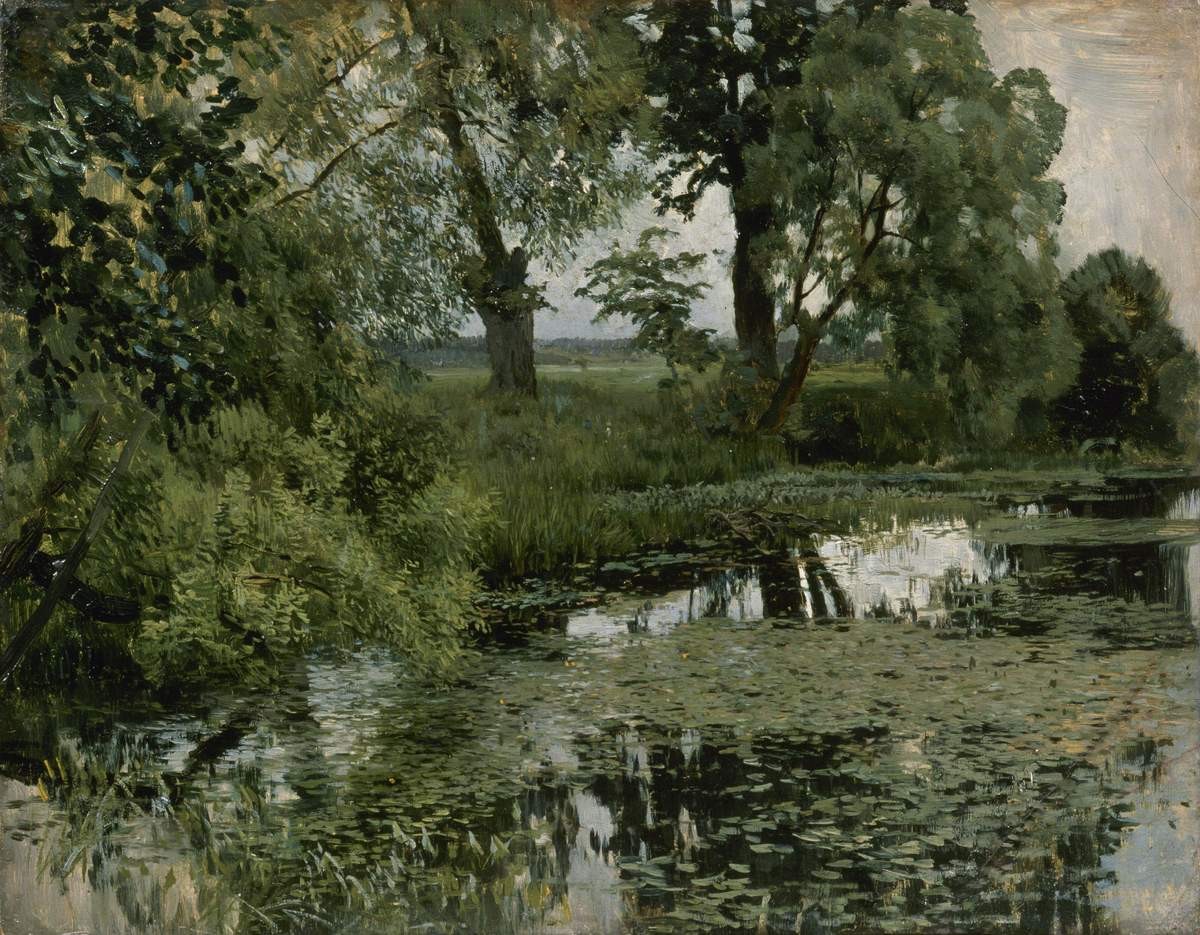
Заросший пруд
Can I see it?
Unknown
Where is “Заросший пруд” now? Collection: State Russian Museum, Saint Petersburg. Unknown.

Saint Petersburg, Russia
The owner is known; whether it is on view today is not.
- In this state since
- Source
- The museum
About the painting
Museum text in Russian
Этюды Левитана очень высоко ценил В. Д. Поленов , возглавивший пейзажный класс Московского училища живописи, ваяния и зодчества после ухода Саврасова в 1882 году. Общение, а затем дружба с новым педагогом, признанным мастером пленэрной живописи, стали очередной ступенью эволюции творчества Левитана. Он открывает для себя новые возможности в передаче воздушной перспективы, о чем свидетельствует, например, написанный через несколько лет не без влияния известной картины Поленова одноименный пейзаж « Заросший пруд » (1887, Ж-4282 ). К сожалению, затянувшееся на десятилетие обучение Левитана не принесло ему желаемого профессионального признания. В 1883 году он фактически заканчивает образовательный курс и на следующий год получает всего лишь звание неклассного художника с правом работать учителем рисования. Сергей Кривонденченков. « Пейзаж, завещанный И. И. Левитаном » // Исаак Левитан. К 150-летию со дня рождения. СПб, 2009. С. 8.
Read on
Произведение «Заросший пруд» является подтверждением тесных связей творчества Исаака Левитана с традициями отечественного реалистического пейзажа. Картина была начата под влиянием одноименной работы Василия Поленова , учителя и старшего друга Левитана, вероятно, в один из приездов молодого живописца на дачу Поленовых «Жуковка» летом 1887 года. Художник соединил в запечатленном уголке деревенского пейзажа его естественную неповторимость и «узнаваемость» типичных черт русской природы.
State Russian Museum
Details
- Accession number
- Ж-4282
What it shows
In the catalog
Sources
- State Russian Museum
- Image: State Russian Museum — © State Russian Museum
In the life of Isaac Levitan
The whole lifemid-1880s
His heart disease sharply worsens
Levitan's material situation improves in the mid-1880s, but a hungry childhood, an unsettled life and hard work tell on his health: his heart disease sharply worsens.
spring 1885
He graduates without the title of artist
In spring 1885, at twenty-four, he graduates from the school but does not receive the title of artist: he is given a diploma as a teacher of penmanship. He has no money.
April 1885
He settles at Maximovka and meets Chekhov
In April 1885 he settles in the remote village of Maximovka near Babkino, where the Chekhovs are staying at the Kiselyov estate; his acquaintance with Anton Pavlovich Chekhov begins a friendship and rivalry that will last all his life.
1886
The Crimea and an exhibition of fifty landscapes
A trip to the Crimea in 1886 restores his strength; on his return Levitan organises an exhibition of fifty of his landscapes.
spring 1888
He discovers Plyos on the Volga
In spring 1888 he sails by steamer along the Oka to Nizhny Novgorod and on up the Volga with the artist Alexei Stepanov and Sofia Kuvshinnikova; to their own surprise they discover the small, quiet town of Plyos and decide to stay on for a while. The three summer seasons there (1888–1890) prove extremely productive: some two hundred works bring Levitan wide fame.
late 1889 – early 1890
His first trip to Western Europe
He visits France and Italy, wanting to get to know modern painting better as shown at the World Exhibition in Paris — probably above all the Barbizon school and the Impressionists. According to Nesterov, in the West he became convinced that the path he had chosen was the right one.