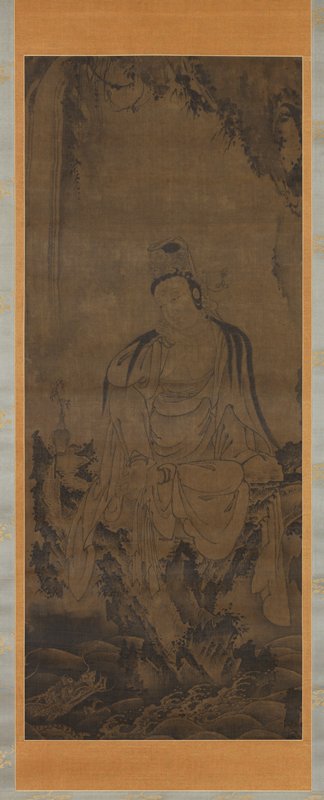
White-Robed Kannon
May one see it?
Not receiving at present

Minneapolis Institute of Art
Minneapolis, United States
It belongs to the collection, but is not on display at present.
- Checked
- yesterday
- In this state since
- Sep 25, 2026
- Source
- The museum's own collection data
About the painting
Painted images of the Buddhist deity Kannon wearing white robes and seated on a rocky outcropping emerged in China during the Tang dynasty (618–907) and became important in the Zen sect of Buddhism before it was introduced to Japan a few hundred years later. Such images refer to a passage from the Avatamsaka Sutra, a sacred Buddhist text that narrates the story of Zenzai Dōji, a boy who sets out on a journey of truth and consults with numerous teachers, Kannon being one of them. Kannon is a bodhisattva, an enlightened being that forgoes Buddhahood in order to assist humans on the path to enlightenment. According to the text, the boy finds Kannon in Fudaraku, the bodhisattva’s paradise, seated on a boulder in a warm, misty locale. The boy’s journey and his encounter with Kannon can be seen as allegories for Zen practice and the path to enlightenment, so Zen masters hung paintings of white-robed Kannon in the temple hall devoted to the training of novice monks.
Minneapolis Institute of Art
Particulars
- Accession number
- 2015.79.48
In the catalog
Sources
- Minneapolis Institute of Art: the museum's own open data · fetched 5 days ago
- Image: Minneapolis Institute of Art — public domain