 Aleksandr RodchenkoRussian, 1891–1956
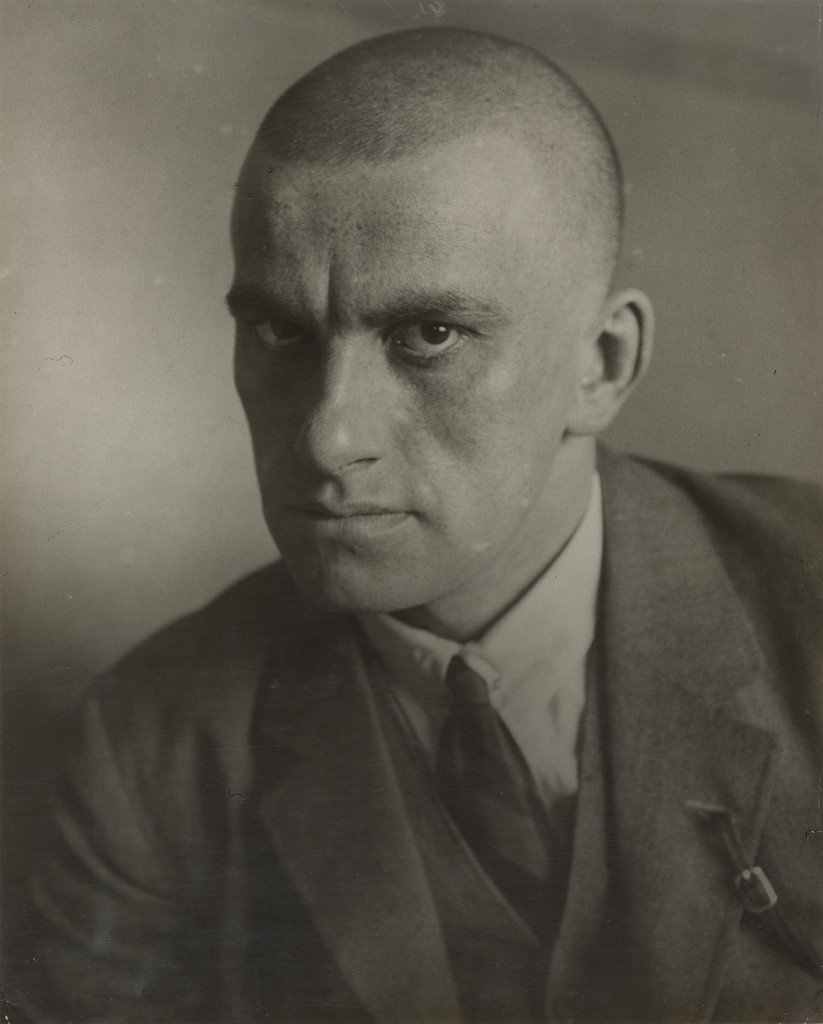
Vladimir Mayakovsky
May one see it?
Not receiving at present

New York, United States
It belongs to the collection, but is not on display at present.
- Checked
- Source
- The museum
Particulars
- Accession number
- 795.1998
In the catalog
Sources
- The Museum of Modern Art
- Image: The Museum of Modern Art — © the artist or rights holder
Meanwhile, in the life of Aleksandr Rodchenko
The whole life1920–1930
Professor at VKhUTEMAS/VKhUTEIN
For ten years Rodchenko teaches in the woodworking and metalworking faculties (merged into the Dermetfak in 1928), training students to design multifunctional objects for everyday life and public buildings, expressive through construction rather than ornament.
1922
Works with Dziga Vertov
Rodchenko works intensively with the filmmaker Dziga Vertov, whose ideas and practice deeply influenced him.
1923–1928
LEF and Novy LEF with Mayakovsky
From 1923 to 1928 Rodchenko works closely with Mayakovsky — photographing him several times and designing and laying out LEF and Novy LEF, the Constructivists' publications; many of his photographs serve as their covers.
1924
Takes up photography
From 1924 Rodchenko takes his own photographs, becoming famous for his experiments with angles and viewpoints. His credo: “I want to teach people to see extraordinarily ordinary things.”
1925
Sent to Paris for the World Exhibition
Appointed to the Soviet exhibition committee, Rodchenko is sent to Paris to design the Soviet pavilion, built to Konstantin Melnikov's plans.
1926
First angled shots published in Sovetskoe Kino
The magazine Sovetskoe Kino publishes his first angled shots of buildings — the series “The Building on Myasnitskaya” (1925) and “The Mosselprom Building” (1926). Rodchenko champions high and low viewpoints and a dynamic, documentary-precise view of the world.