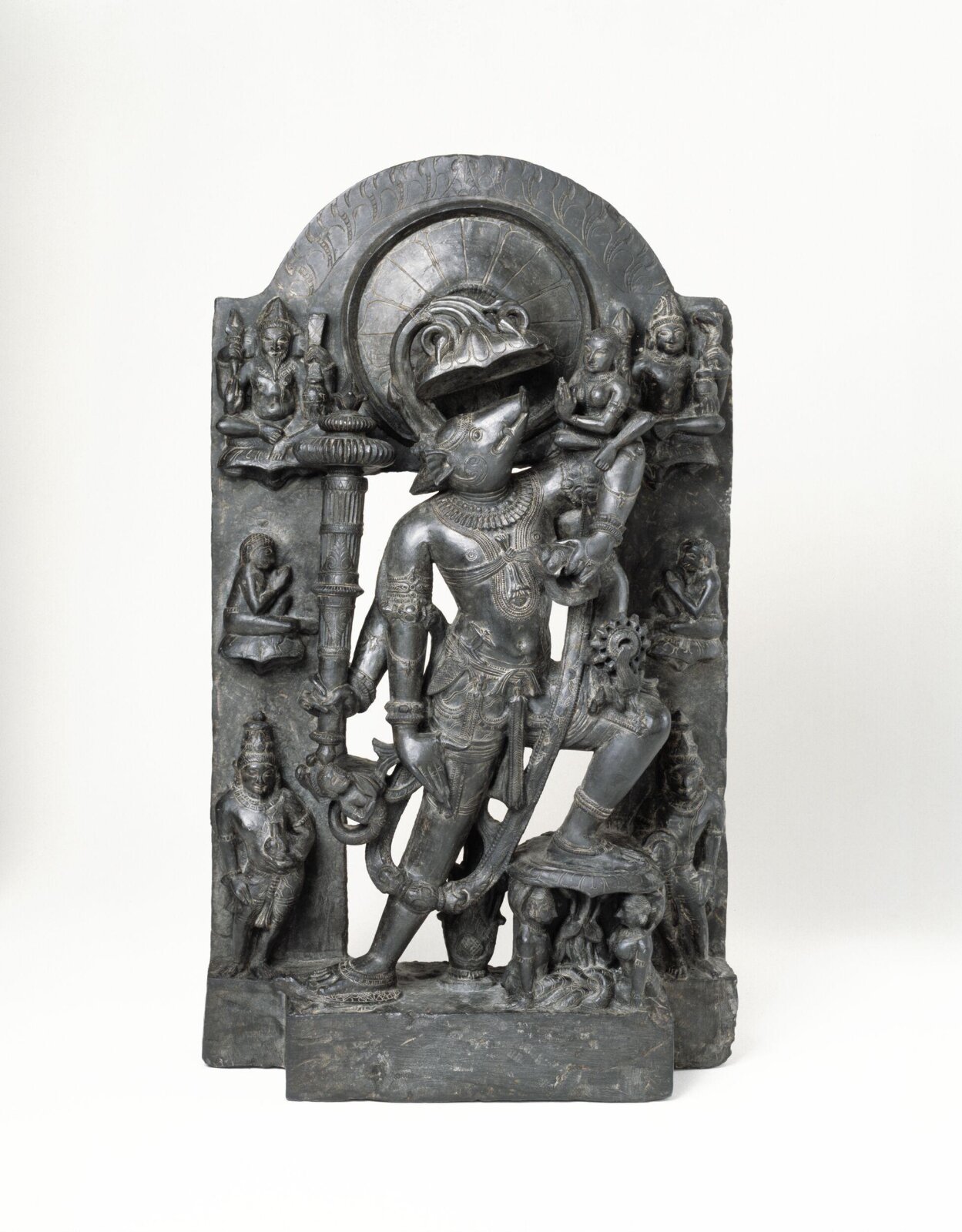
Varaha ascending from the Cosmic Ocean
May one see it?
Not receiving at present

London, United Kingdom
It belongs to the collection, but is not on display at present.
- Checked
- In this state since
- Source
- The museum
About the sculpture
Varaha, the boar incarnation of Visnu, lifting the earth goddess, Bhumi, from the floor of the primeval ocean, where she had been immersed by the demon Hiranyaksa. This creation myth is perhaps rooted in a Vedic memory of a Great Flood; certainly Varaha is amongst the oldest of the Visnu avataras and among the first to be celebrated and worshipped in monumental sculptures, as seen at Eran and Udayagiri, both early Gupta-period sites in Madhya Pradesh.
Read on
Varaha stands with raised left foot resting on a large lotus flower, beneath which sit a naga and nagini, male and female snake divinities. The right foot is placed on the back of a tortoise, emblematic of the Universe. Of the four arms, one rests on the right hip, the other three hold the symbols of Visnu, the mace (gada), conch shell (sangka) and discus (cakra). On his left elbow Varaha supports the diminutive figure of the earth goddess who gazes at him with hands pressed together in adoration (anjali) and in acknowledgement of her deliverance. Above Varaha’s boar-head is an inverted lotus-leaf, serving both as an honorific umbrella and as an indication of their emergence from the depths of the ocean. Flanking the lotus-halo are the seated figures of Brahma (left) and Siva (right). Midway, two worshippers are seated on lotuses and at the bottom are personifications (ayudapurushas) of Visnu’s conch and discus attributes.
Victoria and Albert Museum
Particulars
- Accession number
- IM.307-1921
What it shows
In the catalog
Sources
- Victoria and Albert Museum
- Image: Victoria and Albert Museum — © Victoria and Albert Museum, London