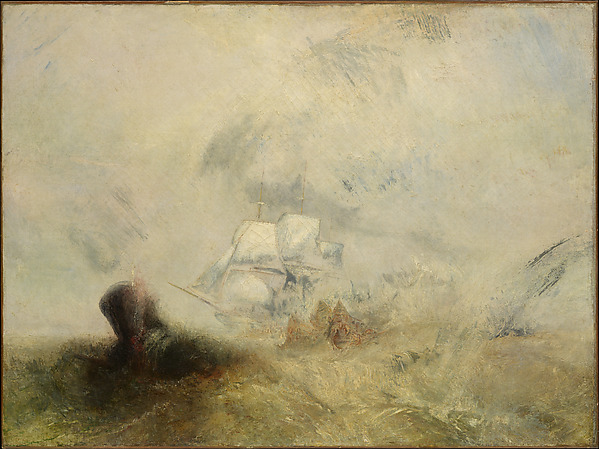
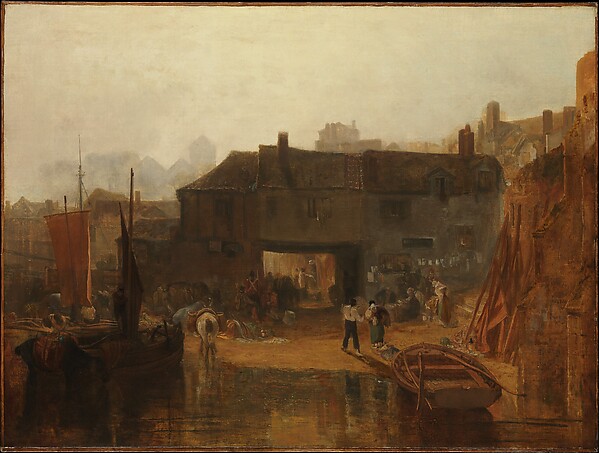
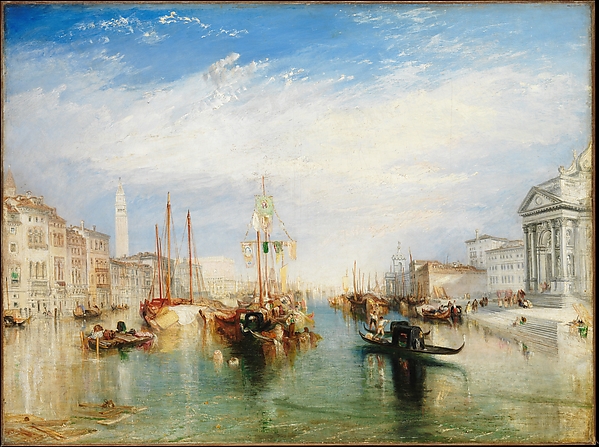
Joseph Mallord William TurnerBritish, 1775–1851
Tynemouth Priory
May one see it?
Unknown

London, United Kingdom
The owner is known; whether it is on view today is not.
- In this state since
- Source
- The museum
Particulars
- Accession number
- NG3133
In the catalog
Sources
- Wikidata
- Image: The National Gallery — J. M. W. Turner · Public domain · Wikimedia Commons
Meanwhile, in the life of Joseph Mallord William Turner
The whole life1806–1819
Work on the “Liber Studiorum”
For nearly twelve years he worked on about 70 mezzotints — the “Book of Studies”, inspired by Claude’s Liber Veritatis and meant as a manifesto of British landscape art; commercially it failed because of poor handling of sales and distribution, but it did elevate the prestige of landscape painting.
1808–1824
Summers at Walter Fawkes’s Farnley Hall
From 1808 to 1824 he stayed many summers at Farnley Hall near Otley in Yorkshire with its owner Walter Fawkes, becoming almost part of the family, with a room assigned for his exclusive use.
1819
First journey through Italy
He visited Turin, Milan, Rome, Venice and Naples, studying the works of Titian, Tintoretto, Raphael and contemporary Italian artists; after the trip his painting became brighter, his palette more intense, with primary colours predominating, and the Venetian theme took a special place in his work.
1829
The death of his father
His father, who had lived with him for thirty years and worked as an assistant in his studio, died in 1829; the loss strongly affected Turner, who began to suffer fits of depression afterwards, and he finally abandoned his own gallery.
1829
Paris, Normandy and Brittany
In the twenty-year period from 1821 to 1844 he visited several European countries, studying the old masters and taking long hikes into the countryside: in 1829 Paris, Normandy and Brittany, and three years later Paris for the second time.
1830–1840s
Criticism in the 1830s–1840s and Ruskin’s defence
His innovative works, bordering on abstraction, gave him a reputation for madness: the Victorian public preferred realism and sentimentality, and Queen Victoria refused to knight him. John Ruskin came to his defence, calling him “the greatest artist of all time”.