 Rogier van der WeydenFlemish, 1399–1464
Braque Triptych
Triptyque de la famille Braque
Can I see it?
Not on view at present
Where is “Braque Triptych” now? Collection: Musée du Louvre, Paris. Not on view at present. Checked September 26, 2026.

Paris, France
It belongs to the collection, but is not on display at present.
- Checked
- In this state since
- Source
- The museum
About the painting
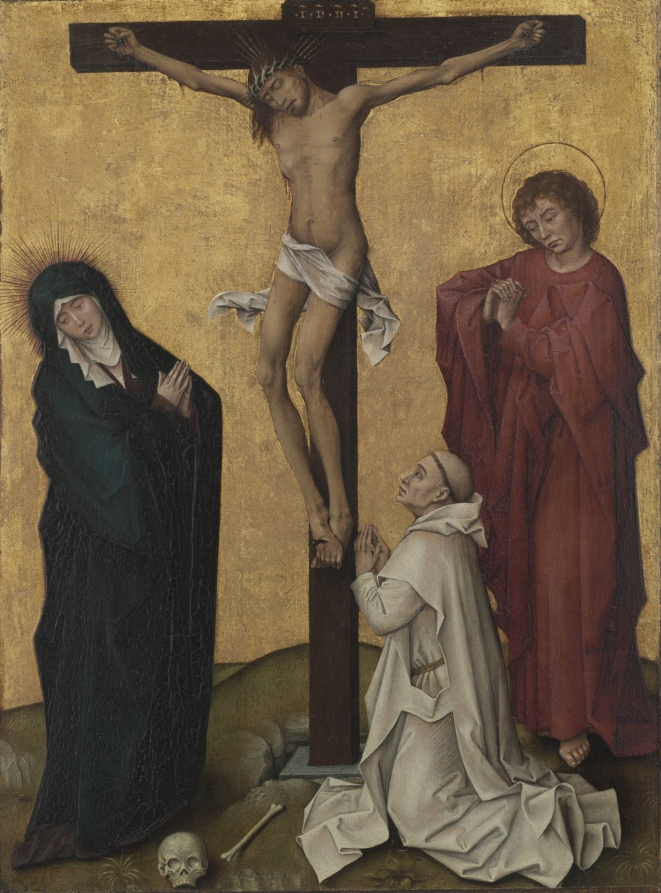
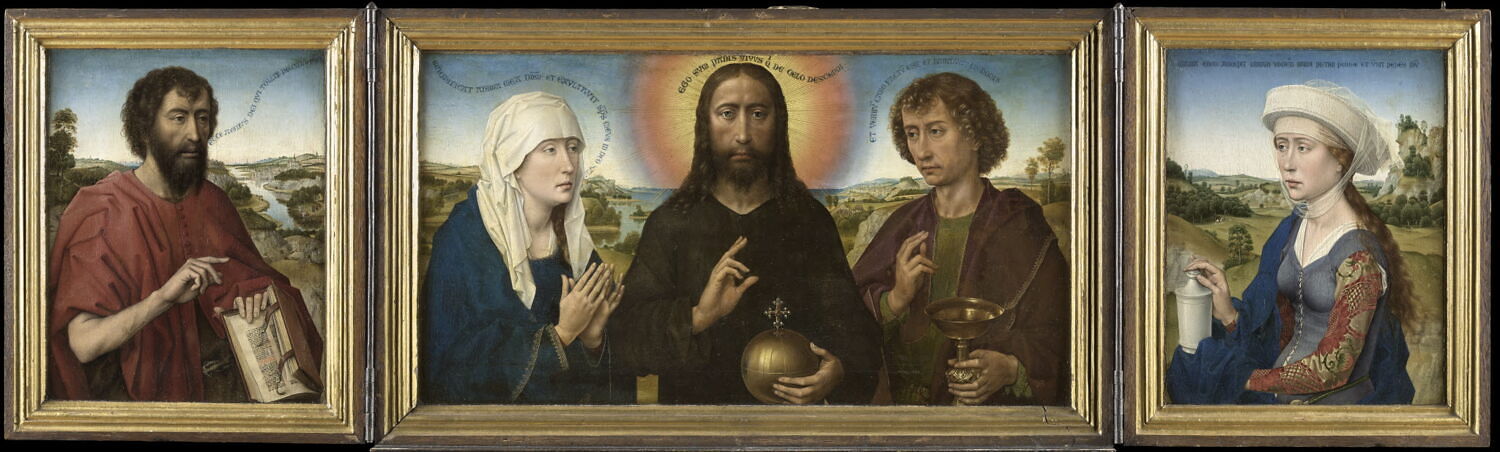
The Braque Triptych (or the Braque Family Triptych) is a c. 1452 oil-on-oak altarpiece by the Early Netherlandish painter Rogier van der Weyden. When open, its three half-length panels reveal, from left to right, John the Baptist, The Virgin Mary with Jesus and Saint John the Evangelist, and Mary Magdalene. When the wings are closed, the work shows a vanitas motif of a skull and cross.
Read on
The Braque Triptych is the only surviving devotional work by van der Weyden known to be painted for private rather than public display. The altarpiece was probably commissioned by either Jehan Braque of Tournai or, more likely, his wife Catherine de Brabant – possibly after Jehan's sudden and early death in 1452. The couple had been married for only a brief period. Catherine was much younger than her husband; when they married in 1450 or early 1451, she was 20 and some 12 or 13 years his junior. She evidently held a deep and lasting affection for him. When she died, almost 50 years after him, she had asked to be buried alongside him, despite remarrying years earlier.
Today the triptych is on permanent display in the Musée du Louvre, Paris, in its original oak frame. Because of its fragility, it is encased in glass.
Details
- Accession number
- RF 2063
In the catalog
Sources
- Musée du Louvre
- Image: Musée du Louvre — © 2017 GrandPalaisRmn (musée du Louvre) / Tony Querrec
In the life of Rogier van der Weyden
The whole life1390s
Born
1426
He marries Elisabeth Goffaert, a shoemaker’s daughter
In 1426 he married Elisabeth, daughter of the Brussels shoemaker Jan Goffaert and his wife Cathelyne van Stockem; they had four children.
1427
Teacher: Robert Campin
by 21 October 1435
He moves to Brussels and takes a new name
By 21 October 1435 he and his family were living in Brussels — one of Europe’s largest cities and the chief residence of the Dukes of Burgundy; Dutch was spoken there, and Roger de la Pasture became Rogier van der Weyden.
2 March 1436
Painter to the town of Brussels
From 2 March 1436 he held the prestigious title of “painter to the town of Brussels” (stadsschilder): the post was created especially for him, was meant to lapse on his death and was tied to a huge commission — four justice scenes for the “Golden Chamber” of the town hall.
18 June 1464
Died