 Henri MatisseFrench, 1869–1954
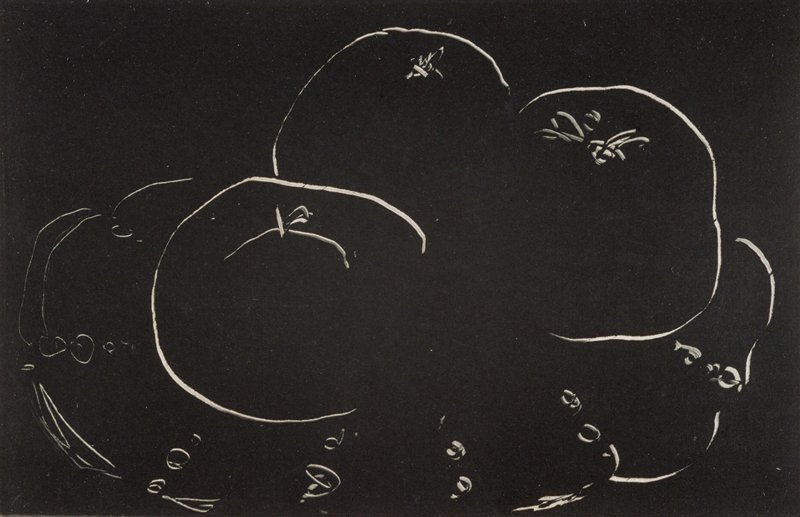
Three Apples and Plate
Can I see it?
Not on view at present
Where is “Three Apples and Plate” now? Collection: Minneapolis Institute of Art, Minneapolis. Not on view at present. Checked September 29, 2026.

Minneapolis, United States
It belongs to the collection, but is not on display at present.
- Checked
- In this state since
- Source
- The museum
About the work
The creation of a monotype involves drawing a design in ink on a smooth, nonabsorbent printing plate. While the ink is still wet, a sheet of paper is applied to the plate, which is then run through a press to transfer the image to the sheet of paper. Unlike other printing processes, the monotype technique allows for only one unique impression to be taken from the plate.
Matisse monotypes all date from a short period during the mid-teens, when he produced a total of about seventy. Artists frequently use monotype to create their images by building up desired areas of the dark ink on the surface of the plate. Matisse, however, reversed the process. He began with a plate completely covered in black ink, and subsequently scratched lines of varying width through the field of wet ink. The resulting white lines in his printed monotypes electrify and seem to quiver against the deep black ground.
Minneapolis Institute of Art
Details
- Accession number
- P.86.4
In the catalog
Sources
- Minneapolis Institute of Art
- Image: Minneapolis Institute of Art — public domain
In the life of Henri Matisse
The whole life1912
First Exhibition in the United States
Matisse's first American exhibition was held in New York, organized by Alfred Stieglitz at Gallery 291.
1912–1913
Seven Months in Morocco
Matisse spent about seven months in Morocco, producing roughly 24 paintings and numerous drawings. His Orientalist motifs — odalisques and goldfish in aquariums — date from this period.
1913
Armory Show: A Storm of Indignation
Several of Matisse's paintings were included in the Armory Show in New York and provoked a storm of indignation among the conservative American public. Nevertheless, his works continued to be exhibited in the United States until 1926.