
 Grosz, GeorgeGerman, 1893–1959
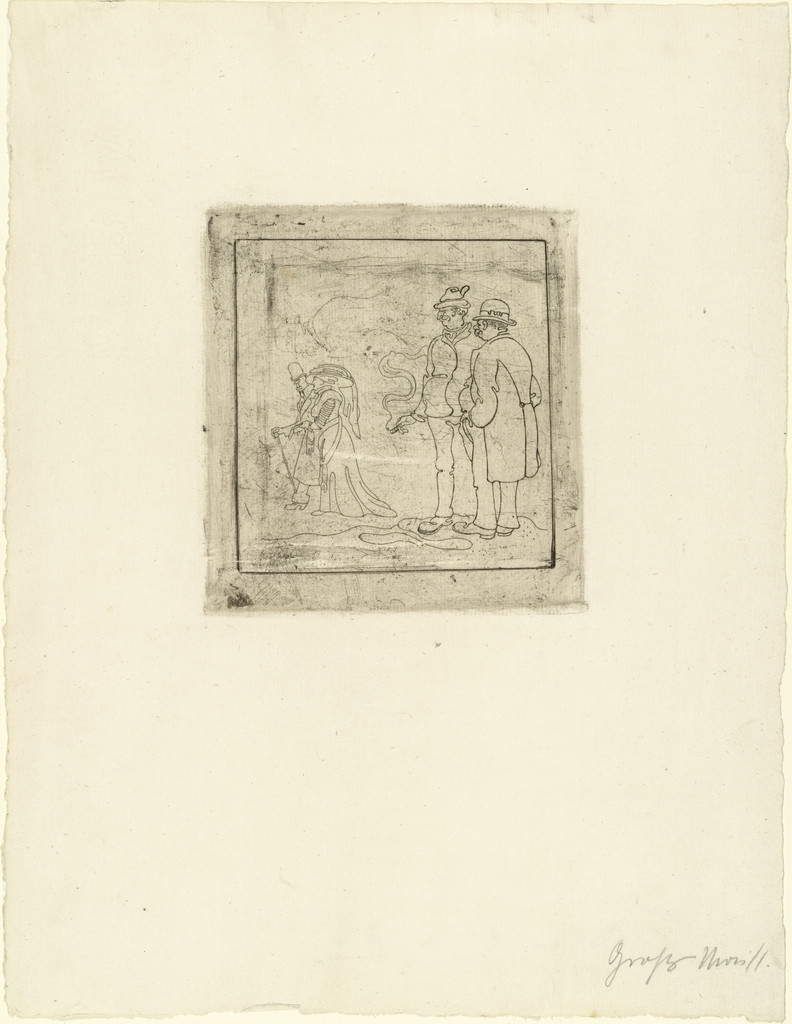
"They thunder forth from their clouds about gentleness and forbearance, while they sacrifice human victims to the God of love." (Act II, scene 3), from Die Rauber
Can I see it?
Not on view at present
Where is “"They thunder forth from their clouds about gentleness and forbearance, while they sacrifice human victims to the God of love." (Act II, scene 3), from Die Rauber” now? Collection: Art Institute of Chicago, Chicago. Not on view at present. Checked September 29, 2026.

Chicago, United States
It belongs to the collection, but is not on display at present.
- Checked
- In this state since
- Source
- The museum
Details
- Accession number
- 1963.753.7
In the catalog
Sources
- Art Institute of Chicago
- Image: Art Institute of Chicago — © the artist or rights holder
In the life of Grosz, George
The whole life1918–1921 · Residence
Wilmersdorf
1920
The First International Dada Fair
Grosz helps organise the First International Dada Fair and exhibits his work there.
26 May 1920
Marriage to Eva Louise Peter
Grosz marries Eva Louise Peter; the couple will have two sons — Peter Michael, a historian of early German aviation, and Marty, a jazz guitarist.
1921
Convicted of insulting the German army
Grosz is charged with insulting the German army and fined; by the court's verdict his series of satirical drawings Gott mit uns is destroyed.
1922
A journey to Russia with Martin Andersen Nexø
On arrival in Murmansk, Grosz and the Danish writer Martin Andersen Nexø are briefly arrested as spies; after their credentials are approved they are allowed to continue their journey.
1922
Meetings with Lenin, Lunacharsky and Tatlin
In Russia Grosz meets Bolshevik leaders such as Grigory Zinoviev, Karl Radek and Vladimir Lenin, and with Arthur Holitscher goes to see Anatoly Lunacharsky to discuss Proletkult, rejecting the concept of 'proletarian culture'. There he also meets the Constructivist artist Vladimir Tatlin.


![The End of the Road (Out of Fear of Starvation) [Das Ende des Weges (Aus Nahrungssorgen)], George Grosz, 1913](https://www.moma.org/media/W1siZiIsIjEyMTkwNyJdLFsicCIsImNvbnZlcnQiLCItcmVzaXplIDEwMjR4MTAyNFx1MDAzZSJdXQ.jpg?sha=864379f3ce59af36)









