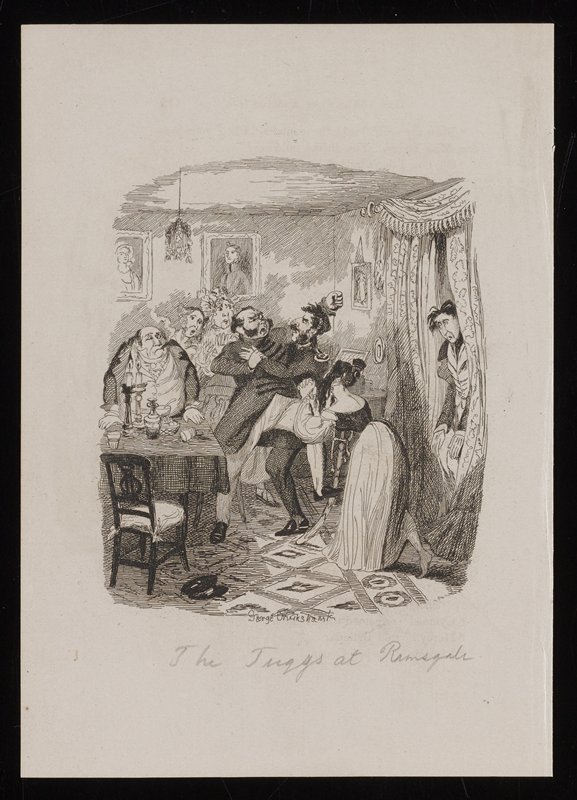
 George CruikshankEnglish, 1792–1878
The Tuggs at Ramsgate
May one see it?
Not receiving at present

Minneapolis, United States
It belongs to the collection, but is not on display at present.
- Checked
- In this state since
- Source
- The museum
Particulars
- Accession number
- P.5, 888.5
In the catalog
Sources
- Minneapolis Institute of Art
- Image: Minneapolis Institute of Art — public domain
Meanwhile, in the life of George Cruikshank
The whole life1811
Fame through caricatures for “The Scourge”
A series of satirical caricatures for the monthly “The Scourge, a Monthly Expositor of Imposture and Folly” makes him famous. In four years with the magazine he comes close to James Gillray in popularity and earnings, and in the end replaces him as England’s most popular satirist.
1823
Turns to book illustration
At 31 he begins to focus on book illustration (other accounts say books by contemporary authors had occupied him since 1820, while he went on illustrating political life until 1825). Over his long life he will illustrate more than 850 books and create nearly 10,000 prints, illustrations and plates.
16 October 1827
Marries Mary Ann Walker
He marries Mary Ann Walker (1807–1849); the marriage will last until her death.
late 1840s
Becomes a champion of temperance
In the late 1840s Cruikshank’s attention shifts from book illustration to temperance and the fight against smoking: a former heavy drinker, he supports, lectures to and draws for the National Temperance Society and the Total Abstinence Society. His committed teetotalism further sours his friendship with Dickens, who held to moderation.
30 December 1871
Claims credit for the plot of “Oliver Twist”
On 30 December 1871 he publishes a letter in The Times claiming credit for much of the plot of “Oliver Twist”, which launches a fierce controversy over who created the novel. Robert Seymour had made a similar claim about “The Pickwick Papers”; in his 1867 preface Dickens strenuously denied any outside input.
1 February 1878
Death in London
He dies in London; in his last years, after developing palsy, his health and the quality of his work declined. He is first buried in Kensal Green Cemetery, and in November 1878 his remains are reburied in St Paul’s Cathedral. The obituary in Punch called him a blameless man with a childlike nature, apparently unaware of his large illegitimate family — 11 children by his former servant Adelaide Attree.