 Pietro PeruginoItalian, 1448–1523
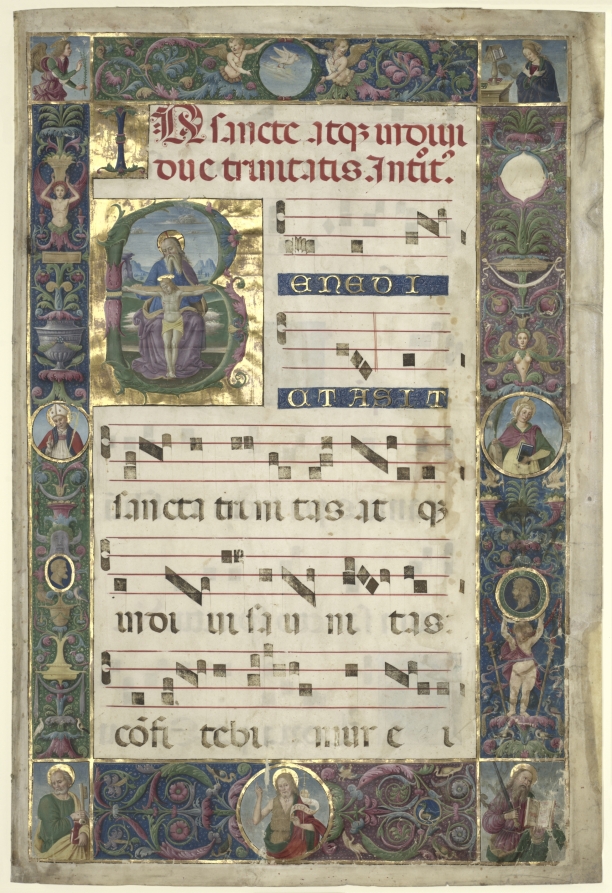
The Trinity: Leaf from a Gradual with Initial B
May one see it?
Not receiving at present

Cleveland, United States
It belongs to the collection, but is not on display at present.
- Checked
- In this state since
- Source
- The museum
About the painting
The focus of this lavishly illuminated page is a large initial B containing a representation of the Holy Trinity (three persons in one godhead). The text, Benedicta sit sancta Trinitas, introduces the opening of the Introit for Mass on Trinity Sunday, celebrated one week after Pentecost. An illusion has been created by the artist who painted the framing initial to appear three-dimensional. Beyond the initial a landscape recedes as if viewed through an open window. The decoration extends into all four margins that are filled with small miniatures depicting saints (one was left blank). This page is a masterful example of Renaissance manuscript painting with classicizing leaf scrolls, masks, urns, putti, and other decorative motifs fashionable in Italy at the close of the 15th century. It may come from a set of choir books illuminated for Perugia Cathedral.
The Cleveland Museum of Art
Particulars
- Accession number
- 1952.461
In the catalog
Sources
- The Cleveland Museum of Art
- Image: The Cleveland Museum of Art — Museum open access
Meanwhile, in the life of Pietro Perugino
The whole life1486–1499
Two studios: in Florence and in Perugia
Between 1486 and 1499 Perugino works mainly between Florence and Perugia, maintaining a studio in each city. In the 1480s and 1490s he is one of the most celebrated artists of Italy.
1494
Lorenzo di Credi paints Perugino's portrait
Lorenzo di Credi paints Perugino's portrait (now in the Uffizi) and places in it a scroll inscribed Timete Deum — 'Fear God'; this seems odd, as Vasari is the main source stating that Perugino had very little religion and openly doubted the immortality of the soul. Perugino himself had painted a portrait of Credi in 1488.
1496
The money-changers' guild commissions the Cambio hall
The money-changers' guild of Perugia asks Perugino to decorate the Sala delle Udienze of the Collegio del Cambio, with the humanist scholar Francesco Maturanzio as consultant. The scheme — a vault with the seven planets and the signs of the zodiac, and sacred subjects on the walls — may have been finished by 1500; on the mid-pilaster Perugino placed his own bust-form portrait.
c. 1496
Raphael's possible apprenticeship as a boy
Around 1496 Raphael, still a boy, may have been placed by his uncles under Perugino's tuition and may have had a hand in the work on the vaulting of the Cambio hall.
1501
Made one of the priors of Perugia
In 1501 Perugino is made one of the priors of Perugia.
1504
On the commission to site Michelangelo's “David”
Perugino sits on the commission of artists charged with choosing the site for Michelangelo's David.