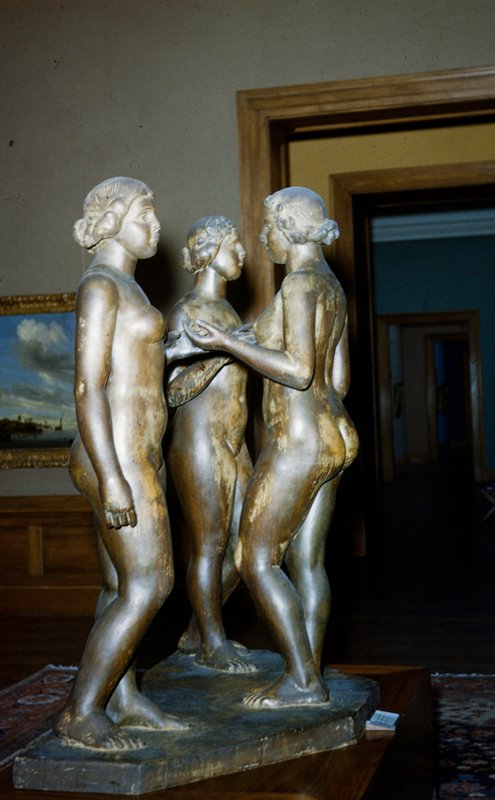
 Aristide MaillolFrench, 1861–1944
The Three Nymphs
Can I see it?
Not on view at present
Where is “The Three Nymphs” now? Collection: Minneapolis Institute of Art, Minneapolis. Not on view at present. Checked September 29, 2026.

Minneapolis, United States
It belongs to the collection, but is not on display at present.
- Checked
- In this state since
- Source
- The museum
About the sculpture
Throughout his career, Aristide Maillol drew inspiration from the female form. His Three Nymphs recall the Three Graces of Greek mythology - personifications of grace, charm, and beauty. He also followed classical precedent by showing the three figures clasping hands and dancing.
Maillol rejected the roughly textured surfaces favored by such earlier sculptors as Rodin for the smoothly swelling forms of ancient Greek sculpture. Maillol's massive figures convey a classical serenity and repose, which also contrasted with the vigorous intensity and drama of Rodin's or Degas' sculptures. The three women here all share the same sturdy form, yet each has slight facial and physical differences.
Minneapolis Institute of Art
Details
- Accession number
- 49.25
In the catalog
Sources
- Minneapolis Institute of Art
- Image: Minneapolis Institute of Art — © Minneapolis Institute of Art
In the life of Aristide Maillol
The whole life1933
Retrospectives in New York and Basel
In 1933 two retrospective exhibitions of Maillol's work were held, in New York and in Basel.
1934
Meets Dina Vierny
In 1934 the architect Jean-Claude Dondel introduced the 73-year-old Maillol to Dina Vierny, a fifteen-year-old émigrée from Bessarabia. For ten years she was his principal model and muse — The Mountain, The River, The Air, Harmony — and through their collaboration Maillol returned to drawing from life.
1937
Recognition at the 1937 World's Fair
In 1937 Maillol's work won recognition at the World's Fair and in the new National Museum of Modern Art at the Palais de Tokyo in Paris; that same year he was made a Commander of the Legion of Honour.
1939
Withdraws to Banyuls as war breaks out
At the outbreak of the Second World War Maillol withdrew to his native Banyuls-sur-Mer.
1940–1944
The Nazis seize his works
During the German occupation of France dozens of Maillol's works were seized by the Einsatzstab Reichsleiter Rosenberg; the Jeu de Paume database lists thirty of them. His Head of Flora was later found in the hoard of Cornelius Gurlitt, son of Hitler's art dealer.