 Diego VelázquezSpanish, 1599–1660
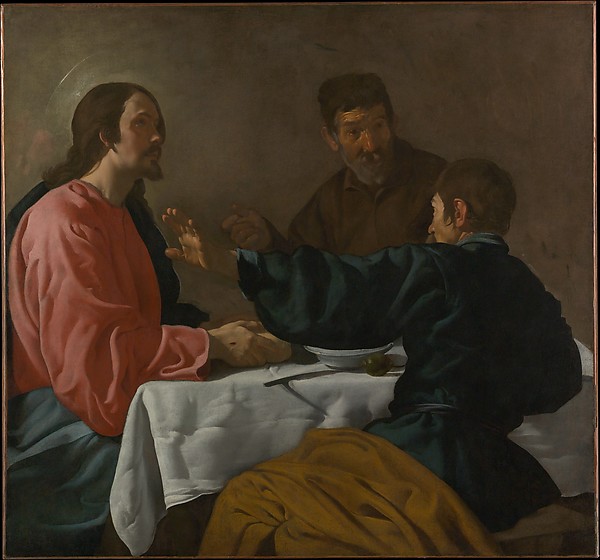
The Supper at Emmaus
May one see it?
Yes, receiving visitors

The Metropolitan Museum of Art
Room624New York, United States
On public display.
- Checked
- 5 hours ago
- In this state since
- Sep 26, 2026
- Source
- The museum's own collection data
Particulars
- Accession number
- 14.40.631
What it shows
Sources
- The Metropolitan Museum of Art: the museum's own open data · fetched 4 days ago
- Image: The Metropolitan Museum of Art — Open Access (CC0)
Meanwhile, in the life of Diego Velázquez
The whole life1611–1622 · Workplace
Seville
April 1622
First journey to Madrid
With letters of introduction to the royal chaplain Juan de Fonseca, Velázquez went to Madrid. He was not allowed to paint the new king, Philip IV, but at Pacheco's request he portrayed the poet Luis de Góngora.
1622–1623
The Escorial: discovering Titian
Thanks to Juan de Fonseca, Velázquez saw the royal collection at the Escorial — Titian, Veronese, Tintoretto, Bassano. According to the historian Julián Gállego, studying it, Titian above all, decisively changed his style, from stern naturalism toward silvery greys and transparent blues.
1622–1660 · Workplace
Madrid
30 August 1623
Philip IV sits for Velázquez for the first time
After the death of the king's favourite court painter, Rodrigo de Villandrando, the Count-Duke of Olivares summoned Velázquez to court. The king sat for him, the portrait pleased, and Olivares ordered the painter to move to Madrid.
6 October 1623
Appointed court painter
Velázquez was appointed court painter in place of the late Villandrando at twenty ducats a month, plus fees for his pictures. The king repeated to him Alexander the Great's promise to Apelles: “No one but you shall paint me from now on.”