 Jacques CallotFrench, 1592–1635
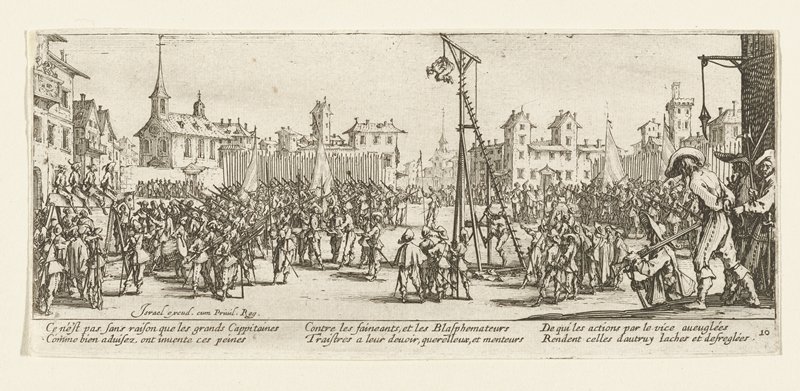
The Strappado (L'estrapade)--Torture
May one see it?
Not receiving at present

Minneapolis, United States
It belongs to the collection, but is not on display at present.
- Checked
- In this state since
- Source
- The museum
About the work
The Miseries and Misfortunes of War (Les Misères et les Mal-Heures de la Guerre), a series of 18 small etchings by French artist Jacques Callot, grimly document the violence and degradation of war. Callot's native region, the duchy of Lorraine, was invaded by French troops in 1633 in response to siding with the Habsburgs during the Thirty Years War (1618–1648). The territory was decimated; troops looted, raped, tortured, and murdered the duchy's citizens. This print depicts men being punished for such crimes. At center, a public torture and execution by strappado is underway, the guilty party is shown suspended from a scaffolding by his wrists which are bound behind his back. Another soldier, depicted in the right foreground, appears to be waiting his turn. At left, four bound men are mounted on a saw-horse, another common form of torture.
Read on
The inscription beneath the print reads, It is not without cause that great captains have well-advisedly invented these punishments for idlers, blasphemers, traitors to duty, quarrelers and liars, whose actions, blinded by vice, make those of others lax and lawless
Minneapolis Institute of Art
Particulars
- Accession number
- P.1, 366
In the catalog
Sources
- Minneapolis Institute of Art
- Image: Minneapolis Institute of Art — public domain
Meanwhile, in the life of Jacques Callot
The whole life1621–1635 · Workplace
Nancy
1633
The French invasion of Lorraine
In the year the large series of the “Miseries of War” is published, Lorraine is invaded by the French during the Thirty Years’ War; Callot’s etchings of pillaging, executions and the lot of crippled beggars are counted among the most powerful artistic statements of the inhumanity of war and will later inspire Goya.
25 March 1635
Died









