 William SimpsonBritish, 1823–1899
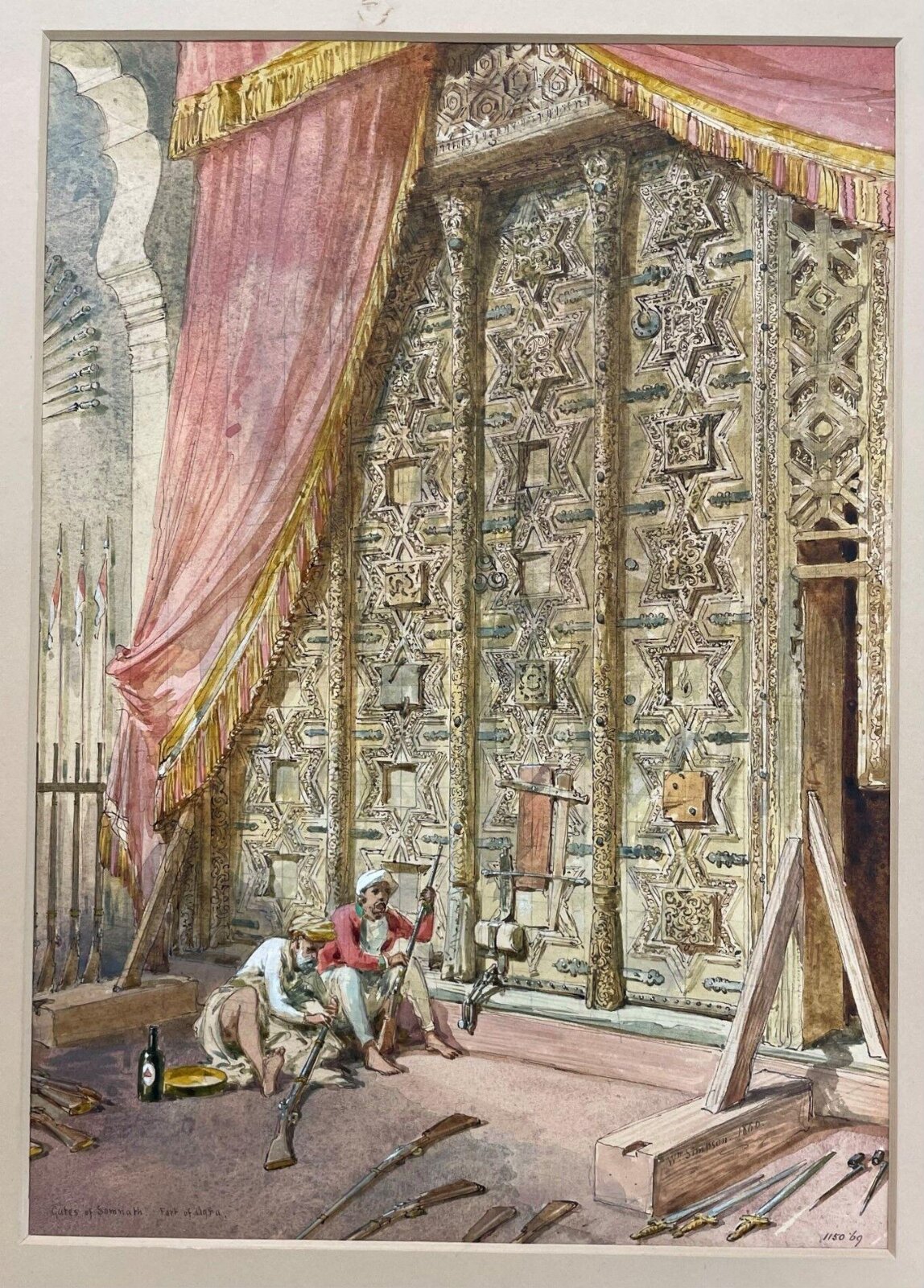
The Somnath gates, Fort Agra
Can I see it?
Not on view at present
Where is “The Somnath gates, Fort Agra” now? Collection: Victoria and Albert Museum, London. Not on view at present. Checked September 25, 2026.

London, United Kingdom
It belongs to the collection, but is not on display at present.
- Checked
- In this state since
- Source
- The museum
About the painting
William Simpson (1823 - 1899) was a distinguished watercolourist and war artist. Having established his reputation by documenting the Crimean war in 1854, Day and Sons, the London lithography firm, commissioned him to sketch well-known sites in and around Delhi associated with the Revolt of 1857 by Indians against the rule of the British East India Company.
Simpson arrived in Calcutta (Kolkata) in 1859 and travelled widely. His rapid pencil drawings formed the preparatory studies for his finished watercolours done after his return to London in 1862. His detailed journal, sketches and pictures from India resulted in these highly coloured, evocative, and romantic interpretations of the landscape and architecture.
Read on
Simpson completed the painting of the Gates of Somnath, Agra in London in 1866. Like many others, he was mistaken about the provenance of the gate. This gate belonged to the tomb of Mahmud Ghaznavi at Ghazni. In 1842, The British brought it from Ghazni for the Proclamation of Lord Ellenborough, the Governor General of Britain's territories in India. They claimed these were the sandalwood gates of Somnath, taken by the Mahmud to Ghazni in 1025. However, an Arabic inscription on the top notes the Mahmud with his epithets. Also, the gates were made of deodar, and the decoration had no resemblance to the ancient Gujarati woodwork found in Somnath.
Victoria and Albert Museum
Details
- Accession number
- 1150-1869
In the catalog
Sources
- Victoria and Albert Museum
- Image: Victoria and Albert Museum — © Victoria and Albert Museum, London