 William HogarthEnglish, 1697–1764
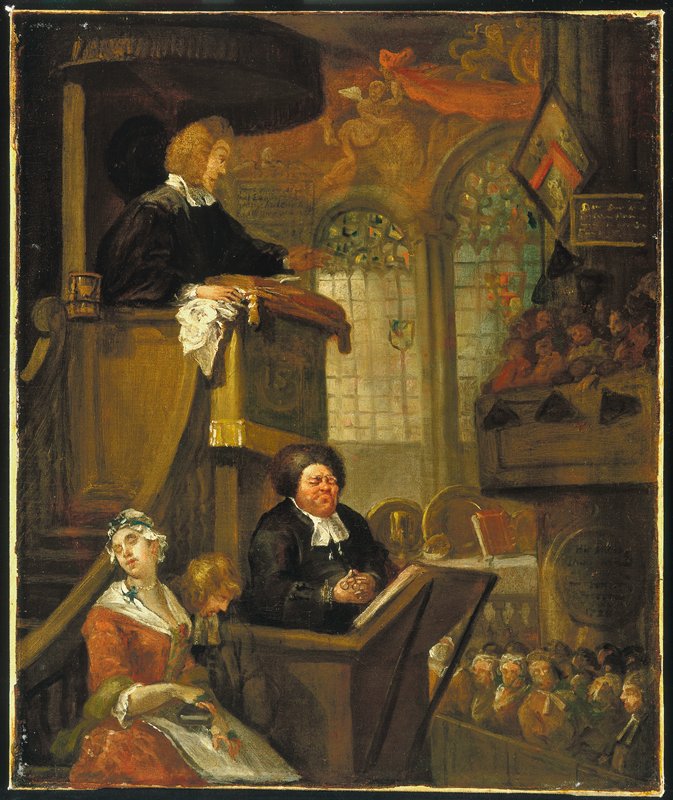
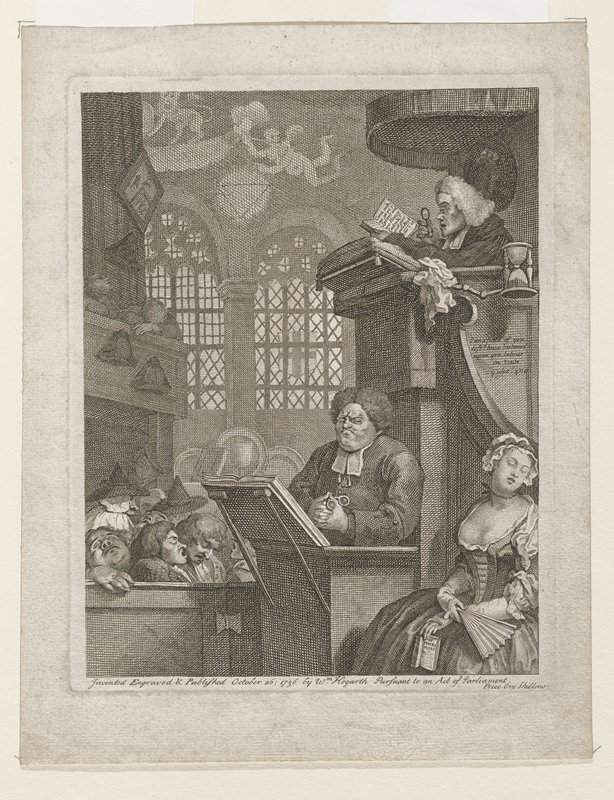
The Sleeping Congregation
May one see it?
Not receiving at present

Minneapolis Institute of Art
Minneapolis, United States
It belongs to the collection, but is not on display at present.
- Checked
- In this state since
- Source
- The museum's own collection data
About the work
Human weakness was an endless source of humor for Hogarth, and his pointed satires sought to draw lessons through full disclosure of people's failings. Here religion-a frequent target of caricature-takes a backseat to more basic needs; sleep and sex, not piety, captivate the faithful during Sunday services. A shortsighted old preacher clutches his magnifying glass as he delivers what is surely a long-winded and dull sermon. Meanwhile, the undignified congregants appear in different stages of slumber, and a portly clerk sneaks an amorous glance at the bosom of a young maiden who sleeps, her dream colored by her biblical reading on matrimony.
Hogarth was a master storyteller, incisively capturing the characters and customs of his time in amusing narratives.
Minneapolis Institute of Art
Particulars
- Accession number
- P.12, 612
In the catalog
Sources
- Minneapolis Institute of Art: the museum's own open data · fetched 7 days ago
- Image: Minneapolis Institute of Art — public domain
Meanwhile, in the life of William Hogarth
The whole life1712–1764 · Workplace
London
1735
Founds the St Martin’s Lane Academy
In 1735 Hogarth founded the St Martin’s Lane Academy in London — in essence a drawing studio that grew out of a circle of painters, draughtsmen and engravers who met at Slaughter’s coffee house on St Martin’s Lane. It became a forerunner of the Royal Academy of Arts and spread new artistic ideas in England.
25 June 1735
“Hogarth’s Act”: copyright for engravings
When the success of the two series produced numerous pirated copies, Hogarth lobbied Parliament for a law protecting engravers: the Engravers’ Copyright Act, known as “Hogarth’s Act”, became law on 25 June 1735 — the first copyright law to cover visual works and to recognise the authorial rights of an individual artist.