Albrecht DürerGerman, 1471–1528
The Second Knot
May one see it?
Not receiving at present

Art Institute of Chicago
Chicago, United States
It belongs to the collection, but is not on display at present.
- Checked
- In this state since
- Source
- The museum's own collection data
About the work
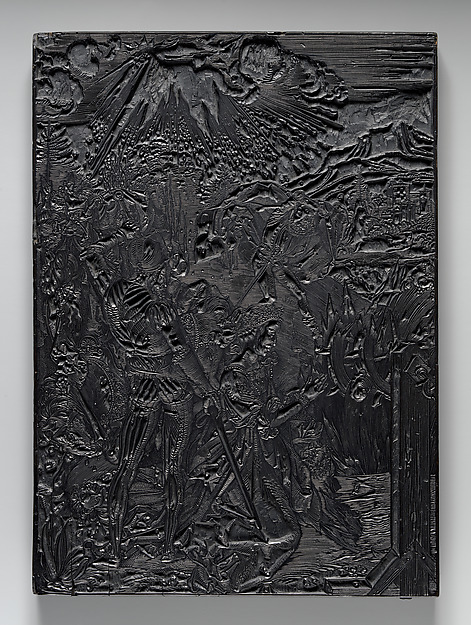
Around 1506, Albrecht Dürer designed a series of six ornate woodcuts of labyrinthine designs after a set of engravings by the school of Leonardo da Vinci, which he may have seen or acquired during an early trip to Italy. Though Dürer left them unsigned, possibly because he borrowed their source material, he referred in his diary to giving away his series of knots on a trip to the Netherlands, and this title has become standard. These impressions are printed on a thin, nearly translucent Italian paper, which may have influenced scholars to occasionally interpret them as embroidery patterns.
Art Institute of ChicagoCC BY 4.0
Particulars
- Accession number
- 1929.314
In the catalog
Sources
- Art Institute of Chicago: the museum's own open data · fetched 7 days ago
- Image: Art Institute of Chicago — CC0
Meanwhile, in the life of Albrecht Dürer
The whole life1505
Second journey to Italy
Dürer set off for Italy again — perhaps not only to earn money but also to stop Marcantonio Raimondi from copying his prints. His stay in Venice is known from ten surviving letters to Pirckheimer.
1505–1507
To Bologna for the secrets of perspective
Dürer travelled to the university city of Bologna, hoping to learn the secrets of geometric perspective from its scholars. He then meant to visit Mantegna in Padua but received news of his death, which he greatly regretted afterwards.
1505–1507
Friendship with Giovanni Bellini
Dürer considered Giovanni Bellini “the best in painting”, the only Venetian master with whom he became friends. The Madonna of the Siskin may have been painted at Bellini's request.
1505–1507 · Workplace
Venice
1507
Leaving Venice: “Here I am a gentleman”
Dürer left Italy, apparently reluctantly: in one of his last letters to Pirckheimer he remarked, “Here I am a gentleman, while at home I am only a parasite.”
1507–1528 · Workplace
Nuremberg

![Madonna and Child [obverse], Albrecht Dürer, c. 1496/1499](https://api.nga.gov/iiif/878db7e6-10ae-4cae-ba5d-6d6f5c413ae8/full/!2400,2400/0/default.jpg)
![Lot and His Daughters [reverse], Albrecht Dürer, c. 1496/1499](https://api.nga.gov/iiif/7565a449-f82a-414b-9bda-c93f55a51b4d/full/!2400,2400/0/default.jpg)