ART WIKI32,963 on view
MapCollectionArtistsMuseumsExhibitionsJournal
Sign in

ART WIKI

Where the masterpiece hangs, and when they let you in.

Collections: Art Institute of Chicago, Getty Villa, Harvard Art Museums, Hirshhorn Museum and Sculpture Garden, J. Paul Getty Museum, Minneapolis Institute of Art, Musée du Louvre, National Gallery of Art, National Museum of Asian Art, National Portrait Gallery (Smithsonian), Pushkin State Museum of Fine Arts, Rijksmuseum, Smithsonian American Art Museum, SMK — National Gallery of Denmark, State Hermitage Museum, State Russian Museum, The Cleveland Museum of Art, The Metropolitan Museum of Art, The Museum of Modern Art, Tretyakov Gallery, Victoria and Albert Museum, Whitney Museum of American Art, State Catalogue of the Museum Fund of Russia (274 museums), Europeana (19 museums), Wikidata (6 museums), Paris Musées (12 museums), and Joconde, the French Ministry of Culture's museum database (495 museums). Images belong to their rights holders.

Sections

  • Map
  • Search
  • Collection
  • Masterpieces
  • On view now
  • Artists

More

  • Museums & galleries
  • Exhibitions
  • Journal
  • Where the data comes from
  • Privacy & cookies
HomeMapBrowse
  1. Collection/
  2. Art Institute of Chicago/
  3. The Policeman
The Policeman, Joan Miró, 1925
Joan Miró, portraitJoan MiróSpanish, 1893–1983

The Policeman

1925 · Painting

About the painting

Soon after Joan Miró moved to Paris from his native Barcelona in 1920, he met a group of avant-garde painters and writers who advocated merging the everyday rational world with that of dreams and the unconscious in order to produce an absolute reality, or surreality. To release images of this higher realm, the Surrealists embraced automatism, a spontaneous working method much like free association. Miró experimented with automatism: “Even a few casual wipes in cleaning my brush,” he said, “may suggest the beginning of a picture.” Between 1925 and 1927, his experiments unleashed a revolutionary series of works called the “dream paintings,” which straddle abstraction and representation in freely moving, calligraphic compositions.

Read on

In The Policeman, a large canvas from this group, two biomorphic shapes spring to life as a policeman and a horse, their forms defined by thinly applied white paint against a neutral ocher ground. The form on the left has sprouted five buds that act as fingers, and both forms extrude curves that suggest torsos or mouths. With sketch-like dots and squiggles added to their heads to make eyes and a mustache, Miró’s shapes come to life in a liquid space as animated equivalents of a policeman and his horse.

Art Institute of Chicago · CC BY 4.0

Particulars

1925 · aged 32
18931983
Accession number
1991.1499

Meanwhile, in the life of Joan Miró

The whole life
  1. 1924

    Joins the Surrealist circle

    Miró joined the Surrealist circle, whose dream-like automatism suited his symbolic and poetic art, but chose not to become an official member so as to experiment freely; Breton called him “the most Surrealist of us all”.

  2. 1925

    Friendship with Robert Desnos

    Miró became friends with the poet Robert Desnos; they soon planned a livre d'artiste together, but the Spanish Civil War and World War II put the plans on hold. Desnos died in 1945, shortly after his release from the concentration camps.

  3. second half of the 1920s

    A language of signs and ideograms

    In “Person Throwing a Stone at a Bird” and “Dog Barking at the Moon” (both 1926) a set of recurrent ideograms took shape: symbols of space — horizon, waves, heavenly bodies — and “mediating symbols” — birds, a ladder to the sky, an eye, an ear, a figure with giant feet.

  4. 1926

    Designs for Diaghilev with Max Ernst

    Miró collaborated with Max Ernst on designs for the ballet impresario Sergei Diaghilev.
More by Joan Miró

All works

In the same room · Gallery 398, Art Institute of Chicago

Museum page

May one see it?

Yes, receiving visitors

Art Institute of Chicago

Chicago, United States

Room398

On public display.

Checked
3 days ago
In this state since
Aug 19, 2026
Source
The museum
On the mapMuseum page

What it shows

AutomatismAnimalFigures (representations)

In the catalog

PaintingsOilSpanish paintingModernism20th centurySpain

Sources

  • Art Institute of Chicago
  • Image: Art Institute of Chicago — © the artist or rights holder
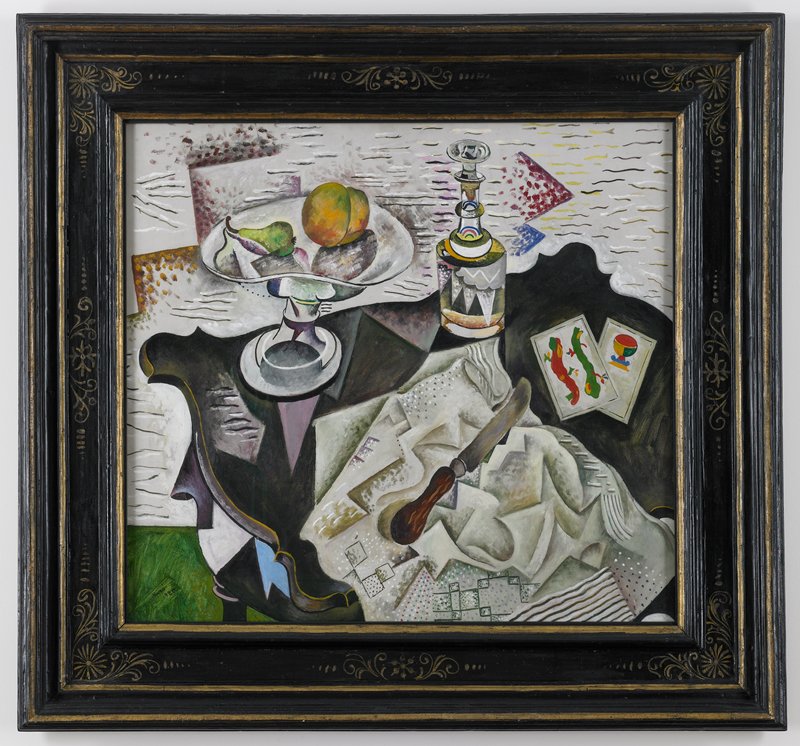
The Spanish Playing Cards, Joan Miró, 1920

The Spanish Playing Cards

1920 · Minneapolis Institute of Art

The Farm, Joan Miró, 1921-1922

The Farm

1921-1922 · National Gallery of Art

Head of a Catalan Peasant, Joan Miró, 1924

Head of a Catalan Peasant

1924 · National Gallery of Art

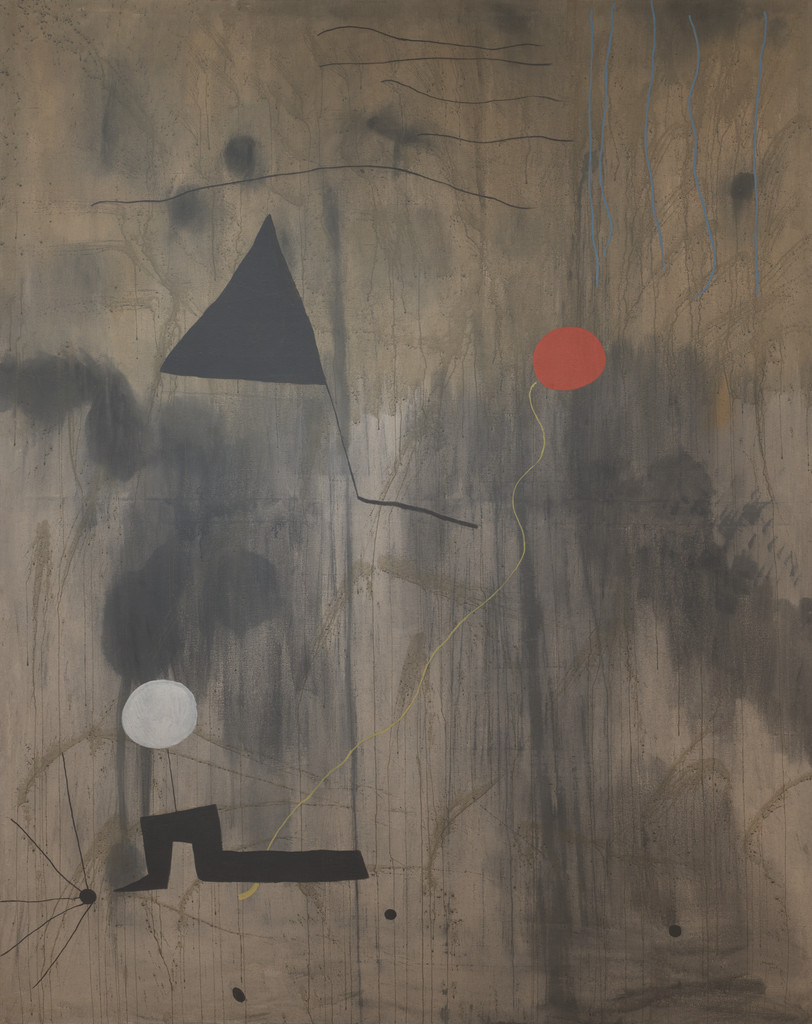
The Birth of the World, Joan Miró, Montroig, late summer-fall 1925

The Birth of the World

Montroig, late summer-fall 1925 · The Museum of Modern Art

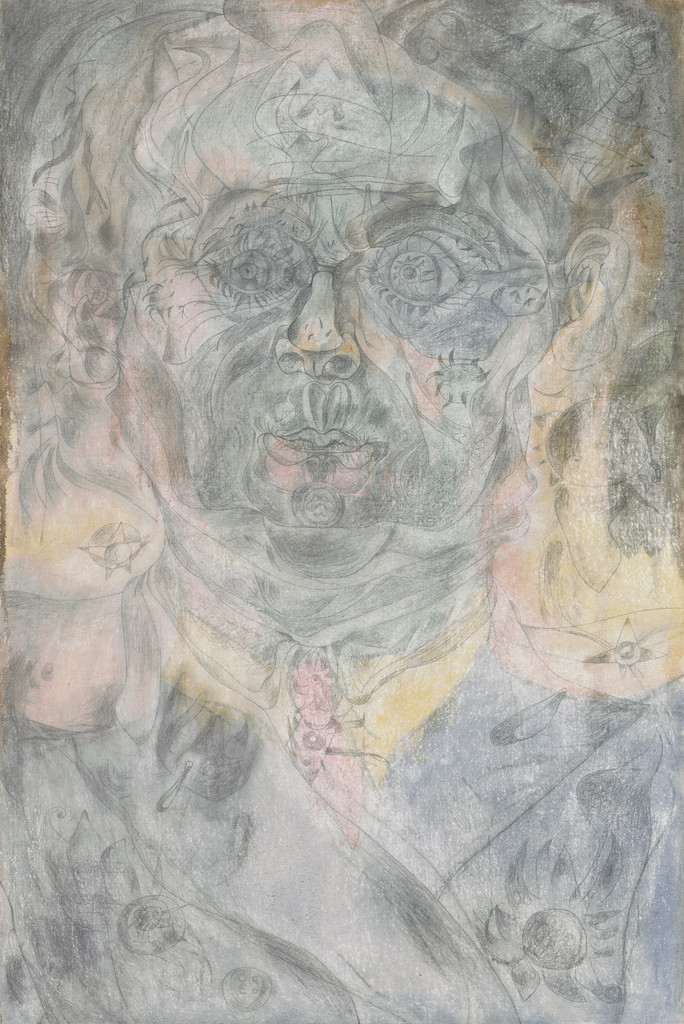
Self-Portrait I, Joan Miró, Paris, October 1937-March 1938

Self-Portrait I

Paris, October 1937-March 1938 · The Museum of Modern Art

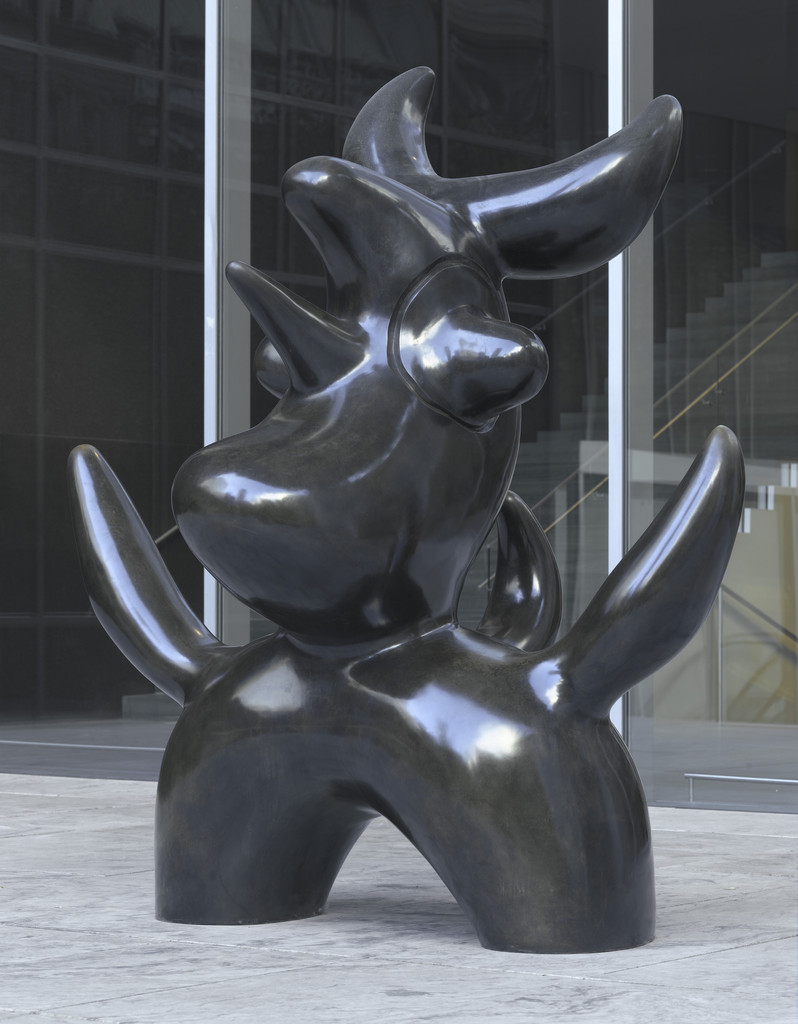
Moonbird, Joan Miró, 1966

Moonbird

1966 · The Museum of Modern Art

Flight of the Dragonfly in Front of the Sun, Joan Miró, 1968

Flight of the Dragonfly in Front of the Sun

1968 · National Gallery of Art

Personnage Gothique, Oiseau-Eclair (Gothic Personage, Bird-Flash), Joan Miró, model 1974, cast 1977

Personnage Gothique, Oiseau-Eclair (Gothic Personage, Bird-Flash)

model 1974, cast 1977 · National Gallery of Art

The Earth Is a Man, Matta, 1942

Matta

The Earth Is a Man, 1942

Walking Man II, Alberto Giacometti, 1960

Alberto Giacometti

Walking Man II, 1960

Two Figures (Menhirs), Barbara Hepworth, c. 1954/55

Barbara Hepworth

Two Figures (Menhirs), c. 1954/55

Painting, Franz Kline, 1952

Franz Kline

Painting, 1952

Les Baux, Loren MacIver, 1952

Loren MacIver

Les Baux, 1952

PH-246, Clyfford Still, 1951/52

Clyfford Still

PH-246, 1951/52

Caos-Caos, Wifredo Lam, 1950

Wifredo Lam

Caos-Caos, 1950

Wake, Lee Mullican, 1949

Lee Mullican

Wake, 1949