 Denis, MauriceFrench, 1870–1943
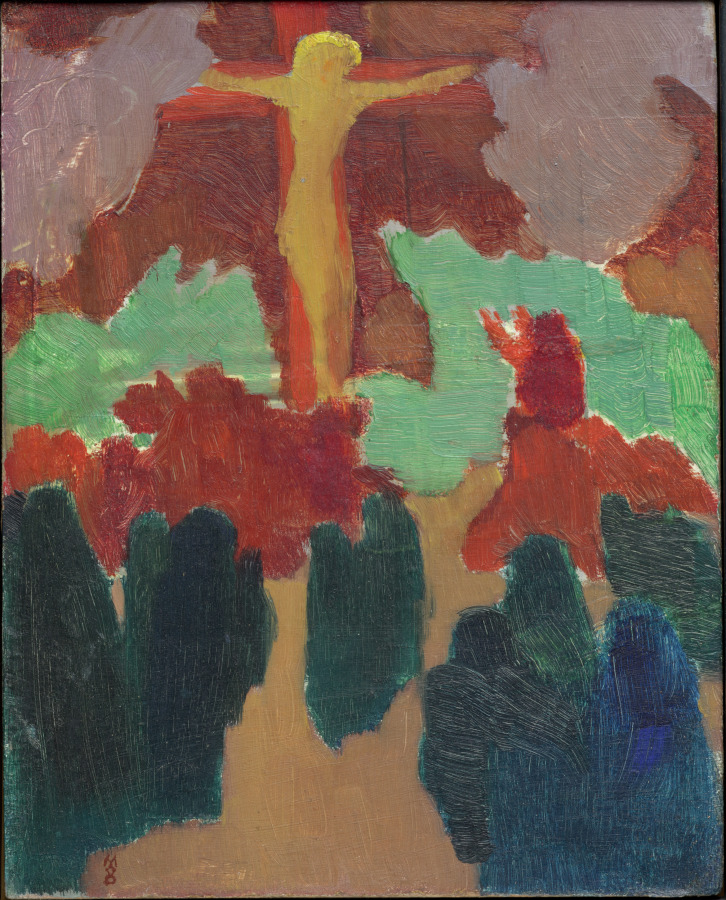
The Orange Christ
Can I see it?
Not on view at present
Where is “The Orange Christ” now? Collection: The Cleveland Museum of Art, Cleveland. Not on view at present. Checked September 29, 2026.

Cleveland, United States
It belongs to the collection, but is not on display at present.
- Checked
- In this state since
- Source
- The museum
About the painting
A devout Catholic, Maurice Denis sought to create what he described as “imperishable icons.” In this small painting, he used flat planes of intense colors to conjure emotion in the viewer. Here, a somber group of women, depicted as amorphous black forms, gather around an orange figure of Christ on the cross. The sky is a reddish-purple streaked with green clouds. Pink angels flank the crucified Christ whose head is haloed in brilliant yellow. In this painting, the daring young artist combined religious fervor with unprecedented visual experimentation.
The Cleveland Museum of Art
Details
- Accession number
- 2020.107
In the catalog
Sources
- The Cleveland Museum of Art
- Image: The Cleveland Museum of Art — Museum open access
In the life of Denis, Maurice
The whole life1882–1887 · Education
Lycée Condorcet
1888 · Education
Académie Julian
1888
Meeting Sérusier and Bonnard at the Académie Julian
At the Académie Julian he befriended Paul Sérusier and Pierre Bonnard, and through Bonnard met Vuillard, Ranson and Roussel — the future core of the Nabis group.
1889
Revelation at the Gauguin exhibition at the Café Volpini
He was captivated by the exhibition of works by Gauguin and other artists at a café near the World's Fair in Paris; he later called it "an astonishment, followed by a revelation."
1890
Founding of the Nabis group
Together with his fellow students from the Académie Julian he formed the artistic group Les Nabis (from the Hebrew for "prophet"); Denis is considered its most prominent theorist.
August 1890
Manifesto in Art et Critique: the "flat surface"
He published in the journal Art et Critique his famous essay with the words defining a picture as "essentially a flat surface covered with colors assembled in a certain order" — a thesis that became part of the foundation of modernism.