
 Winslow HomerAmerican, 1836–1910
The Gulf Stream
May one see it?
Not receiving at present

Chicago, United States
It belongs to the collection, but is not on display at present.
- Checked
- In this state since
- Source
- The museum
About the work
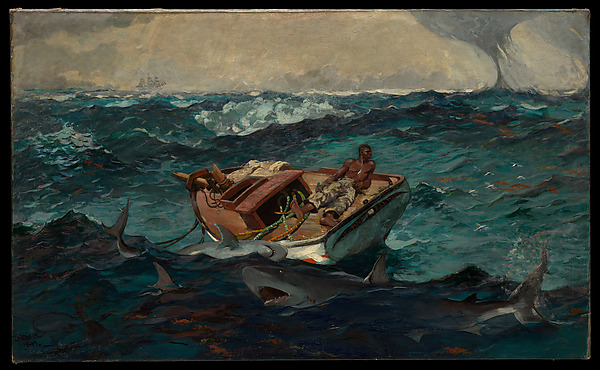
Homer’s exploration of life and death in the tropics found ultimate expression in his oil painting The Gulf Stream painted at Prout’s Neck following his return from the Bahamas. A group of four watercolors documents the evolution of this terrifying seascape, which details the plight of a solitary black man, adrift in stormy seas on a broken boat and encircled by a school of aggressive requiem sharks. In early 1885, on his first trip to the Bahamas, Homer had painted Shark Fishing which depicts two fishermen controlling a hooked shark that struggles, mouth open, in the immediate foreground. On this same trip, the artist executed a similar subject, Sharks (The Derelict). In this work, an unmanned wooden boat, broken-masted and taking on water, is under attack by at least three large, circling animals. The fact that the boat is empty leaves the viewer to wonder if the worst has already happened.
Read on
Homer’s 1898 voyage to the Bahamas must have reminded him of these works, suggesting the idea for his next major painting. Either in Nassau, or more likely after he returned to Prout’s Neck, he developed the theme in two watercolors. One is Study for “The Gulf Stream”, a detailed view of the bow of the derelict boat that corresponds closely to the final painting. In the work, the artist trimmed a horizontal sheet into a vertical format and filled it nearly to the top with churning waves. In the Art Institute’s watercolor study The Gulf Stream, Homer positioned the shark so that it appears to swim over the submerged side of the boat. It is probable that he painted this work in his Prout’s Neck studio, where he would have been able to refer to the studies from 1885. He trimmed the bottom of The Gulf Stream sheet, forcing the belly of the shark right up against the picture plane. In both this watercolor and in the finished painting, the impassive (or dazed) expression of the castaway and his surprisingly relaxed (or resigned) pose imbue the subject with ambiguity.
Art Institute of ChicagoCC BY 4.0
Particulars
- Accession number
- 1933.1241
What it shows
In the catalog
Sources
- Art Institute of Chicago
- Image: Art Institute of Chicago — CC0
Meanwhile, in the life of Winslow Homer
The whole life1888–1903
Trips to Key West
Between 1888 and 1903 Homer frequently visited Key West, Florida; some of his best-known works, “A Norther, Key West”, “The Gulf Stream”, “Taking on Wet Provisions” and “Palms in the Storm”, are said to have been produced there.
c. 1890
The sea without people
In Homer's works of the 1880s man contended with the power of the ocean; around 1890 he left these themes behind and concentrated on the drama of the sea itself. These last works are the best known of his career.
c. 1898
Death of his father
Around 1898 Homer's father died; the artist had looked after him like a “parent” since his mother's death, and by 1900 he was free of these responsibilities.
by 1900
Financial security at last
By 1900 Homer had finally reached financial stability: museums paid good prices for his paintings, and he received rents from real estate. He went on producing watercolours, mostly on trips to Canada and the Caribbean, and seascapes without figures: waves crashing against rocks in varying light.









.jpg?width=1280)
![[Das Schiff des Glücks; The Ship of Fortune; La fortune contraire], Rembrandt, 1633](https://diglib.hab.de/varia/haum/rembrandt-v3-4595/max/000001.jpg)