 Winslow HomerAmerican, 1836–1910
The Gulf Stream
Can I see it?
Yes, on view now
Where is “The Gulf Stream” now? The Metropolitan Museum of Art, Gallery 767, New York. Yes, on view now. Checked September 29, 2026.

New York, United States
Open now· until 9:00 PM
On public display.
- Checked
- In this state since
- Source
- The museum
About the painting
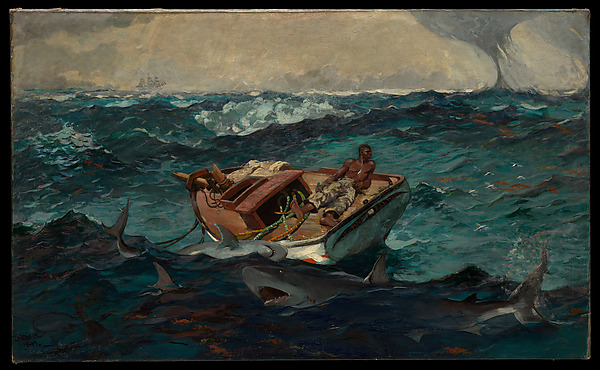
The Gulf Stream is an 1899 oil painting by the American artist Winslow Homer. It shows a man in a small dismasted rudderless fishing boat struggling against the storm-tossed waves and perils of the sea, presumably near the Gulf Stream, and was the artist's statement on a theme that had interested him for more than a decade. During the time he explored this theme, Homer, a New Englander, boated often near Florida, Cuba, and the Caribbean.
Details
- Accession number
- 06.1234
What it shows
In the catalog
Sources
- The Metropolitan Museum of Art
- Image: The Metropolitan Museum of Art — Open Access (CC0)
In the life of Winslow Homer
The whole life1888–1903
Trips to Key West
Between 1888 and 1903 Homer frequently visited Key West, Florida; some of his best-known works, “A Norther, Key West”, “The Gulf Stream”, “Taking on Wet Provisions” and “Palms in the Storm”, are said to have been produced there.
c. 1898
Death of his father
Around 1898 Homer's father died; the artist had looked after him like a “parent” since his mother's death, and by 1900 he was free of these responsibilities.
by 1900
Financial security at last
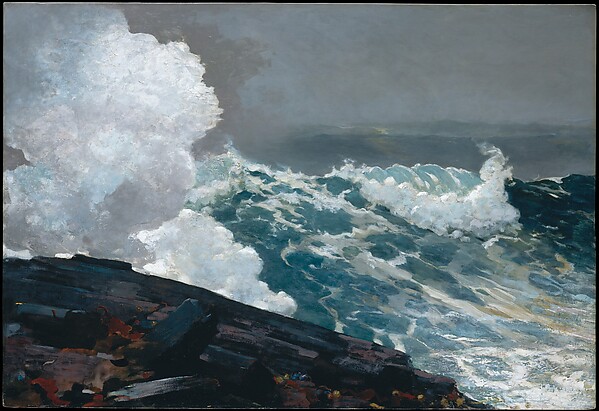
By 1900 Homer had finally reached financial stability: museums paid good prices for his paintings, and he received rents from real estate. He went on producing watercolours, mostly on trips to Canada and the Caribbean, and seascapes without figures: waves crashing against rocks in varying light.
1902
An unusual sculpture and a new gallery
In 1902 Homer exhibited a most unusual work for him, the sculpture “Hunter with Dog – Northwoods”. By then he had switched his primary gallery from Boston's Doll and Richards to Knoedler & Co. in New York.
1907
“Leave rocks for your old age”
In 1907 Homer advised a student artist: “Leave rocks for your old age—they're easy.” In his last decade he at times followed the advice himself.