Max BeckmannGerman, 1884–1950
The Fire (Small Still Life)
May one see it?
Not receiving at present

Cambridge, United States
It belongs to the collection, but is not on display at present.
- Checked
- In this state since
- Source
- The museum
About the painting
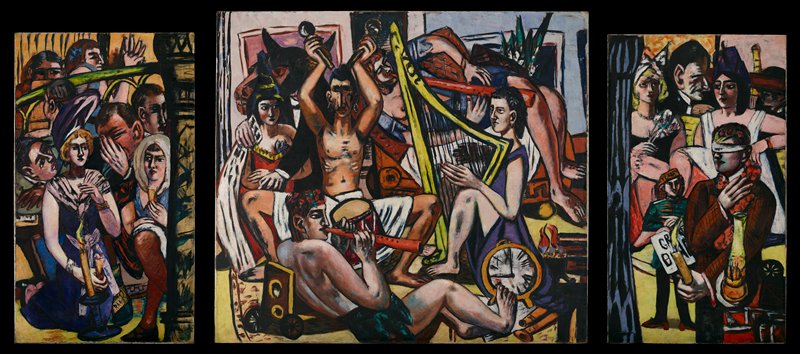
Like his large triptych Actors, on view in a gallery on the opposite side of the Calderwood Courtyard, Beckmann’s The Fire takes as its subject Amsterdam during World War II. This small still life focuses on the more mundane challenges of the exile experience. By the winter of 1944/1945, Beckmann’s large studio, a former tobacco storeroom, could no longer be adequately heated for lack of coal. The inspiration for this painting was the new round oven used by the artist in a makeshift space. The temperature, as the artist notes in his diary, was still a brisk “8 degrees Celsius” (about 46ºF).
Read on
Thanks to a strong network of supporters during his ten-year exile in Amsterdam (1937–47), Beckmann continued to sell his work abroad, as well as in Germany, despite the strict ban there on the sale of art deemed “degenerate.” This small painting, however, remained with the artist until his death in 1950.
Harvard Art Museums
Particulars
- Accession number
- 1976.96
In the catalog
Sources
- Harvard Art Museums
- Image: Harvard Art Museums — © President and Fellows of Harvard College
Meanwhile, in the life of Max Beckmann
The whole life1937–1947
Ten years of exile in Amsterdam
Beckmann lives in Amsterdam in self-imposed exile, making desperate but failed attempts to obtain a visa for the United States.
1944
The threat of conscription and a heart attack
In 1944 the Germans try to draft the sixty-year-old Beckmann into the army, although he has suffered a heart attack; he barely escapes mobilisation.
1947
Moving to the United States to teach in St. Louis
In 1947 Beckmann and his wife finally cross the ocean: at the invitation of Perry T. Rathbone, director of the Saint Louis Art Museum, he takes a teaching post at the St. Louis School of Fine Arts at Washington University, a vacancy left by Philip Guston, who had taken a leave.
1947–1949
Morton May: patron and student
In St. Louis Morton D. May, an avid amateur photographer and painter, becomes Beckmann's patron and student; the artist also helps him learn to appreciate Oceanian and African art.