Man RayAmerican, 1890–1976
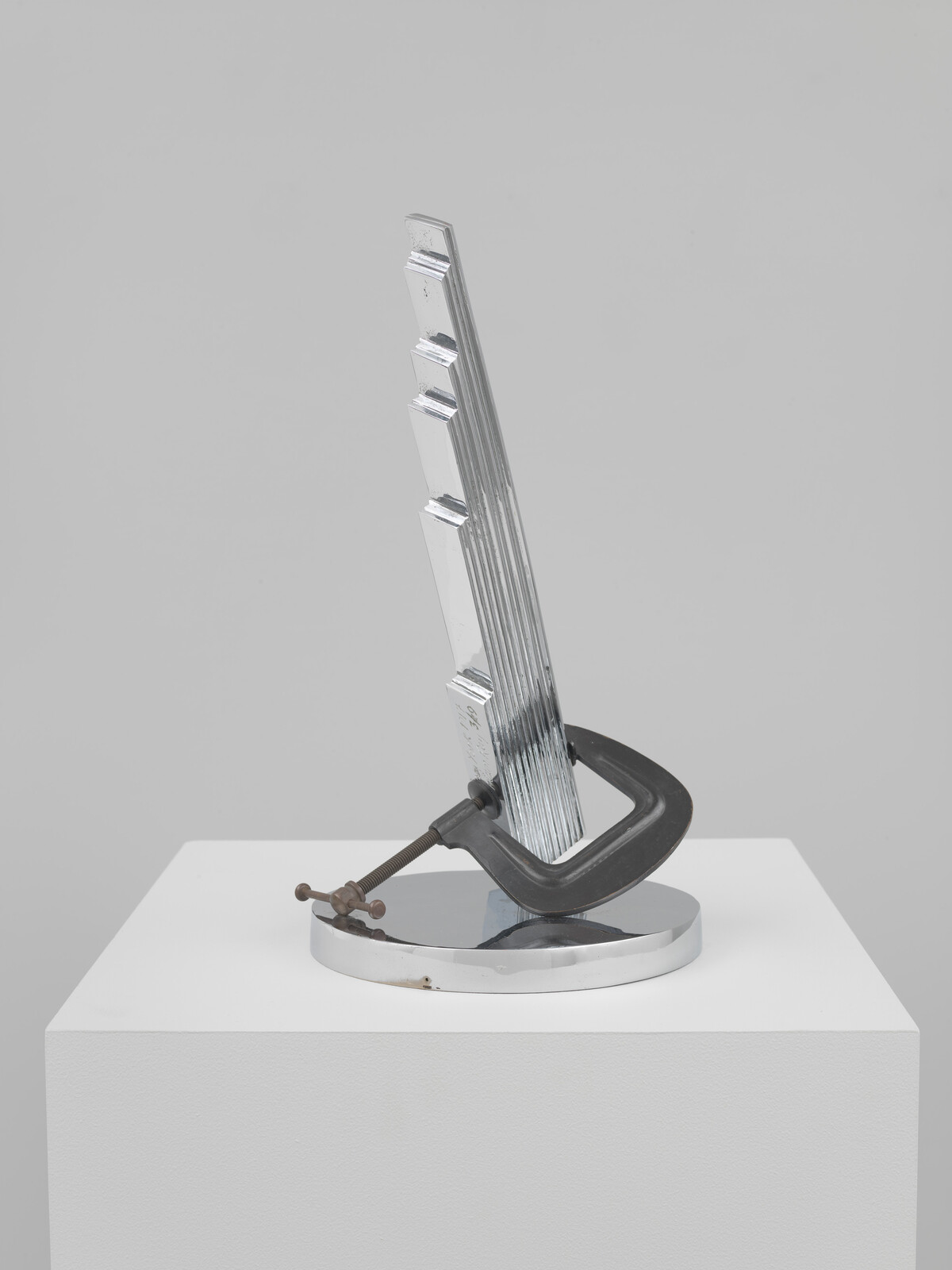
The Eye That Sees Everything
May one see it?
Not receiving at present

Chicago, United States
It belongs to the collection, but is not on display at present.
- Checked
- In this state since
- Source
- The museum
About the work
In 1918, in New York, Man Ray decided to paint without making use of any of the traditional tools of the painter-neither an easel, nor brushes, palette, or tubes of color. Instead, he used a spray gun, and he called the resulting paintings "aerographs." The All-Seeing Eye, while not an "aerograph," is informed by Man Ray's experiments with industrial techniques.
Art Institute of ChicagoCC BY 4.0
Particulars
- Accession number
- 2021.339
In the catalog
Sources
- Art Institute of Chicago
- Image: Art Institute of Chicago — © the artist or rights holder
Meanwhile, in the life of Man Ray
The whole life1918
His first significant photographs
Having picked up the camera to document his own artwork, Ray produces his first significant photographs; from 1918 he takes up photography and film in earnest, experimenting with photograms, solarization and other techniques.
1920
Founding the Société Anonyme
Man Ray, Katherine Dreier and Marcel Duchamp found the Société Anonyme, an itinerant collection that becomes the first museum of modern art in the United States; in 1941 its collection is donated to the Yale University Art Gallery.
c. 1921
Rayographs: photograms without a camera
His accidental rediscovery of the cameraless photogram, which he calls 'rayographs', produces images hailed by Tristan Tzara as 'pure Dada creations'.
1921
His first Paris exhibition at the Galerie Six
Ray's first solo exhibition in Paris is held at the Galerie Six, organised by Philippe Soupault; for it he creates his first Dadaist work in France, The Gift (Le Cadeau).
c. 1921
Meeting Kiki de Montparnasse
Shortly after arriving in Paris Ray meets and falls in love with Alice Prin, known as Kiki de Montparnasse, an artists' model and celebrated figure of Paris bohemian circles. She remains his companion for most of the 1920s, the subject of some of his most famous photographs, and stars in his films Le Retour à la raison and L'Étoile de mer.
July 1921
Moving to Paris, Montparnasse
In July 1921 Ray goes to live and work in Paris, settling in the Montparnasse quarter favoured by many artists.