 Édouard ManetFrench, 1832–1883
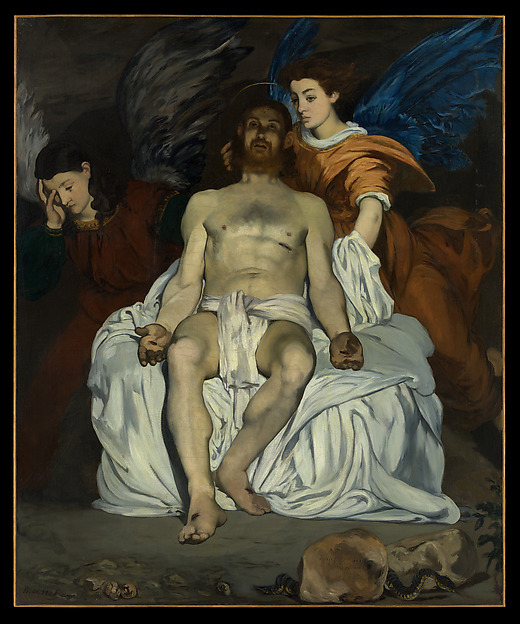
The Dead Christ with Angels
May one see it?
Yes, receiving visitors

The Metropolitan Museum of Art
Room810New York, United States
On public display.
- Checked
- 5 hours ago
- In this state since
- Sep 26, 2026
- Source
- The museum's own collection data
About the painting
The Dead Christ with Angels is an 1864 oil painting by French painter Édouard Manet. The painting depicts the biblical story (John 20:12) of Mary Magdalene entering the tomb of Jesus and seeing two angels but finding Jesus's body missing. It is now in the Metropolitan Museum of Art in New York City.
Manet seldom chose to paint images with religious meaning, and he tended to focus on contemporary subjects. John Hunisak speculates that Manet may have wanted to display a religious work at the Salon of 1864 because of the negative reaction he had received for his recent paintings of modern subjects. Manet may have hoped, Hunisak suggests, that the more traditional topic, with a contemporary twist, would please his supporters and critics alike.
Particulars
- Accession number
- 29.100.51
What it shows
Sources
- The Metropolitan Museum of Art: the museum's own open data · fetched 4 days ago
- Image: The Metropolitan Museum of Art — Open Access (CC0)
Meanwhile, in the life of Édouard Manet
The whole life1862
“Music in the Tuileries”: the fury of the public
In 1862 Manet exhibited “Music in the Tuileries” (probably painted in 1860), where the strollers include the poet Baudelaire, the musician Offenbach and the artist himself. It mostly provoked fury: the thick brushstrokes looked crude and unfinished, several visitors threatened to destroy the canvas; Delacroix defended it, and the controversy made Manet a well-known name in Paris.
c. 1862
Victorine Meurent: model and lover
Victorine-Louise Meurent, a young provincial eager to escape poverty, posed for “The Street Singer”; soon the painter and his model were bound not only by creative but by intimate ties. Rumours spread across Paris, but Suzanne either learned nothing or did not let on.
1863
“The Luncheon on the Grass” at the Salon des Refusés
The Salon of 1863 rejected “The Luncheon on the Grass” (originally “Le Bain”), and Manet exhibited it at the Salon des Refusés, a parallel exhibition initiated by Napoleon III after a public outcry, the jury having accepted only 2,217 of more than 5,000 submissions. The juxtaposition of dressed men and a nude woman and the sketch-like handling caused a scandal; one critic compared the brushwork to a “floor mop”.
1863
Marries Suzanne Leenhoff
In 1863, a year after his father's death, Manet married Suzanne Leenhoff at a Protestant church: a Dutch-born piano teacher two years his senior with whom he had been romantically involved for about ten years. Auguste Manet had employed her to teach his sons the piano, and she may also have been Auguste's mistress.
1863
Married: Suzanne Manet
1865
“Olympia” at the Salon: a scandal
In 1865 the Salon accepted “Olympia”, and the frank depiction of a self-assured prostitute created a scandal; according to Antonin Proust, only the precautions taken by the administration prevented the painting from being punctured and torn. The popular press caricatured it, while the avant-garde, including Courbet, Cézanne and Monet, championed it.