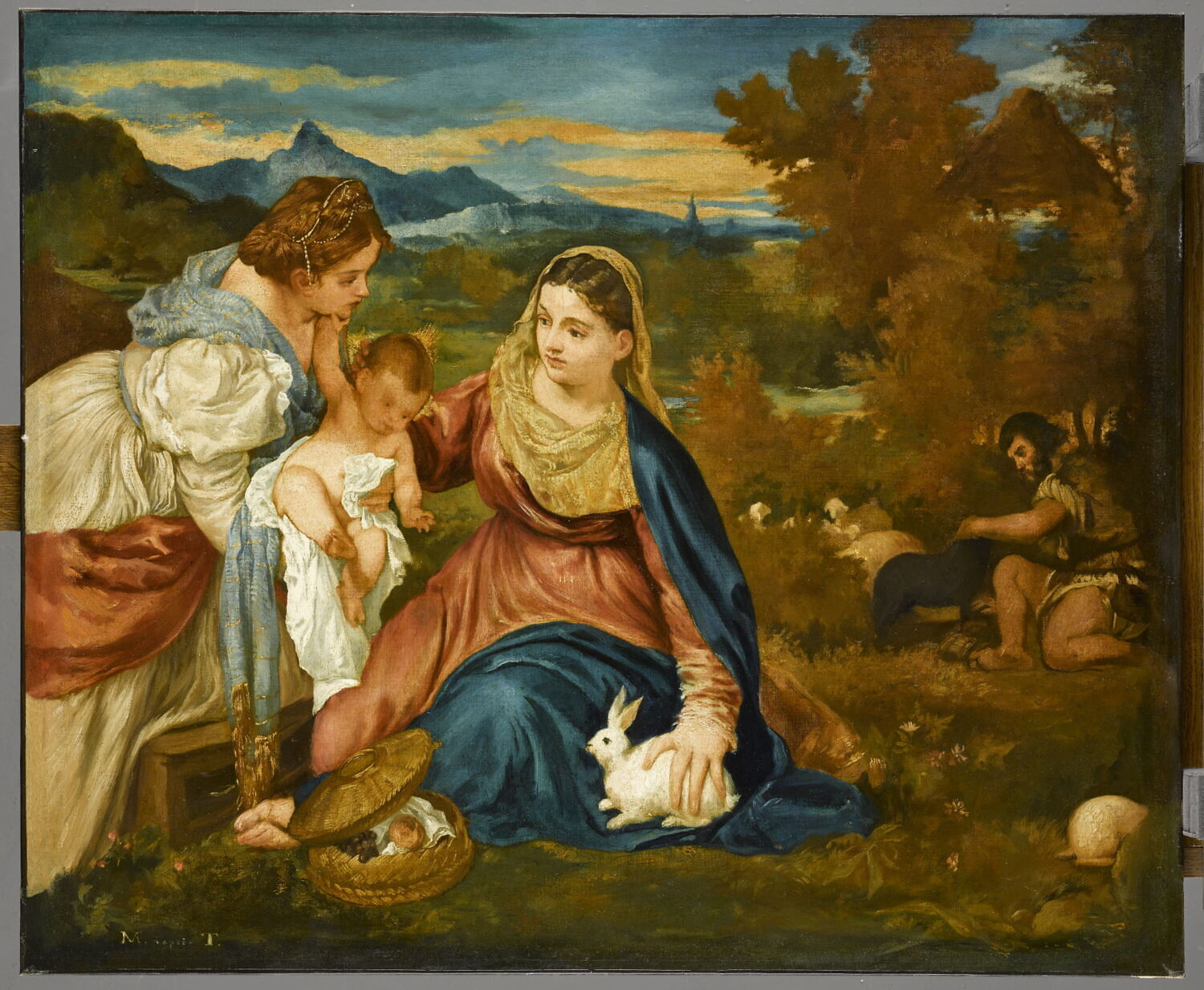
 Édouard ManetFrench, 1832–1883
La Vierge au lapin
May one see it?
Yes, receiving visitors

Musée du Louvre
Room711, Aile Denon, Niveau 1Paris, France
On public display.
- Checked
- 7 days ago
- In this state since
- Sep 26, 2026
- Source
- The museum's own collection data
Particulars
- Accession number
- RF 2017 7
Sources
- Musée du Louvre: the museum's own open data · fetched 7 days ago
- Image: Musée du Louvre — © 2017 GrandPalaisRmn (musée du Louvre) / Franck Raux
Meanwhile, in the life of Édouard Manet
The whole life1848–1849
A voyage to Brazil aboard the “Havre et Guadeloupe”
In 1848, after failing the entrance exam of the naval school, Manet set out on a training voyage aboard the sailing ship “Havre et Guadeloupe” and visited Brazil. He brought back many drawings and studies, and in letters to relatives described the carnival in Rio de Janeiro and judged slavery critically.
July 1849
A second failure at the naval school and his father's consent
In July 1849, back in Paris, Manet again failed the naval school examination. His father, having seen the drawings brought from the voyage, no longer doubted his son's vocation and advised him to enter the École des Beaux-Arts in Paris.
1850
In Thomas Couture's studio
Fearing the overly rigid academic programme of the École des Beaux-Arts, in 1850 Manet entered the studio of the fashionable Thomas Couture, who had become famous in 1847 for his monumental canvas “The Romans of the Decadence”.
1859
“The Absinthe Drinker” rejected; a final break with Couture
In 1859 Manet decided that his education was complete and submitted “The Absinthe Drinker” to the Salon; Couture reacted negatively and Manet finally broke with his teacher. The Salon jury rejected the painting: only Delacroix voted for it, while Couture voted against.
1861
His first participation in the Salon
In 1861 the Salon accepted two canvases by Manet: “Portrait of Monsieur and Madame Manet” and “The Spanish Singer”. Critics received the portrait coldly, while “The Spanish Singer” was admired by Théophile Gautier and, because of its popularity, hung in a more conspicuous place; the work intrigued young artists and brought new business to his studio.
1862
“Music in the Tuileries”: the fury of the public
In 1862 Manet exhibited “Music in the Tuileries” (probably painted in 1860), where the strollers include the poet Baudelaire, the musician Offenbach and the artist himself. It mostly provoked fury: the thick brushstrokes looked crude and unfinished, several visitors threatened to destroy the canvas; Delacroix defended it, and the controversy made Manet a well-known name in Paris.