 Albrecht DürerGerman, 1471–1528
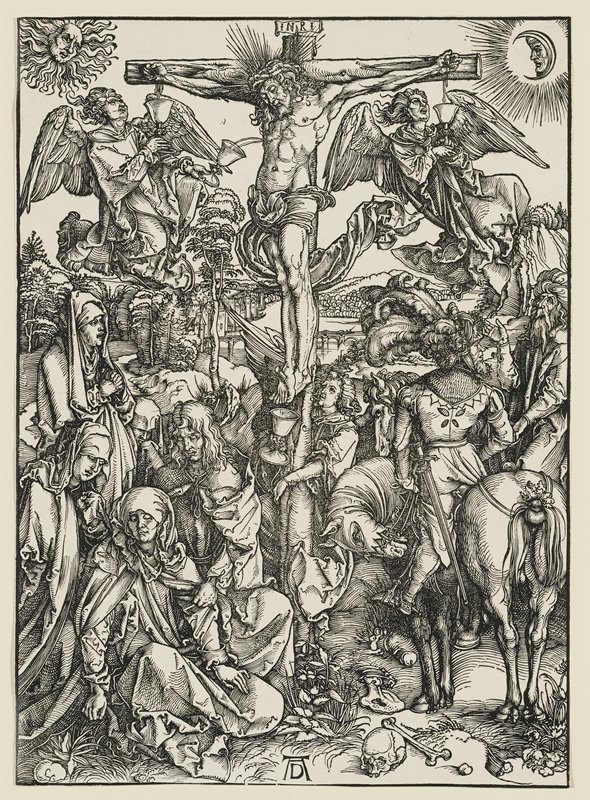
The Crucifixion
Can I see it?
Yes, on view now
Where is “The Crucifixion” now? Minneapolis Institute of Art, G344, Minneapolis. Yes, on view now. Checked October 12, 2026.

Minneapolis, United States
Closed· opens tomorrow at 10:00 AM
On public display.
- Checked
- In this state since
- Source
- The museum
About the work
Albrecht Dürer's Large Passion (so-called for its size relative to Durer's smaller version of the Passion) was published as an illustrated devotional book, comprising a title page and 11 large woodcuts and the Gospel narrative of Christ's final days, from his triumphal entry into Jerusalem to his murder by crucifixion, as conveyed by the Benedictine monk Benedictus Chelidonius (c. 1456-1521).
Read on
Dürer was a master of the woodcut technique, creating highly detailed and elaborate scenes of what can only be described as a highly personal interpretation of the passion of Christ. In particular, Dürer emphasizes the humanity of Jesus. His mother, the Virgin Mary, is shown seated at the lower left, lost in her grief, in stark contrast to the indifference of the mounted solder. Above and below, three angels catch Christ's blood in chalices, drawing attention to his fresh wounds and agony. Though Dürer began creating the prints for the Large Passion as early as 1497, and had finished seven of the woodcuts by 1500, it was not until 1511 that he completed the remaining prints in the series and the title page for the book.
Minneapolis Institute of Art
Details
- Accession number
- P.12, 515
In the catalog
Sources
- Minneapolis Institute of Art
- Image: Minneapolis Institute of Art — public domain
In the life of Albrecht Dürer
The whole life1500
Jacopo de' Barbari and the secret of proportion
The Venetian Jacopo de' Barbari, whom Dürer had met in Venice, came to Nuremberg, and Dürer said he learned much from him about perspective, anatomy and proportion. Feeling that de' Barbari would not explain everything he knew, Dürer began studies of his own that became a lifelong preoccupation.
1501–1502
In the circle of Nuremberg's humanists
Through his lifelong friend Willibald Pirckheimer, Dürer entered the circle of Nuremberg's humanists. He engraved illustrations for Conrad Celtis's editions of Hrotsvitha (1501) and of his Four Books of Love (1502), and decorated 14 books in Pirckheimer's library with drawings.
1502
Death of his father
Albrecht Dürer the Elder died, and his son took on the care of his mother and his two younger brothers, Endres and Hans.
1505
Second journey to Italy
Dürer set off for Italy again — perhaps not only to earn money but also to stop Marcantonio Raimondi from copying his prints. His stay in Venice is known from ten surviving letters to Pirckheimer.
1511
Publishes the Great Passion and the Life of the Virgin
Dürer published two woodcut series as books, the Great Passion and the Life of the Virgin, with a second edition of the Apocalypse and the 37 woodcuts of the Little Passion. His post-Venetian woodcuts developed chiaroscuro modelling.
1512
Emperor Maximilian I becomes his chief patron
From 1512 Emperor Maximilian I was Dürer's chief patron. For him Dürer and his workshop produced the Triumphal Arch, a giant woodcut 295 × 357 cm printed from 192 blocks and modelled on the triumphal arches of ancient Rome.
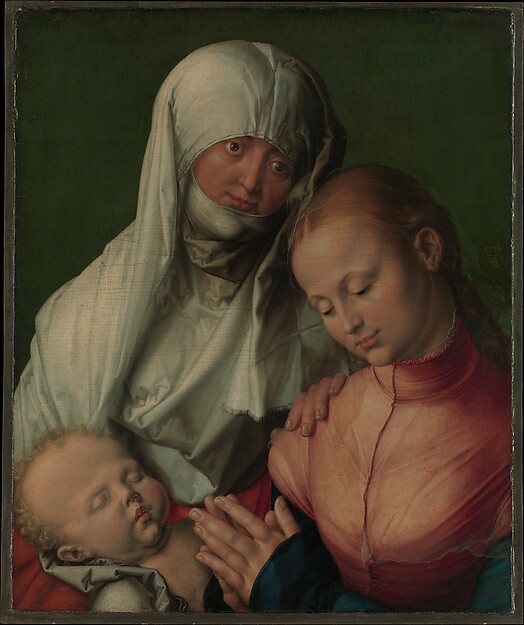

![Madonna and Child [obverse], Albrecht Dürer, c. 1496/1499](https://api.nga.gov/iiif/878db7e6-10ae-4cae-ba5d-6d6f5c413ae8/full/!2400,2400/0/default.jpg)
![Lot and His Daughters [reverse], Albrecht Dürer, c. 1496/1499](https://api.nga.gov/iiif/7565a449-f82a-414b-9bda-c93f55a51b4d/full/!2400,2400/0/default.jpg)