 Albrecht DürerGerman, 1471–1528
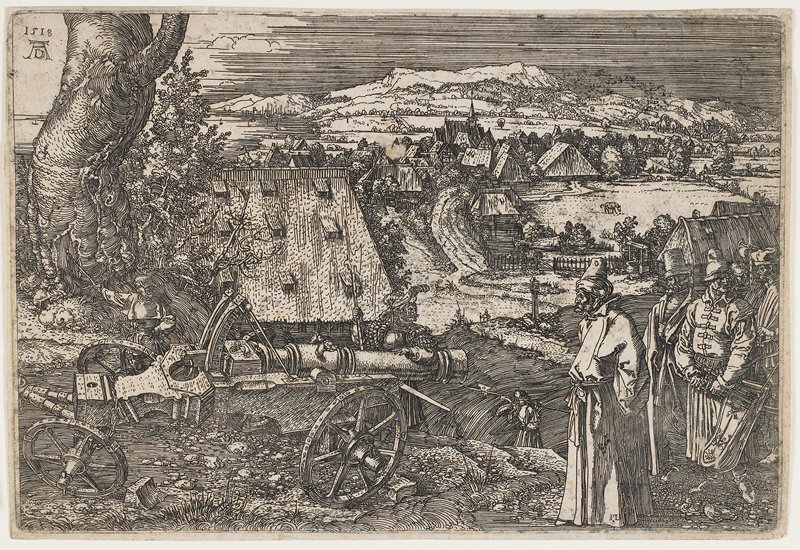
The Cannon
May one see it?
Not receiving at present

Minneapolis, United States
It belongs to the collection, but is not on display at present.
- Checked
- In this state since
- Source
- The museum
About the work
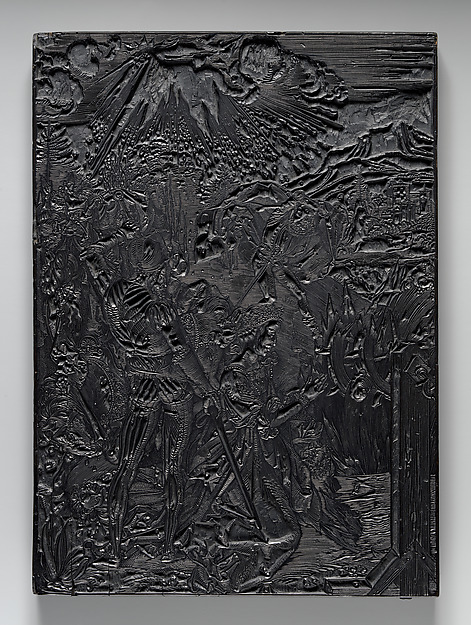
The toolbox on this cannon bears the arms of Nuremberg, Albrecht Dürer's birthplace and home to several of Emperor Maximilian's arms foundries. What's more, the Turk at right is believed to bear the face of Dürer himself. The artist made just six etchings on iron, probably abandoning the medium because he was dissatisfied with the coarse, crumbly lines that resulted. Although he preferred the more controlled vocabulary of engraving, Dürer exploited the freedom of the etching needle in the muscular tree and distant landscape, creating naturalistic effects that would have a lasting impact on the artists of the Danube School, who made prints focused solely on nature.
Minneapolis Institute of Art
Particulars
- Accession number
- P.175
In the catalog
Sources
- Minneapolis Institute of Art
- Image: Minneapolis Institute of Art — public domain
Meanwhile, in the life of Albrecht Dürer
The whole life1507–1528 · Workplace
Nuremberg
1517
Joins Nuremberg's circle of reformers
Dürer joined the circle of Nuremberg reformers led by the Augustinian vicar Johann Staupitz and Wenceslaus Linck. Around 1518 he came to know the writings of Martin Luther, which, he said, had “greatly helped” him.
1519
Death of Emperor Maximilian
Maximilian, Dürer's chief patron, died just as the artist feared he was losing “my sight and freedom of hand” (perhaps from arthritis) and was increasingly drawn to Luther's writings. Shortly before the emperor's death Dürer had made his portrait.
July 1520
Journey to the Netherlands with his wife
To renew his imperial pension and win the patronage of the new emperor, Charles V, Dürer travelled with his wife and her maid down the Rhine via Cologne to Antwerp, where he was warmly received. He attended the coronation at Aachen and saw van Eyck's Ghent Altarpiece and Michelangelo's Madonna of Bruges.
4 October 1520
Charles V confirms his pension
The new emperor, Charles V, confirmed Dürer's right to his pension of 100 guilders a year; the main aim of the journey had been achieved.
1520–1521
An illness caught in the Netherlands
In the Netherlands Dürer caught an unknown illness, possibly malaria, whose attacks plagued him for the rest of his life. He drew himself pointing to his spleen, with the note: “Where the yellow spot is, and where I point with my finger, that is where it hurts.”
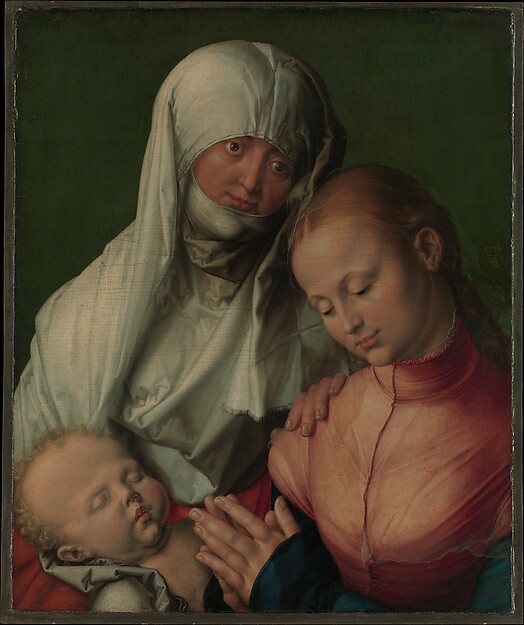
![Madonna and Child [obverse], Albrecht Dürer, c. 1496/1499](https://api.nga.gov/iiif/878db7e6-10ae-4cae-ba5d-6d6f5c413ae8/full/!2400,2400/0/default.jpg)
![Lot and His Daughters [reverse], Albrecht Dürer, c. 1496/1499](https://api.nga.gov/iiif/7565a449-f82a-414b-9bda-c93f55a51b4d/full/!2400,2400/0/default.jpg)