
 Pierre-Auguste RenoirFrench, 1841–1919
The Blue River
May one see it?
Not receiving at present

Washington, D.C., United States
It belongs to the collection, but is not on display at present.
- Checked
- In this state since
- Source
- The museum
Particulars
- Accession number
- 1970.17.75
What it shows
In the catalog
Sources
- National Gallery of Art
- Image: National Gallery of Art — Museum open access
Meanwhile, in the life of Pierre-Auguste Renoir
The whole life1883–1890
The "Ingres" period
Impressed by the classics of the Italian Renaissance and by Ingres, Renoir effectively broke with Impressionism: his lines became crisp, his colors more restrained and cooler. The artist himself called this period "sour"; it includes "Dance in the Country," "Dance in the City" and "Dance at Bougival."
1890
Marriage to Aline Charigot
Renoir married Aline Charigot, whom he had met ten years earlier. After the wedding he painted many scenes of family life with the children and their nanny Gabrielle Renard.
14 April 1890
Married: Aline Charigot
1892
Success at Durand-Ruel's
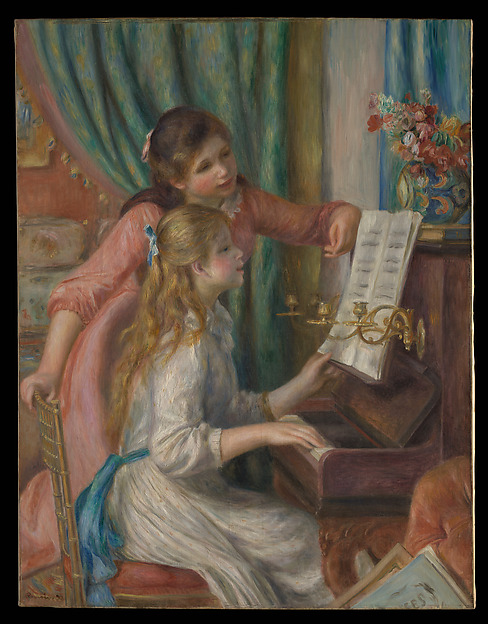
An exhibition of Renoir's work at Durand-Ruel's gallery was a great success. Recognition also came from the state: "Young Girls at the Piano" was acquired for the Musée du Luxembourg.
1894
Birth of his son Jean
Renoir's second son Jean was born — the future celebrated film director and writer.
1897
Broken arm and the onset of rheumatism
Falling from a bicycle, Renoir broke his right arm; rheumatism developed as a result, from which the artist suffered for the rest of his life. In time the illness made life in Paris difficult and forced the family to move to the south.


![Ginevra de' Benci [obverse], Leonardo da Vinci, c. 1474/1478](https://api.nga.gov/iiif/8f29e3c9-a289-4d53-abf0-31a66e9e98fa/full/!2400,2400/0/default.jpg)
![Wreath of Laurel, Palm, and Juniper with a Scroll inscribed Virtutem Forma Decorat [reverse], Leonardo da Vinci, c. 1474/1478](https://api.nga.gov/iiif/ff62e8d0-45c4-498f-ad36-6358de827e04/full/!2400,2400/0/default.jpg)


