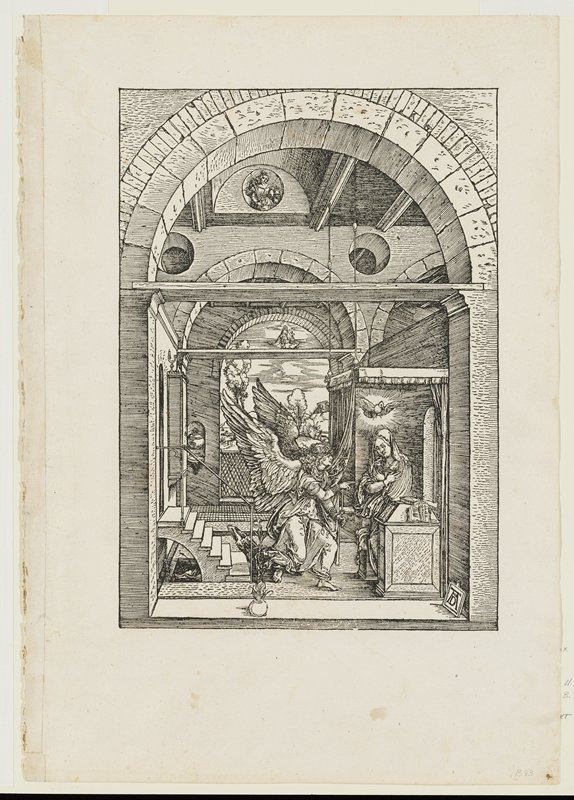
 Albrecht DürerGerman, 1471–1528
The Annunciation
May one see it?
Not receiving at present

Minneapolis, United States
It belongs to the collection, but is not on display at present.
- Checked
- In this state since
- Source
- The museum
Particulars
- Accession number
- P.10, 890
In the catalog
Sources
- Minneapolis Institute of Art
- Image: Minneapolis Institute of Art — public domain
Meanwhile, in the life of Albrecht Dürer
The whole life1501–1502
In the circle of Nuremberg's humanists
Through his lifelong friend Willibald Pirckheimer, Dürer entered the circle of Nuremberg's humanists. He engraved illustrations for Conrad Celtis's editions of Hrotsvitha (1501) and of his Four Books of Love (1502), and decorated 14 books in Pirckheimer's library with drawings.
1502
Death of his father
Albrecht Dürer the Elder died, and his son took on the care of his mother and his two younger brothers, Endres and Hans.
1504 · Workplace
Lutherstadt Wittenberg
1505
Second journey to Italy
Dürer set off for Italy again — perhaps not only to earn money but also to stop Marcantonio Raimondi from copying his prints. His stay in Venice is known from ten surviving letters to Pirckheimer.
1511
Publishes the Great Passion and the Life of the Virgin
Dürer published two woodcut series as books, the Great Passion and the Life of the Virgin, with a second edition of the Apocalypse and the 37 woodcuts of the Little Passion. His post-Venetian woodcuts developed chiaroscuro modelling.
1512
Emperor Maximilian I becomes his chief patron
From 1512 Emperor Maximilian I was Dürer's chief patron. For him Dürer and his workshop produced the Triumphal Arch, a giant woodcut 295 × 357 cm printed from 192 blocks and modelled on the triumphal arches of ancient Rome.
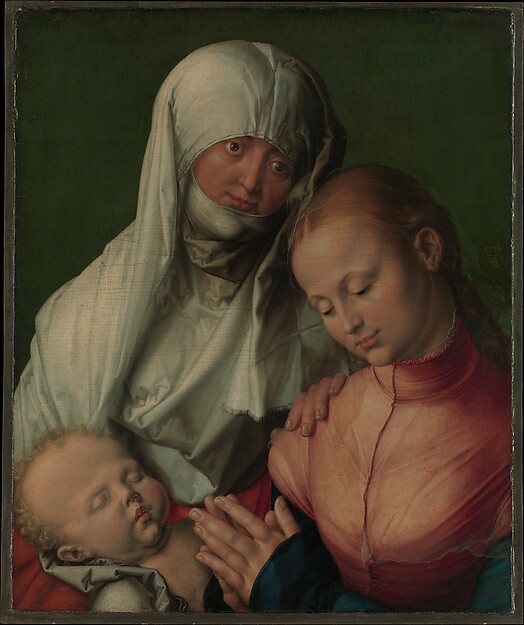
![Madonna and Child [obverse], Albrecht Dürer, c. 1496/1499](https://api.nga.gov/iiif/878db7e6-10ae-4cae-ba5d-6d6f5c413ae8/full/!2400,2400/0/default.jpg)
![Lot and His Daughters [reverse], Albrecht Dürer, c. 1496/1499](https://api.nga.gov/iiif/7565a449-f82a-414b-9bda-c93f55a51b4d/full/!2400,2400/0/default.jpg)