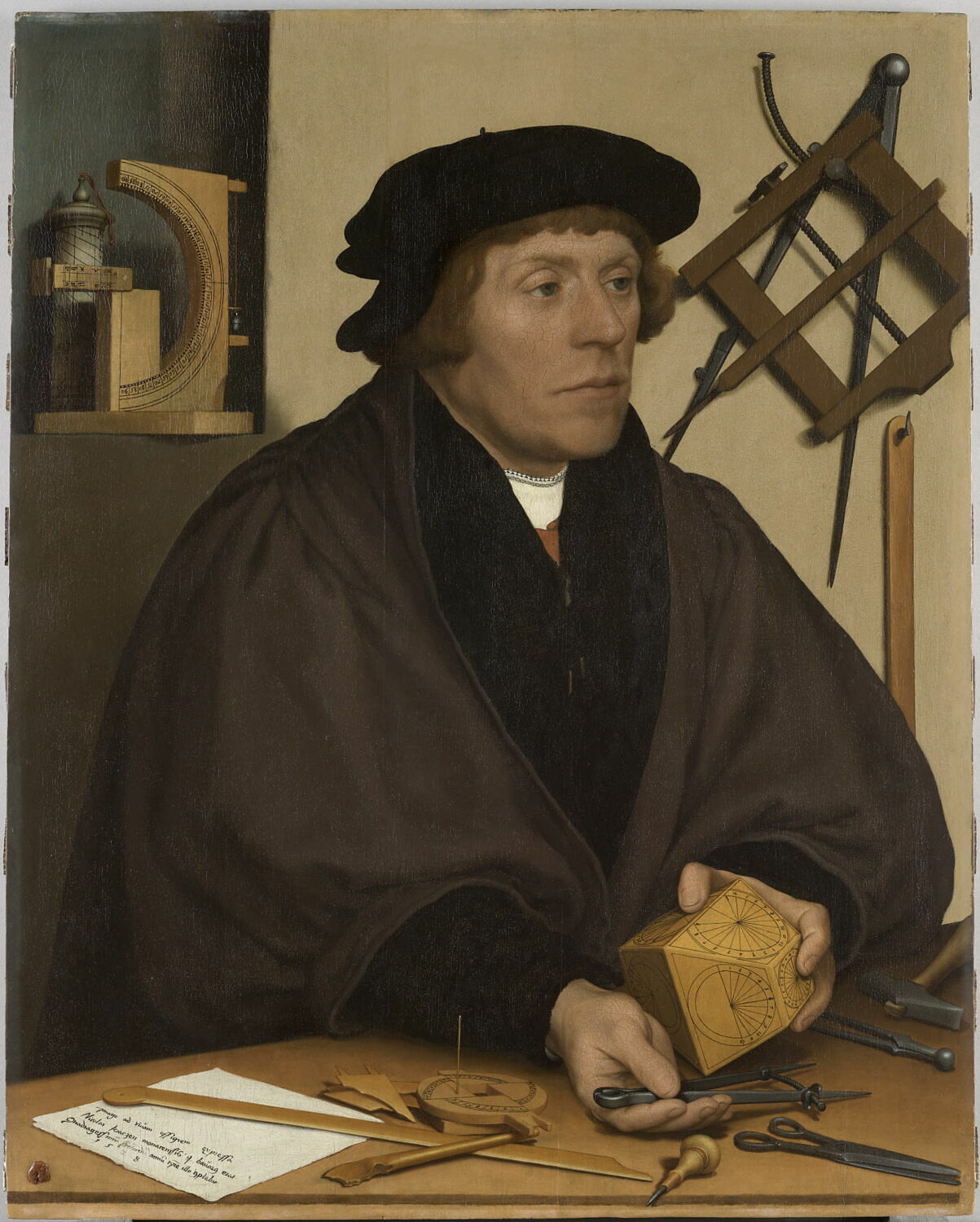
Hans HolbeinGerman, 1497–1543
The Ambassadors
Can I see it?
Unknown
Where is “The Ambassadors” now? Collection: The National Gallery, London. Unknown.

London, United Kingdom
The owner is known; whether it is on view today is not.
- In this state since
- Source
- The museum
About the painting
The Ambassadors is a 1533 painting by Hans Holbein the Younger. Also known as Jean de Dinteville and Georges de Selve, after the two people it portrays, it was created in the Tudor period, in the same year Elizabeth I was born. Franny Moyle speculates that Elizabeth's mother, Anne Boleyn, then Queen of England, might have commissioned it as a gift for Jean de Dinteville, the French ambassador, portrayed on the left. De Selve was a Catholic bishop.
As well as being a double portrait, the painting contains a still life of meticulously rendered objects, the meaning of which is the cause of much debate. An array of expensive scientific objects, related to knowing the time and the cosmos are prominently displayed. Several refer to Rome, the seat of the Pope. A second shelf of objects shows a lute with a broken string, a symbol of discord, next to a hymnal composed by Martin Luther.
Read on
It incorporates one of the best-known examples of anamorphosis in painting. While most scholars have taken the view that the painting should be viewed side on to see the skull, others believe a glass tube was used to see the skull head on. Either way, death is both prominent and obscured until discovered. Less easily spotted is a carving of Jesus on a crucifix, half hidden behind a curtain at the top left.
The Ambassadors has been part of London's National Gallery collection since its purchase in 1890. It was extensively restored in 1997, leading to criticism, in particular that the skull's dimensions had been changed.
Details
- Accession number
- NG1314
In the catalog
Sources
- Wikidata
- Image: The National Gallery — Hans Holbein the Younger · Public domain · Wikimedia Commons
In the life of Hans Holbein
The whole lifeearly 1532
Return to England: The Second English Period
In early 1532 he returned to England and resumed his career under the patronage of Anne Boleyn and Thomas Cromwell; he painted portraits of the Lutheran merchants of the Hanseatic Steelyard.
31 May 1533
Street Decoration for Anne Boleyn's Coronation Procession
Commissioned by the merchants of the Steelyard, he created the street tableau Mount Parnassus for the procession on the eve of Anne Boleyn's coronation on May 31, 1533.
1535
Court Painter to Henry VIII
He became court painter to King Henry VIII: he painted portraits, designed court festivities, and produced designs for fountains, stained glass, jewelry, and objects for the royal household. By 1536 he was receiving an annual salary of thirty pounds.