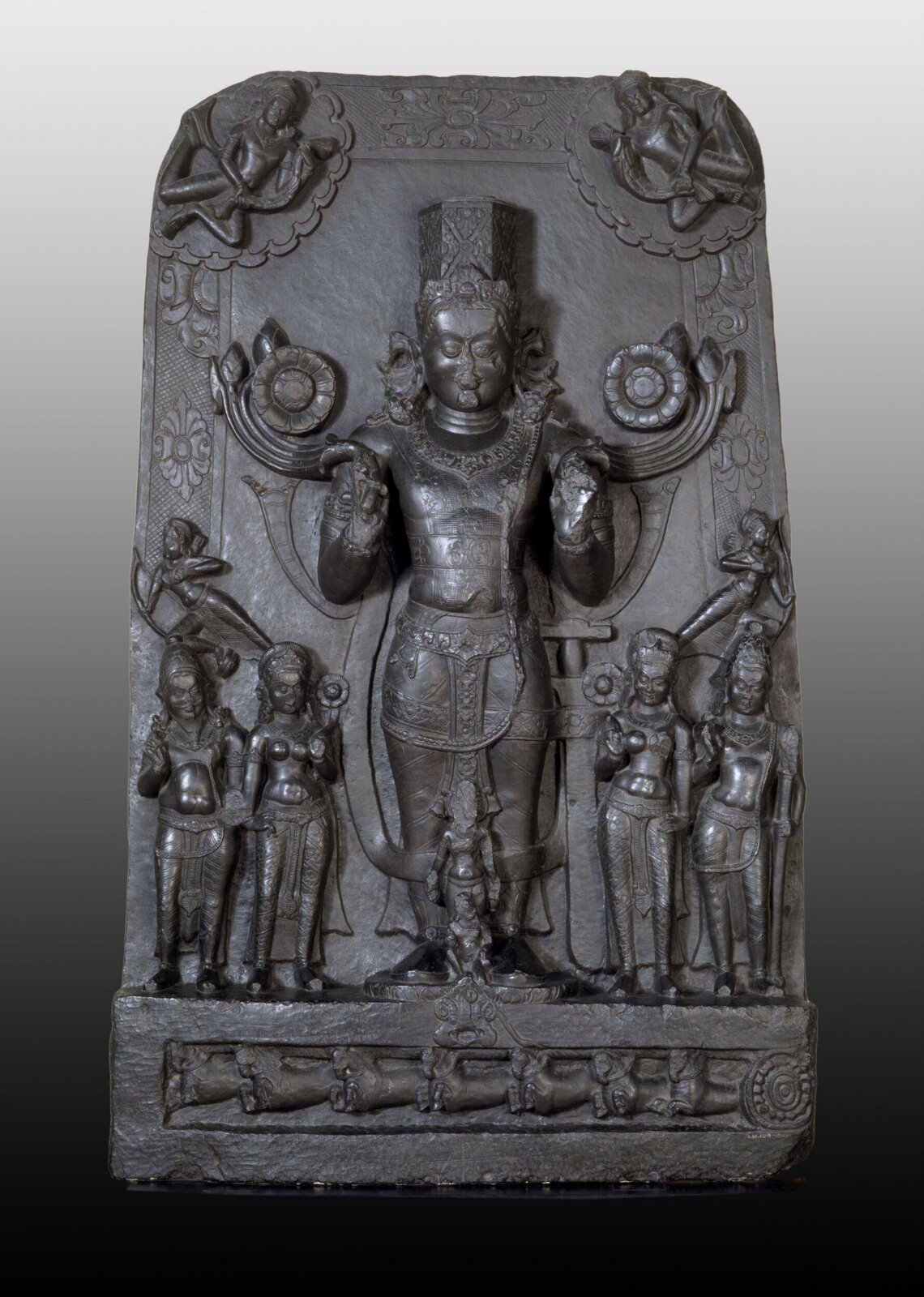
Surya, the Sun God
May one see it?
Not receiving at present

London, United Kingdom
It belongs to the collection, but is not on display at present.
- Checked
- In this state since
- Source
- The museum
About the sculpture
The Hindu deity Surya is considered the source of light, and as the solar deity can be traced to the earliest Indian texts, the Rgveda. The sun deity is represented standing erect, holding lotus blossoms in both his raised hands. The high boots and short sword are a legacy of his Iranian ancestry, a feature he retains well into the medieval period. At his feet is depicted his half-brother charioteer Aruna. On the proper right stand the god Pingala with pen and ink-bottle (broken away) and the goddess Nikshubha (“Earth”). On the left is the god Dandanayaka holding a staff (danda) and the goddess Rajni ("Air"). At the god's feet is his principal consort Prabha ("brightness"; later known as Mahasveta) . Above the attendant divinities are the female archers Usha and Pratyusha driving off the hosts of the night. At each top corner of the lotus-decorated frame are celestial singers (vidyadharas) in cloud, bearing garlands. In the lower register are the seven horses and Surya's chariot, here represented by a single spoked wheel. All the horses face left, a unique configuration.
Read on
The cult of Surya maintained a key position in the hierarchy of deities into the medieval period. Although usurped by Visnu and his solar aspects, Surya nonetheless
maintained his position as a major, if secondary, deity. Major temples were dedicated to Surya across India, as witnessed by Konarak in Orissa, and Modera in Gujarat. This sculpture, of unrecorded origin, undoubtedly graced a temple of some importance in Bihar, eastern India.
Victoria and Albert Museum
Particulars
- Accession number
- IM.109-1916
What it shows
In the catalog
Sources
- Victoria and Albert Museum
- Image: Victoria and Albert Museum — © Victoria and Albert Museum, London