 Jean-Léon GérômeFrench, 1824–1904
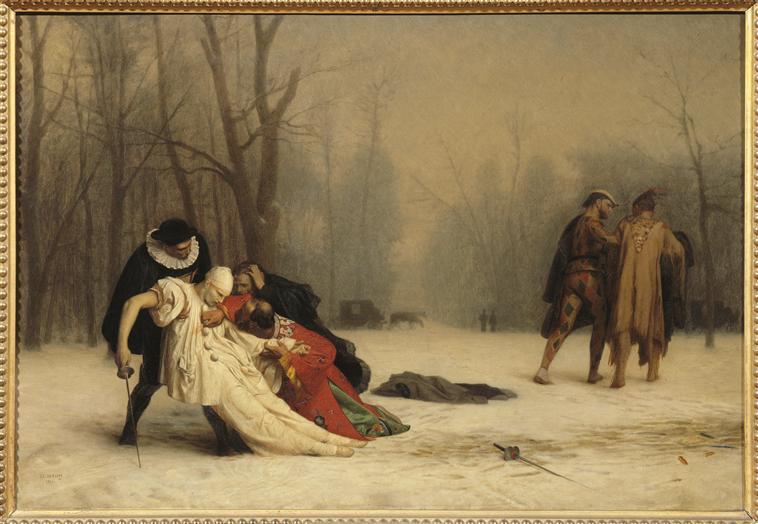
The Duel After the Masquerade
SUITES D'UN BAL MASQUE
Can I see it?
Unknown
Where is “The Duel After the Masquerade” now? Collection: Musée Condé, Chantilly. Unknown.
Chantilly, France
The owner is known; whether it is on view today is not.
- In this state since
- Source
- The museum
Details
- Accession number
- PE 533
What it shows
In the catalog
Sources
- Musée Condé
- Image: Musée Condé — © Gérard Blot ; Réunion des musées nationaux - utilisation soumise à autorisation; Ministère de la Culture (France), base Joconde
In the life of Jean-Léon Gérôme
The whole life1855
The 1855 fair: “The Age of Augustus” and “Recreation in a Russian Camp”
Critics met the huge canvas “The Age of Augustus” (6.2 × 10.15 m) without enthusiasm: they were angered by the belittling of the Nativity and the exaltation of the emperor, and only Gautier left a wholly positive review. The most attention went to the modest “Recreation in a Russian Camp”, painted in a realist spirit; Gérôme was made a knight of the Legion of Honour.
1856
Four months in Egypt with Bartholdi
In 1856 Gérôme spent four months in Egypt with the playwright Augier, the sculptor Bartholdi and other artists; the party hired a boat with cabins. Bartholdi brought a camera and infected Gérôme with his enthusiasm for photography, and from then on Gérôme constantly used photographs as a source of detail for his canvases.
1857
The 1857 Salon: Egyptian subjects and “The Duel”
Paintings inspired by the Egyptian trip — “Egyptian Recruits”, “Camels Watering” — and the puzzling “The Duel after the Masquerade” enhanced Gérôme’s reputation. Capitalising on the success of the “Duel”, he made two copies himself: one for Alexander II (now in the Hermitage) and one for reproduction in print (Walters Art Museum).
1859
The 1859 Salon: “Ave Caesar” and “King Candaules”
Gérôme showed both Egyptian and ancient subjects: he himself thought “Ave Caesar” a failure and later admitted it was full of archaeological inaccuracies, while the erotic “King Candaules” made him popular with lovers of history and connoisseurs of the nude alike. Hoping to capitalise on the success, he petitioned for a professorship at the École des Beaux-Arts but never received a reply.