 RaphaelItalian, 1483–1520
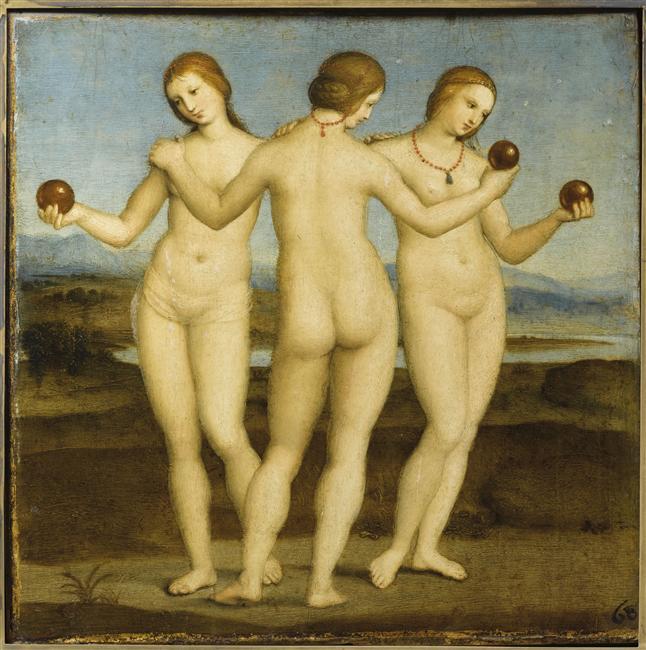
Three Graces
LES TROIS GRACES
Can I see it?
Unknown
Where is “Three Graces” now? Collection: Musée Condé, Chantilly. Whether it is on view today is unknown.
Chantilly, France
The owner is known; whether it is on view today is not.
- In this state since
- Source
- The museum
About the painting
Three Graces by Raphael, dated around 1504 or 1505, belongs to the Musée Condé in Chantilly. Three nude women hold golden spheres, sometimes interpreted as the apples of the Hesperides. The entire scene fits onto a wooden panel only 17 centimetres square. After passing through collections in France and England, the painting was bought by the Duke of Aumale in 1885.
The Three Graces is an oil painting by the Italian painter Raphael in the Musée Condé in Chantilly, France. The date of origin has not been positively determined, though it seems to have been painted at some point after his arrival to study with Pietro Perugino in about 1500, possibly 1503-1505. According to James Patrick in 2007's Renaissance and Reformation, the painting represents the first time that Raphael had depicted the nude female form in front and back views.
Details
- Accession number
- PE 38
What it shows
In the catalog
Sources
- Musée Condé
- Image: Musée Condé — © R.G. Ojeda ; Réunion des musées nationaux - utilisation soumise à autorisation; Ministère de la Culture (France), base Joconde
In the life of Raphael
The whole lifec. 1501 – c. 1502 · Workplace
Perugia
1502
To Siena at Pinturicchio's invitation
Another pupil of Perugino, Pinturicchio, “being a friend of Raphael and knowing him to be a draughtsman of the highest quality”, invited him to Siena to help with the cartoons, and very likely the designs, for the frescoes of the Piccolomini Library in Siena Cathedral.
late 1504
Meets Leonardo and Michelangelo
Having moved to Florence, Raphael met Leonardo da Vinci, Michelangelo and Bartolomeo della Porta and closely studied Leonardo's sfumato. His first Florentine commission, portraits of Agnolo Doni and his wife, was painted under the clear impression of the “Mona Lisa”.
1504
Friendship with Baldassare Castiglione
In Urbino Raphael met the philosopher, writer and patron Count Baldassare Castiglione; they formed a firm friendship and correspondence, including the famous letters about the fresco “The Triumph of Galatea”.
October 1504
To Florence, to study
The mother of the next Duke of Urbino gave Raphael a letter of recommendation to the Gonfaloniere of Florence: “The bearer of this will be found to be Raphael, painter of Urbino, who, being greatly gifted in his profession has determined to spend some time in Florence to study.” She called him “a sensible and well-mannered young man”.
1507
Meets Donato Bramante
Raphael met the architect Donato Bramante, by an unproven account his relative. Bramante became his adviser and patron and later recommended him to Pope Julius II as the best candidate for work in the Vatican.