Piet MondrianDutch, 1872–1944
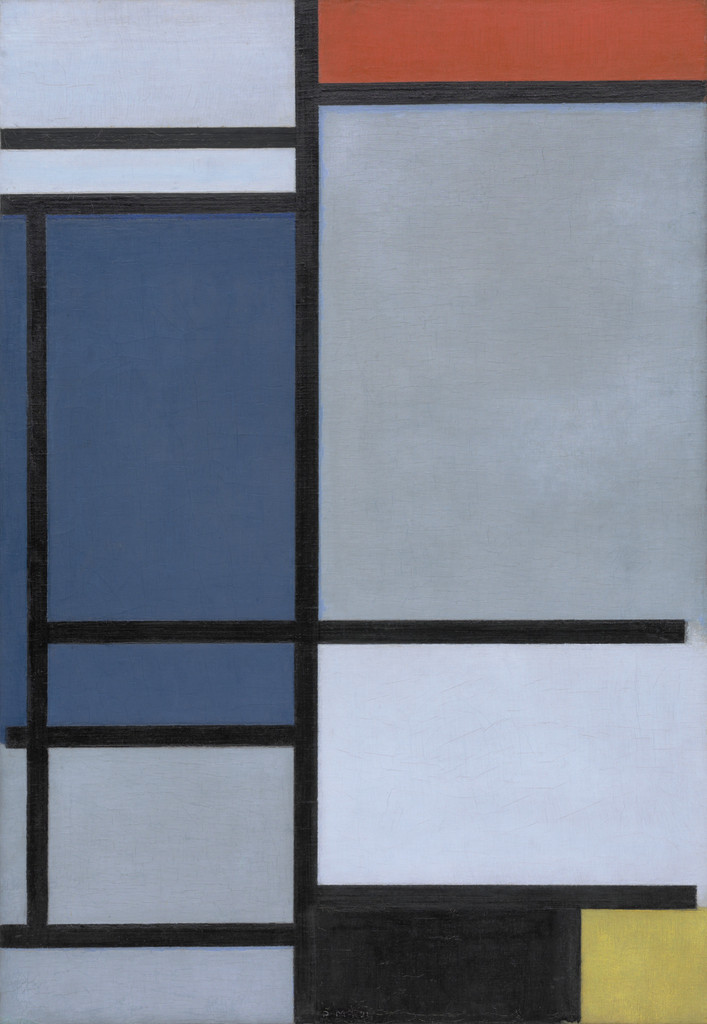
Study for a Composition
May one see it?
Not receiving at present

Art Institute of Chicago
Chicago, United States
It belongs to the collection, but is not on display at present.
- Checked
- 21 hours ago
- In this state since
- Aug 19, 2026
- Source
- The museum's own collection data
Particulars
- Accession number
- 2013.984
What it shows
In the catalog
Sources
- Art Institute of Chicago: the museum's own open data · fetched 5 days ago
- Image: Art Institute of Chicago — CC0
Meanwhile, in the life of Piet Mondrian
The whole life1919–1938
Return to Paris
In 1919 Mondrian left the Netherlands for Paris for the second and last time and at once turned to his studio: to hide its flaws he tacked large single-colour placards to the walls, accented by compositions of smaller coloured paper rectangles. From then on, periods of painting alternated with experiments in regrouping the papers on the walls.
1930s
Double lines, influenced by Marlow Moss
In the 1930s Mondrian began to use thinner and double lines more often, punctuated by a few small coloured forms; the double line, in which he saw a new dynamism, was influenced by the work of his friend and contemporary Marlow Moss.
September 1938
Moves to London to escape advancing fascism
In September 1938 Mondrian left Paris in the face of advancing fascism and moved to London (Hampstead); many canvases begun in Paris or London were finished only months or years later in Manhattan.
1939
Dancing in Camden Town
Living in North London, Mondrian would stroll to Camden Town to dance at the Camden Palace or the Bedford; going out dancing had been his favourite evening pastime since his Amsterdam days, contrary to the myth of the recluse.
23 September 1940
Sailing from Liverpool to New York
After the Netherlands were invaded and Paris fell, Mondrian left London and on 23 September 1940 sailed from Liverpool aboard the Cunard White Star liner RMS Samaria for New York, where he remained until his death.
c. 1941
A night at Café Society after the rheumatism
The year before his seventieth birthday Mondrian marked his emergence from a long bout of rheumatism with a wild night out at Café Society in New York.