 Piet MondrianDutch, 1872–1944
Composition C
Can I see it?
Not on view at present
Where is “Composition C” now? Collection: The Museum of Modern Art, New York. Not on view at present. Checked November 10, 2026.

New York, United States
It belongs to the collection, but is not on display at present.
- Checked
- In this state since
- Source
- The museum
About the painting
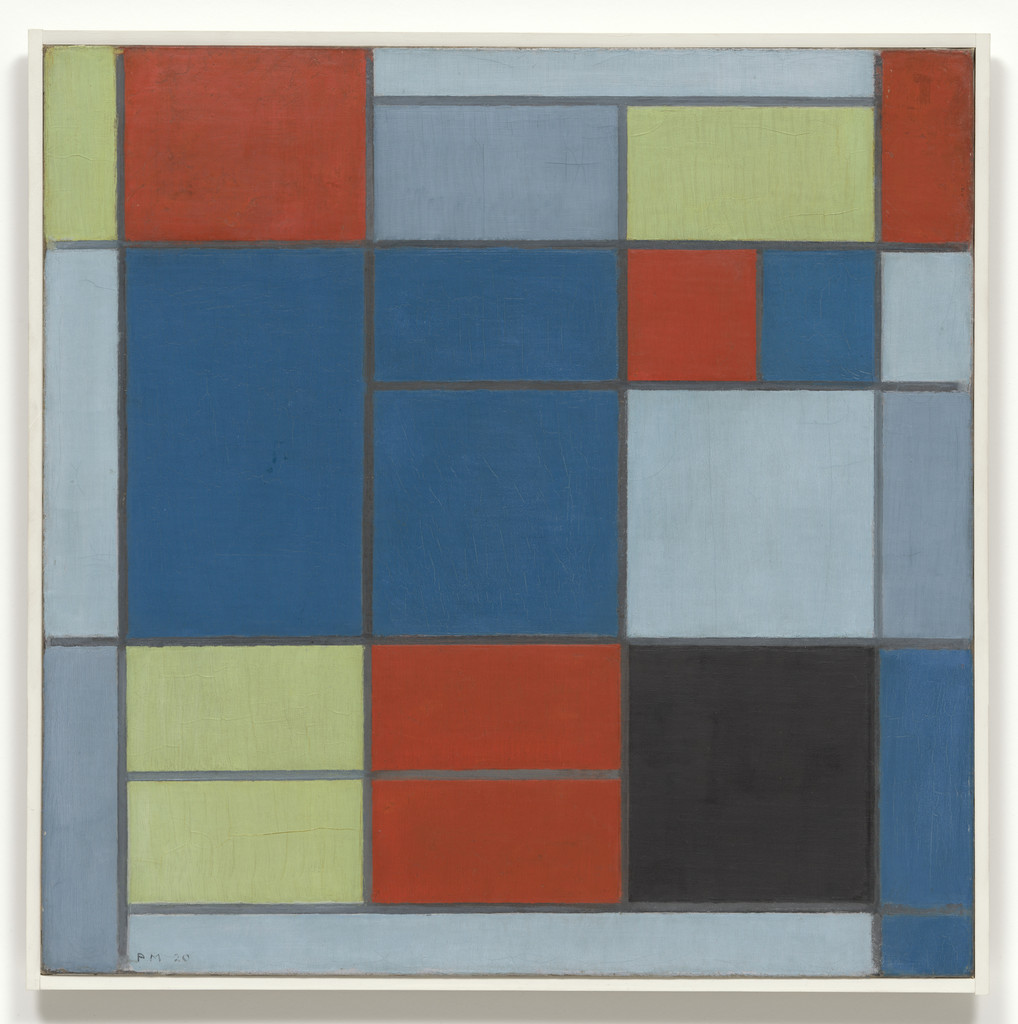
Piet Mondrian's Composition C was painted in 1920 and is in the Museum of Modern Art, New York. The oil painting has an almost square canvas, 60.3 cm high and 61 cm wide. Its acquisition was funded through an exchange involving the Lillie P. Bliss bequest. It is not on view at present.
Details
- Accession number
- 257.1948
In the catalog
Display history
Not on view at present
The Museum of Modern Art · Nov 16, 2026 — now · Verified
Was on view · MoMA, Floor 5, 513
The Museum of Modern Art · Verified
Sources
- The Museum of Modern Art
- Image: The Museum of Modern Art — © the artist or rights holder
In the life of Piet Mondrian
The whole life1914–1918
The artists' colony at Laren
During the war Mondrian stayed at the Laren artists' colony, where he met Bart van der Leck and Theo van Doesburg, both of whom were pursuing their own journeys toward abstraction.
1915–1918
Founding De Stijl with Van Doesburg
With Theo van Doesburg Mondrian founded De Stijl, the journal of the De Stijl group, in which he first published essays defining his theory, which he called Neoplasticism.
1917–1918
The essays “De Nieuwe Beelding in de schilderkunst”
In twelve instalments during 1917 and 1918 Mondrian published “The New Visualisation in Painting”, his first major attempt to set out his artistic theory in writing.
1919–1920
The first grid paintings
From late 1919 Mondrian produced grid-based paintings, and in 1920 the style for which he became renowned began to appear: at first thin grey lines fading towards the edges of the canvas, with the forms filled with primary colours.
1919–1938
Return to Paris
In 1919 Mondrian left the Netherlands for Paris for the second and last time and at once turned to his studio: to hide its flaws he tacked large single-colour placards to the walls, accented by compositions of smaller coloured paper rectangles. From then on, periods of painting alternated with experiments in regrouping the papers on the walls.
1920–1921
The mature manner: thick black lines
In late 1920 and 1921 Mondrian's paintings reached what casual observers take for their definitive form: thick black lines separating larger and fewer forms, more and more of which are left white.