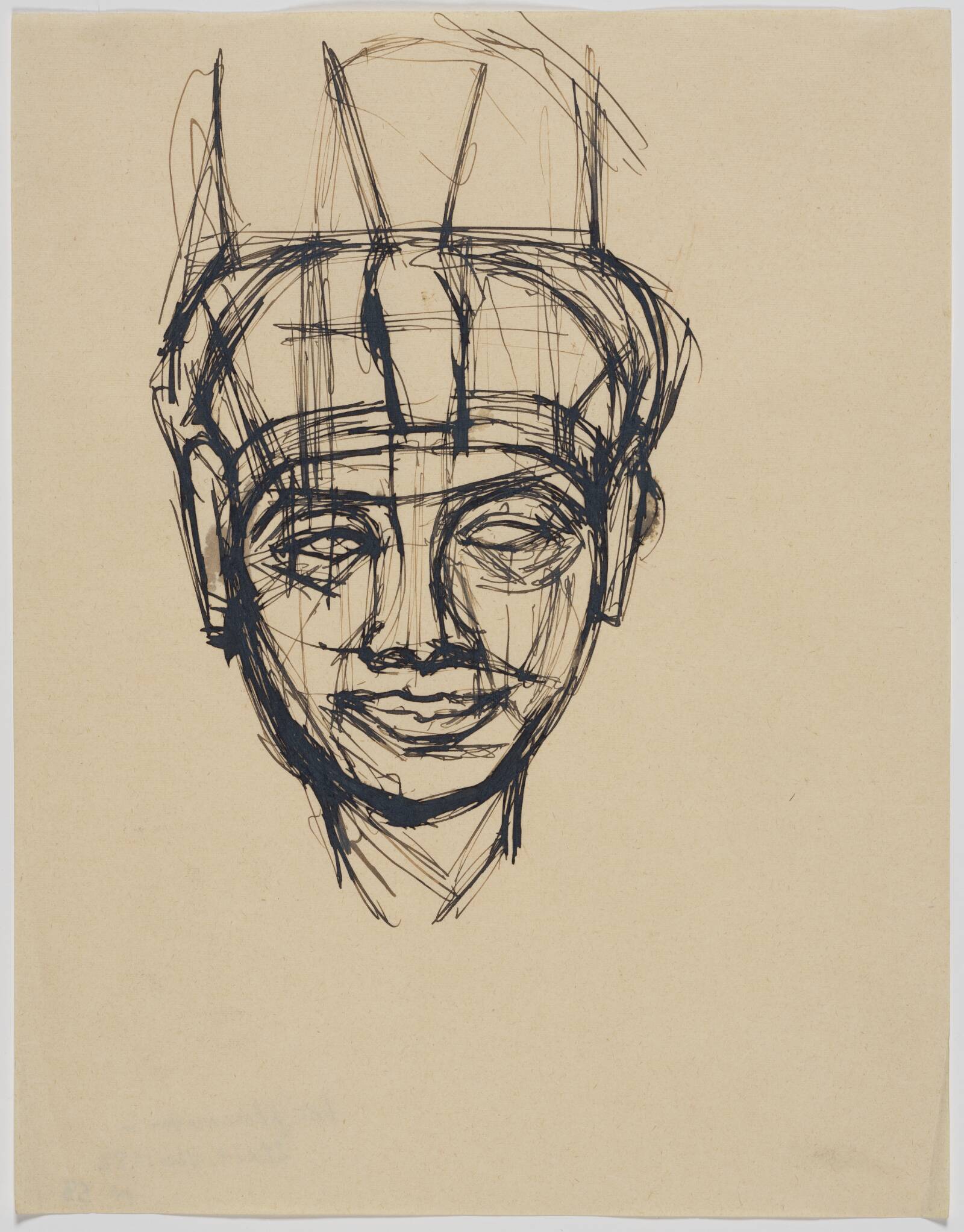
 Alberto GiacomettiSwiss, 1901–1966
Studietegning efter gudinden Muts hoved
Can I see it?
Not on view at present
Where is “Studietegning efter gudinden Muts hoved” now? Collection: SMK — National Gallery of Denmark, Copenhagen. Not on view at present. Checked October 12, 2026.

Copenhagen, Denmark
It belongs to the collection, but is not on display at present.
- Checked
- In this state since
- Source
- The museum
Details
- Accession number
- KKS2019-2
In the catalog
Sources
- SMK
- Image: SMK — National Gallery of Denmark — © the artist or rights holder
In the life of Alberto Giacometti
The whole life1920–1921
Travels through Italy
In 1920 and 1921 he travelled in Italy, where he came to know the classics of Italian art and the monuments of ancient Rome.
1922
Moves to Paris and enters Bourdelle’s studio
From 1922 he lived and worked in Paris, studying under Émile-Antoine Bourdelle at the Grande Chaumière studio until 1925 and spending his summers in Switzerland. In Paris he grew close to André Breton, Louis Aragon, Picasso, Miró, Max Ernst, Sartre, Simone de Beauvoir, Beckett and others.
1926
Moves into a Montparnasse studio
In 1926 he moved into a simple studio at 46 rue Hippolyte-Maindron, which was also his home and which he would not leave for the rest of his life. There he experimented with Cubism and Surrealism and came to be regarded as one of the leading Surrealist sculptors; among his associates were Miró, Max Ernst, Picasso and Balthus.
1929–1930
Joins the Surrealists and André Breton
He became involved with the Surrealists and André Breton (sources give 1929 or 1930) and was an active member of the group for several years; he published in the journal Surrealism in the Service of the Revolution.
1932
First solo exhibition
Giacometti’s first solo exhibition took place in 1932, five years after his works were shown at the Salon des Tuileries.
1935
The end of his Surrealist period
In 1935 the artist turned his back on Surrealism and disowned all his works from that period, calling them “a complete dead end” (by other accounts, he was expelled from the group).