 Valentin Serov1865–1911
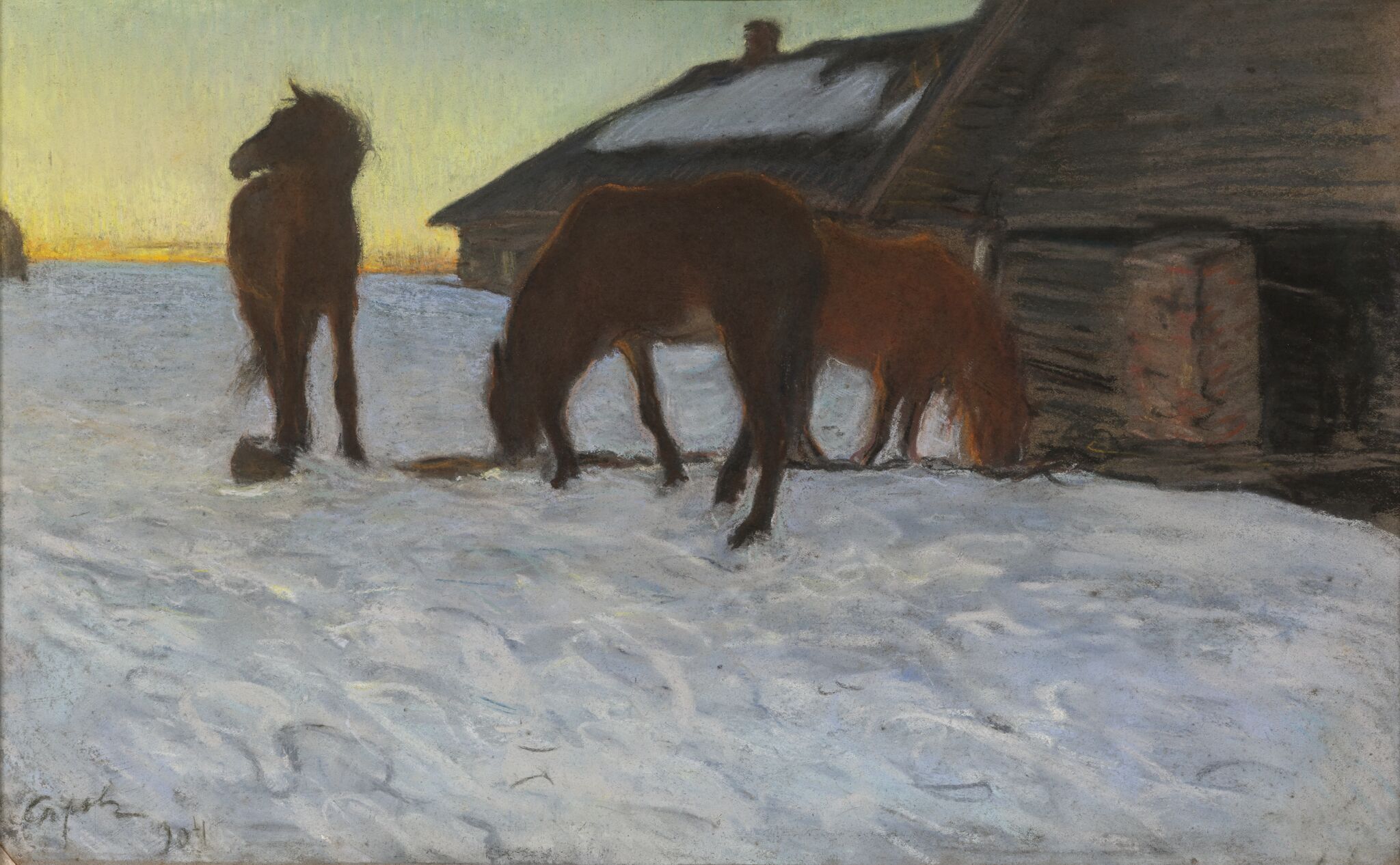
Стригуны у водопоя
May one see it?
Unknown

Tretyakov Gallery
Moscow, Russia
The owner is known; whether it is on view today is not.
- In this state since
- Source
- The museum
About the work
In the museum's own words — in Russian
Эволюцию творчества Валентина Александровича Серова можно определить как переход от непосредственности к остроте художественного образа. На этом пути живописно-пластический язык его произведений приобретает больший лаконизм и эмоциональную выразительность. Характерный для раннего творчества художника пленэрный пейзаж, близкий по характеру этюду, сменяется пейзажно-бытовым жанром, впервые возникшим еще в конце 1870-х годов в творчестве В. Поленова. Серов обращается к этому жанру в 1890-е – начале 1900-х годов. Чаще всего он выбирает самые простые деревенские мотивы: осенние поля, покосившиеся избушки и сараи, неказистые лошадки.
Read on
Одна из таких работ – «Стригуны на водопое». Собственно бытовое начало здесь сведено к минимуму. Это не действие, а состояние, не событие, а явление. Изображены всего лишь избушка с сараем и силуэты стригунов на снегу. Однако эта внешне скромная пастель наполнена удивительной поэзией весеннего вечера. Художник часто обращается в это время к графическим техникам. Более условная и «легкая» по своей природе графика лишает изображение материальности и позволяет сосредоточиться на эмоциональной стороне художественного образа. Серов работает пятном, для него важна ритмика линий, очерчивающих силуэты лошадей, что фиксирует изображение на плоскости, где свободные мазки пастели передают и разнообразные оттенки тающего снега, и лимонную полосу заката… Возникает внутреннее движение, повествование о мире переводится в план его эмоционального переживания.
Эта работа Серова находит параллели в поздних пейзажах Левитана, столь же лаконичных и выразительных, многие из которых также исполнены в технике пастели.
Tretyakov Gallery
Particulars
- Accession number
- 5655
In the catalog
Sources
- Tretyakov Gallery
- Image: Tretyakov Gallery — © State Tretyakov Gallery
Meanwhile, in the life of Valentin Serov
The whole life1878–1911 · Workplace
Moscow
October – November 1903
A grave illness and surgery for peritonitis
In early October 1903 Serov fell gravely ill and even wrote his will. The operation on 25 November at Chegodayev’s surgical clinic revealed a perforated stomach and peritonitis, but it went well and the artist survived.
30 October 1903
Elected a full member of the Academy of Arts
On 30 October 1903 Serov was elected a full member of the Academy of Arts; in April he had declined the post of “professor-leader” of a studio at the Higher Art School of the Academy.
1904
Travel: Italy
January 1905
Leaves the Academy after “Bloody Sunday”
Because of Grand Duke Vladimir Alexandrovich’s role in the events of “Bloody Sunday”, Serov left the Academy of Arts in January 1905; the Grand Duke was its president. Under the impression of those events he painted “Brave Little Soldiers…” and “The Dispersal of a Demonstration by Cossacks in 1905”.
1906
19 works at the Russian exhibition of the Salon d’Automne
In 1906 the exhibition of Russian art that Diaghilev organised within the Salon d’Automne in Paris showed 19 works by Serov; earlier in the year he had taken part in the exhibition of members of the former “World of Art”.