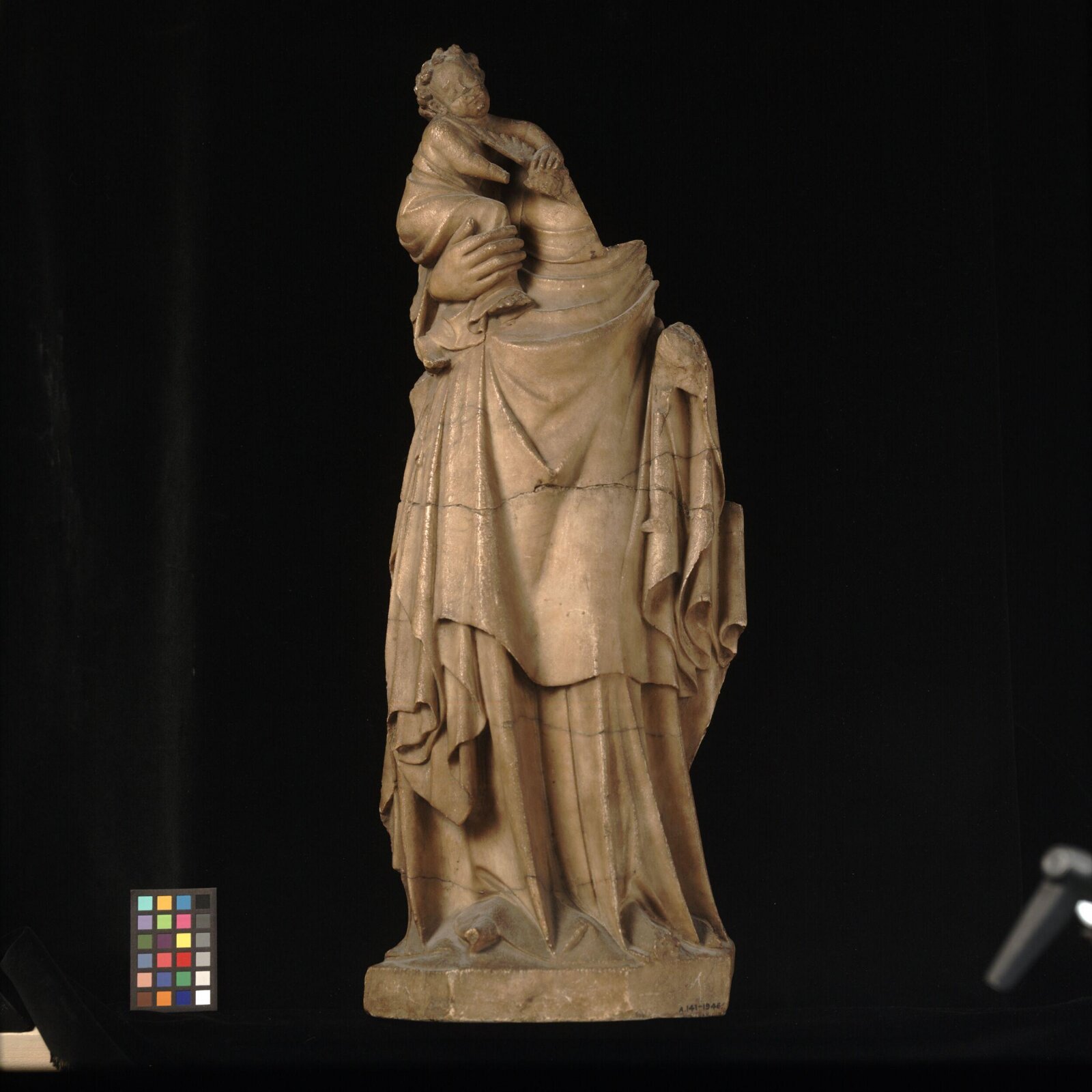
Standing Virgin and Child
May one see it?
Not receiving at present

Victoria and Albert Museum
London, United Kingdom
It belongs to the collection, but is not on display at present.
- Checked
- In this state since
- Source
- The museum's own collection data
About the sculpture
This is an alabaster fragment of a statuette of the Virgin Mary, made in England in the late 14th century. She is wearing a gown and a cloak draped over her shoulders and holds the Christ Child on her right arm. The head and shoulders of the Virgin are missing. Jesus is shown facing straight forward holding a bird, the symbol of the Passion, in his left hand.
Read on
There are two sorts of alabaster. Calcite alabaster is very hard and was used in ancient times. This object is made of gypsum alabaster which is a fine-grained, soft and smooth stone. Although at first glance it looks a little like marble, which it was intended to imitate, it was much easier to carve due to its softness, and alabaster objects were therefore significantly cheaper to produce. Marble does not originate in England, so it was imported if needed. The carving of alabaster, mostly quarried in Tutbury and Chellaston near Nottingham, took on industrial proportions in England between the middle of the 14th and the early 16th centuries. The market for altarpieces and smaller devotional images was a large one. It included not only religious foundations but also the merchant classes. Many hundreds of English alabasters were exported, some as far afield as Iceland and Santiago de Compostela in north-west Spain.
Victoria and Albert Museum
Particulars
- Accession number
- A.141-1946
What it shows
In the catalog
Sources
- Victoria and Albert Museum: the museum's own open data · fetched 11 days ago
- Image: Victoria and Albert Museum — © Victoria and Albert Museum, London







