ART WIKI33,040 on view
MapCollectionArtistsMuseumsExhibitionsJournal
Sign in

ART WIKI

Where the masterpiece hangs, and when they let you in.

Collections: Art Institute of Chicago, Getty Villa, Harvard Art Museums, Hirshhorn Museum and Sculpture Garden, J. Paul Getty Museum, Minneapolis Institute of Art, Musée du Louvre, National Gallery of Art, National Museum of Asian Art, National Portrait Gallery (Smithsonian), Pushkin State Museum of Fine Arts, Rijksmuseum, Smithsonian American Art Museum, SMK — National Gallery of Denmark, State Hermitage Museum, State Russian Museum, The Cleveland Museum of Art, The Metropolitan Museum of Art, The Museum of Modern Art, Tretyakov Gallery, Victoria and Albert Museum, Whitney Museum of American Art, State Catalogue of the Museum Fund of Russia (274 museums), Europeana (19 museums), Wikidata (6 museums), Paris Musées (12 museums), and Joconde, the French Ministry of Culture's museum database (495 museums). Images belong to their rights holders.

Sections

  • Map
  • Search
  • Collection
  • Masterpieces
  • On view now
  • Artists

More

  • Museums & galleries
  • Exhibitions
  • Journal
  • Where the data comes from
  • Privacy & cookies
HomeMapBrowse
  1. Collection/
  2. Harvard Art Museums/
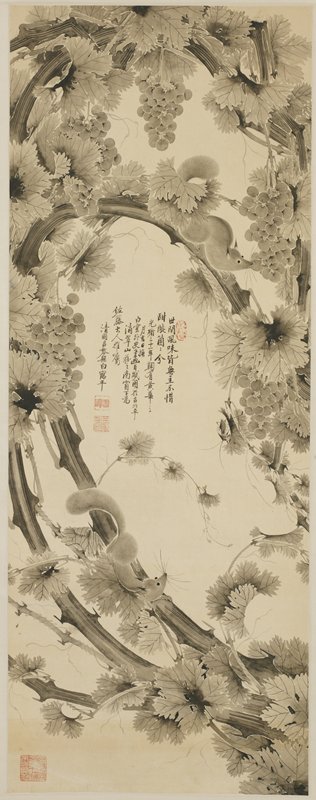
  3. Squirrels and Grapevine
Squirrels and Grapevine, Bai Haonian, dated to 1906
BBai HaonianChinese

Squirrels and Grapevine

dated to 1906 · Painting

About the painting

Painted in ink on paper, this hanging scroll represents an upside-down, U-shaped, old grapevine with two squirrels sporting amongst the fruiting branches. The grapevine comprises four intertwined, leafy stalks that enter the composition in the lower left corner, diagonally traverse the composition, rise along the right edge, make a U-turn at the top, and then extend down the left edge. Numerous bunches of ripe grapes hang from the vines. In the upper left corner of the painting one squirrel nibbles on a grape, while another squirrel in the lower right corner looks up toward the first. Neatly framed all around by the grapevine, the artist's inscription and signature appear at the very center of the composition.

Harvard Art Museums

Particulars

Accession number
2009.83

More by Bai Haonian

All works

In the same room · Gallery 2600, floor 2, East Asian Art, Harvard Art Museums

Museum page

May one see it?

Yes, receiving visitors

Harvard Art Museums

Cambridge, United States

Room2600, floor 2, East Asian Art

On public display.

Checked
9 days ago
In this state since
Sep 27, 2026
Source
The museum
On the mapMuseum page

In the catalog

PaintingsInkChinese paintingModernism20th centuryChinese

Sources

  • Harvard Art Museums
  • Image: Harvard Art Museums — © President and Fellows of Harvard College
Squirrels and Grapevine, Bai Haonian, 1905

Squirrels and Grapevine

1905 · Not on view · Minneapolis Institute of Art

Paper God: Kitchen God and Two Wives, with Two Officers and "Three Stars" (Gods of Happiness, Emoluments, and Longevity), at an Altar Table, and with a Calendar for the Year Minguo 21 (1932), 1932

Paper God: Kitchen God and Two Wives, with Two Officers and "Three Stars" (Gods of Happiness, Emoluments, and Longevity), at an Altar Table, and with a Calendar for the Year Minguo 21 (1932), 1932

This Morning's Autumn (left), Watanabe Kōkan 渡辺公観, 1918 (Taishō 7)

Watanabe Kōkan 渡辺公観

This Morning's Autumn (left), 1918 (Taishō 7)

This Morning's Autumn (right), Watanabe Kōkan 渡辺公観, 1918 (Taishō 7)

Watanabe Kōkan 渡辺公観

This Morning's Autumn (right), 1918 (Taishō 7)

Momoyogusa (Flowers of a Hundred Worlds), vol. 1, Kamisaka Sekka 神坂雪佳, 1909 (vol. 1) - 1910 (vols. 2 and 3)

Kamisaka Sekka

Momoyogusa (Flowers of a Hundred Worlds), vol. 1, 1909 (vol. 1) - 1910 (vols. 2 and 3)

Momoyogusa (Flowers of a Hundred Worlds), vol. 3, Kamisaka Sekka 神坂雪佳, 1909 (vol. 1) - 1910 (vols. 2 and 3)

Kamisaka Sekka

Momoyogusa (Flowers of a Hundred Worlds), vol. 3, 1909 (vol. 1) - 1910 (vols. 2 and 3)

Momoyogusa (Flowers of a Hundred Worlds), vol. 2, Kamisaka Sekka 神坂雪佳, 1909 (vol. 1) - 1910 (vols. 2 and 3)

Kamisaka Sekka

Momoyogusa (Flowers of a Hundred Worlds), vol. 2, 1909 (vol. 1) - 1910 (vols. 2 and 3)

Seasonal Festive Occasions in Kyoto, Mori Kansai 森寛斎, 1879

Mori Kansai

Seasonal Festive Occasions in Kyoto, 1879

Pink and White Lotus, Suzuki Kiitsu 鈴木其一, c. 1850-58

Suzuki Kiitsu

Pink and White Lotus, c. 1850-58