Emil NoldeGerman, Danish, 1867–1956
Segelboot
May one see it?
Not receiving at present

Minneapolis Institute of Art
Minneapolis, United States
It belongs to the collection, but is not on display at present.
- Checked
- 23 hours ago
- In this state since
- Sep 25, 2026
- Source
- The museum's own collection data
About the work
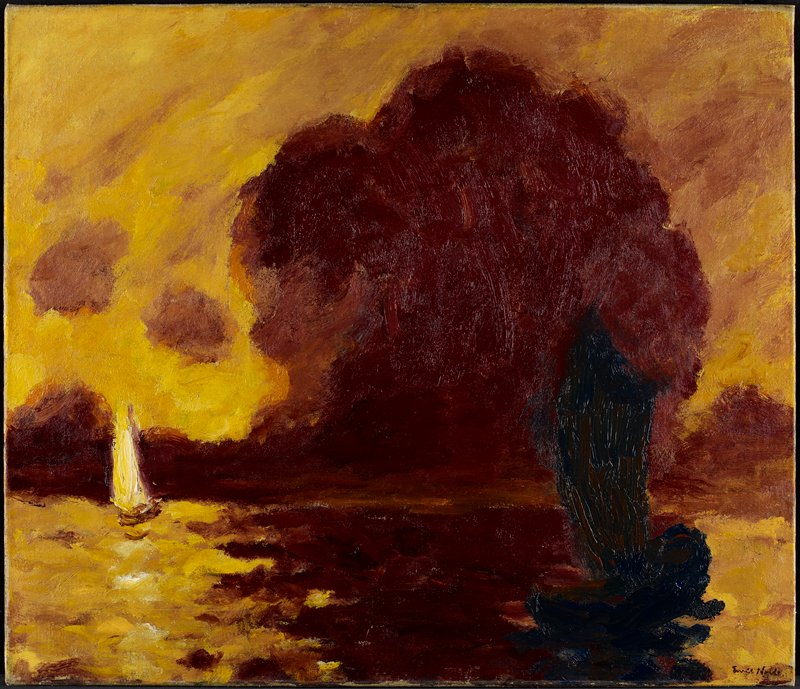
In 1910, Emile Nolde focused much of his creative energy on an extensive series of works based on his observation of boats in the north German seaport harbor of Hamburg. He used unconventional techniques to convey the effects of weather and light and their interaction with the water and various types of watercraft. Here, in this study of a sailboat, he employed an unusually rough cutting technique on his wooden printing block, almost as if chopping it with a hatchet, though probably using broad gouges. He printed the block by hand, applying pressure unevenly so that some parts print solidly and others faintly. He chose to print on a rough sheet of taupe Asian paper, further heightening the sense of atmosphere. Perhaps the tension between the energy of the artist’s hand and the quiet of the scene is key to the mystery of this image.
Minneapolis Institute of Art
Particulars
- Accession number
- 2020.20
In the catalog
Sources
- Minneapolis Institute of Art: the museum's own open data · fetched 5 days ago
- Image: Minneapolis Institute of Art — © Nolde Stiftung Seebüll
Meanwhile, in the life of Emil Nolde
The whole life1908 – 17 December 1910 · Membership
Berlin Secession
1909
Poisoned water: a brush with death
In 1909, at the age of forty-two, Nolde nearly died after drinking poisoned water; the experience hastened his turn to religious painting.
1910
Expelled from the Berlin Secession
In 1910, after a disagreement with the leadership, Nolde was expelled from the Berlin Secession, of which he had been a member since 1908.
1910–1912
First success at exhibitions in Hamburg, Essen and Hagen
In 1910–12 Nolde had his first success at exhibitions in Hamburg, Essen and Hagen.
1912
Exhibits with Kandinsky’s Blaue Reiter
In 1912 Nolde exhibited with Wassily Kandinsky’s Munich-based group Der Blaue Reiter; by then he had achieved some fame and could support himself through his art.