 Utagawa HiroshigeJapanese, 1797–1858
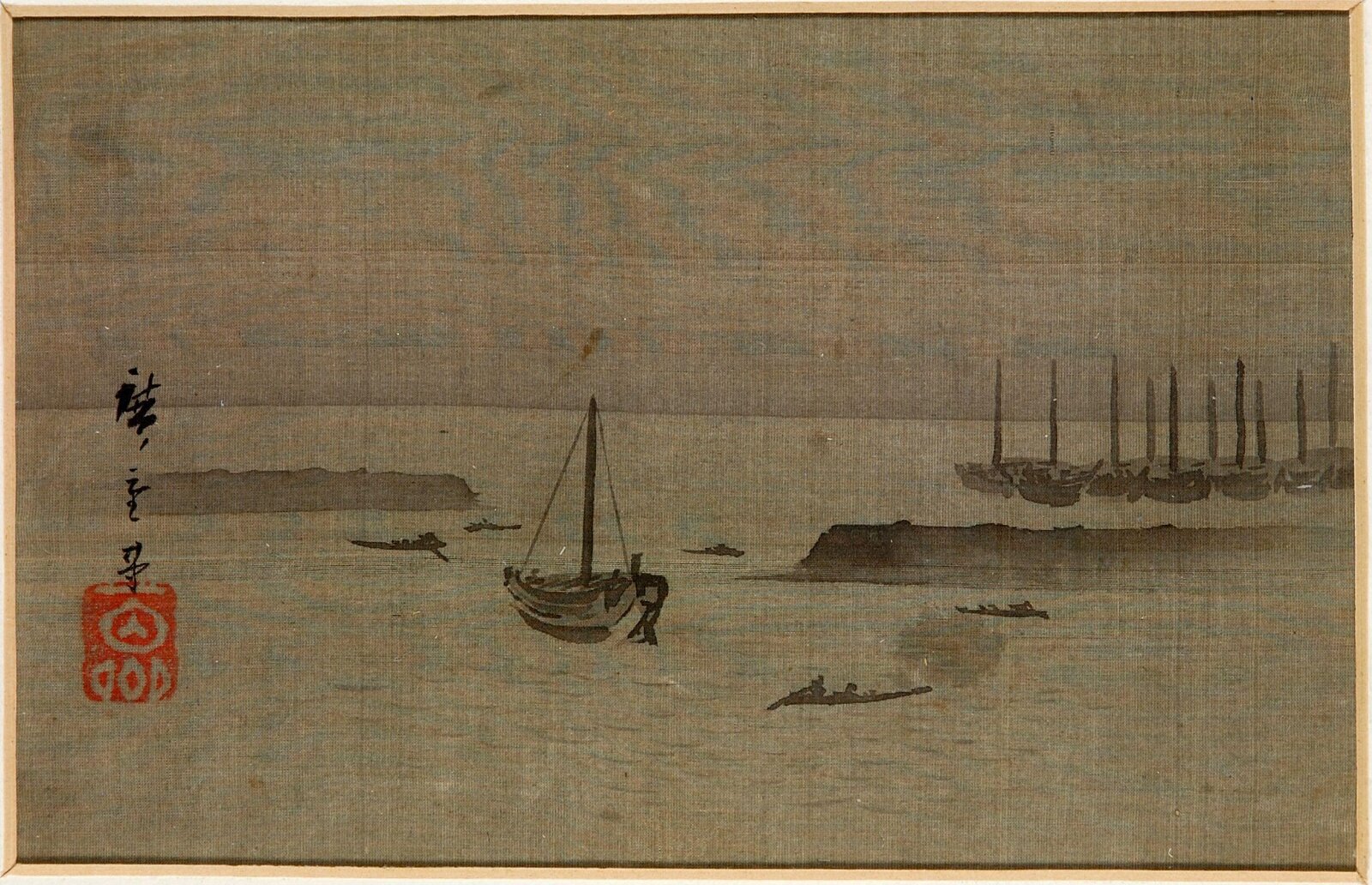
Sea Fortifications
Can I see it?
Not on view at present
Where is “Sea Fortifications” now? Collection: Victoria and Albert Museum, London. Not on view at present. Checked September 25, 2026.

London, United Kingdom
It belongs to the collection, but is not on display at present.
- Checked
- In this state since
- Source
- The museum
About the painting
As an artist, Utagawa Hiroshige is best known for the ukiyo-e prints and albums he designed. However, many of the artists who designed ukiyo-e prints during the Edo Period (1615-1868) also painted pictures. These paintings were not meant to be used as designs for prints, as these were generally based on much freer sketches. Instead, they were individual works, purchased by a wealthier clientele.
Working with ink on silk, Hiroshige uses light strokes to show sea fortifications off the coast of the city of Edo (modern-day Tokyo).
The sudden arrival of American 'Black Ships' in Uraga Harbour in 1853 presaged the end of over two hundred years of self-imposed national seclusion. Nervousness about the country's security soon led to the building of sea fortifications in Edo Bay. In this painting, their presence casts an uncertain air over an otherwise peaceful water scene.
Victoria and Albert Museum
Details
- Accession number
- E.336-1954
In the catalog
Sources
- Victoria and Albert Museum
- Image: Victoria and Albert Museum — © Victoria and Albert Museum, London
In the life of Utagawa Hiroshige
The whole life1856
He becomes a Buddhist monk
In 1856 Hiroshige “retired from the world”, becoming a Buddhist monk; this was the year he began his “One Hundred Famous Views of Edo”.
1856
Luxury editions with the publisher Uoya Eikichi
Working with the publisher Uoya Eikichi, Hiroshige created a series of luxury edition prints using the finest printing techniques: true gradation of color, mica for an iridescent effect, embossing, fabric printing, blind printing and glue printing.
1856–1858
One Hundred Views of Edo: a priest pays up front
His great “One Hundred Famous Views of Edo” was paid for up front by a wealthy Buddhist priest in love with the daughter of the publisher Uoya Eikichi, a former fishmonger. Hiroshige was usually poorly paid per series, yet he remained capable of remarkable art when the conditions were right.
![Shinano Province, Moon Reflected in the Sarashina Paddy-fields, Mount Kyōdai (Shinano, Sarashina tagoto no tsuki, Kyōdaisan), from the series Famous Places in the Sixty-odd Provinces [of Japan] ([Dai Nihon] Rokujūyoshū meisho zue), Utagawa Hiroshige 歌川広重, Edo period, 1853 (Kaei 6, 8th month)](https://nrs.harvard.edu/urn-3:HUAM:CARP04802_dynmc/full/!2400,2400/0/default.jpg)